
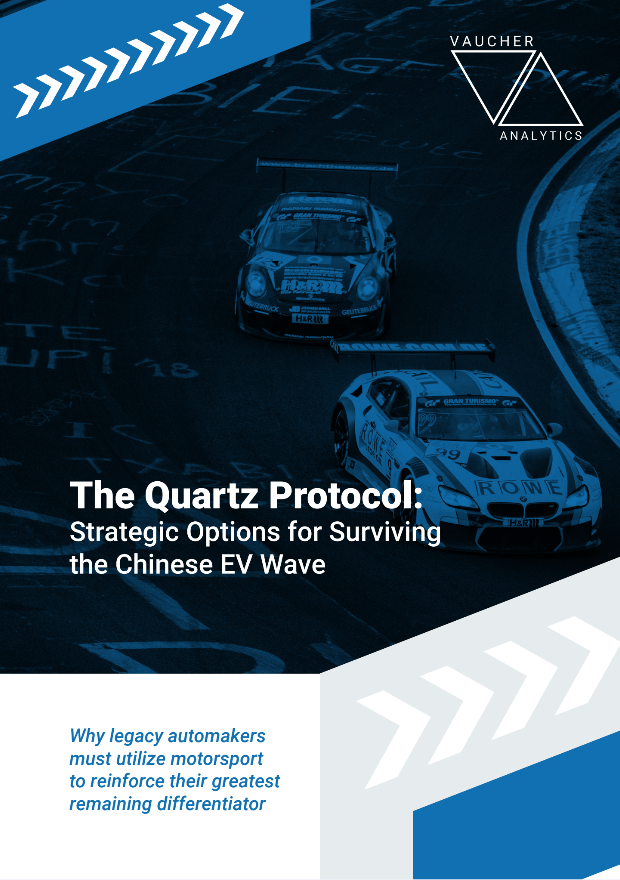
The Quartz Protocol: A Playbook For Legacy Automakers to Leverage Motorsport Against the Competition From Chinese EVs
A practical framework (the Motorsport Value Capture Matrix) to see whether your brand is actually converting racing “proof” into consumer “halo”, or funding performance that never reaches the customer.
A clear strategic argument for why legacy OEMs can’t out-commodity Chinese EVs, and why motorsport-led emotion is their last defensible moat.
Tools for action, including a 10-question self-assessment plus a concrete audit approach to identify where motorsport value is lost in your racing program.
Chinese EVs Are Already Here, What To Do Now?
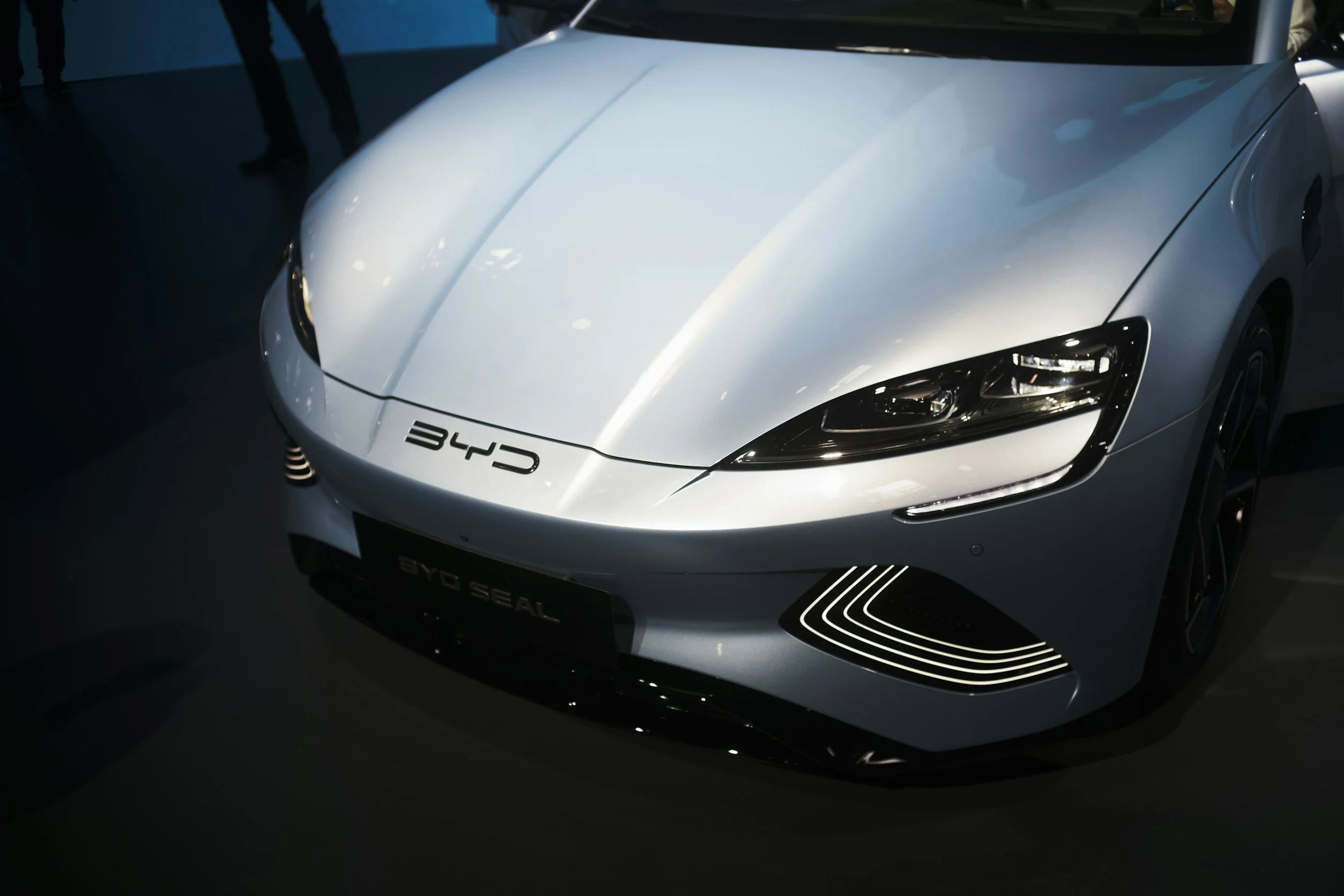
Chinese electric-vehicle (EV) manufacturers are no longer a distant prospect.
They are present in Europe, gaining share in several segments, and exerting growing pressure on prices, margins, and investment decisions.
Much of the public discussion focuses on:
Tariffs and trade defence, or
Broad statements about “catching up” on software and batteries.
Those debates matter, but they don’t fully answer a more fundamental question:
Given the structural advantages Chinese players have built in cost and scale, what can European brands realistically compete on over the next decade and beyond?
This page brings together Vaucher Analytics’ work on Chinese EVs and European legacy automakers into a single, evolving hub.
It is written for people who need to translate headlines into concrete strategic choices, inside OEMs, motorsport programs, and policy circles.
Who This Hub Is For
This hub is written for people who need to turn an abstract “Chinese EV threat” into concrete decisions:
Strategy and product leaders inside European OEMs, grappling with portfolio choices, capital allocation, and positioning
Marketing and motorsport executives trying to reconcile brand, emotion, and hard financial constraints
Policymakers and industry bodies considering whether current frameworks unintentionally reinforce the weakest parts of Europe’s position
Investors and board members who want a structured way to think about the trade-offs ahead
It does not claim to be exhaustive; rather, it aims to provide a set of coherent lenses and questions that can guide internal analysis, for which additional quantitative work will be required.
What Changed With Chinese EVs
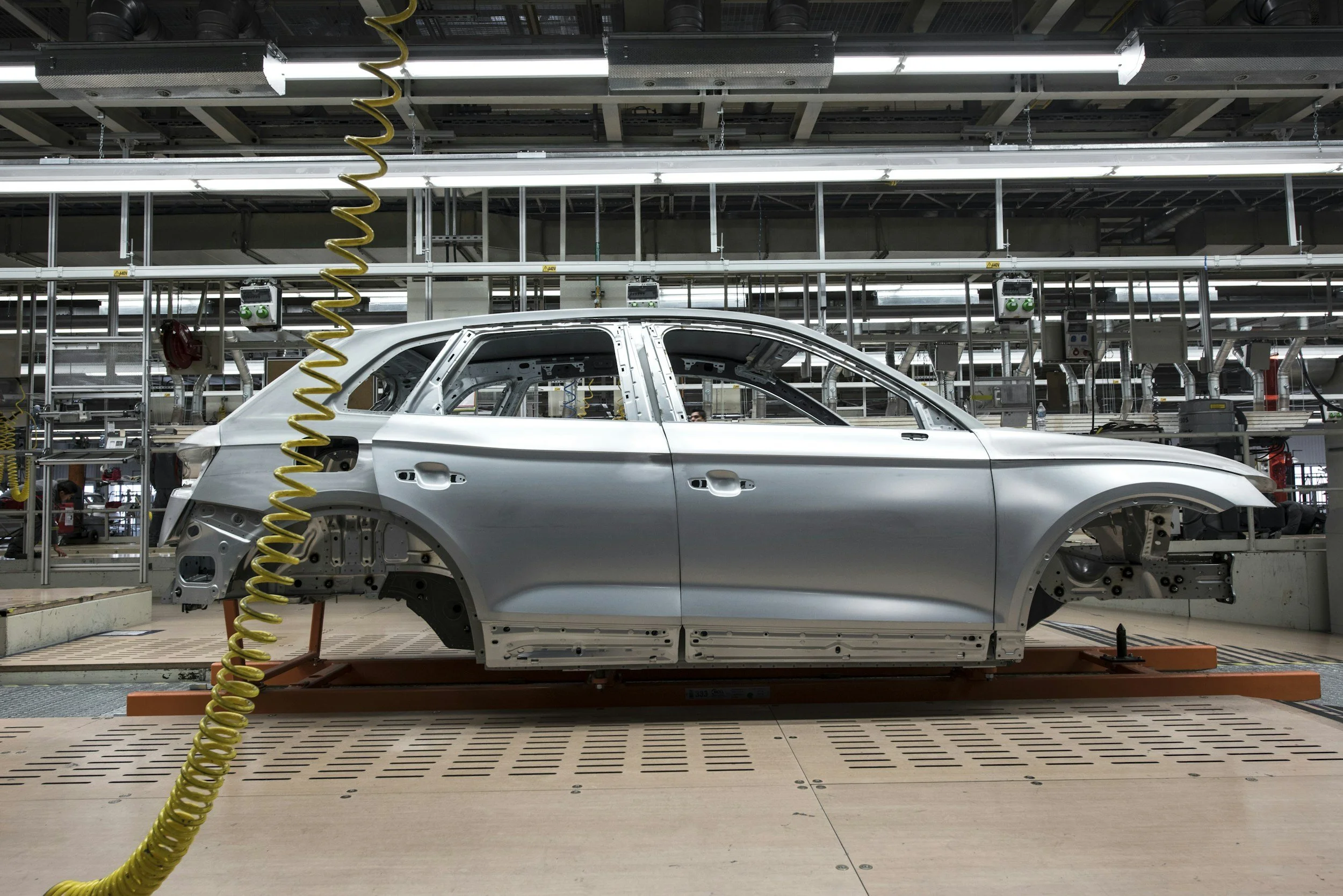
For decades, Europe’s advantage rested on:
Deep mechanical expertise in internal combustion engines
Dense supplier networks across powertrain and chassis components
Strong brands, financed by high-value exports
The transition to EVs has altered that landscape:
Batteries and software have moved closer to the centre of the value chain.
Several Chinese groups are vertically integrated across materials, cells, packs, and vehicles.
Europe is investing heavily, but often with more fragmented industrial and regulatory constraints.
The result is a market where:
Chinese brands can, in many cases, offer competitive products at lower or similar price points, and
European OEMs face simultaneous pressure on margin, capex, and the cost of transition.
This doesn’t mean European players are “finished”.
It does mean that simply assuming a return to the old equilibrium is unlikely to be enough.
Three Strategic Levers Legacy Automakers Can Still Emphasize
Across my insight pieces, three levers emerge repeatedly as areas where European brands can still differentiate in a meaningful way:
Reframing from volume to value: A “Swiss watch” approach to positioning and economics.
Designing for longevity: The “forever car” as a hypothetical but deliberate alternative to fast churn.
Using racing as a structured emotion and brand engine, not just a discretionary marketing spend when times are good.
Each lever is imperfect on its own, but together they suggest a direction of travel that is more aligned with Europe’s existing strengths than a pure scale or subsidy race.
Below is a brief summary of each, with links to the in-depth pieces.

Lever 1 – The “Swiss Watch” Approach: From Volume to Value
Core idea: If competing head-to-head on scale and unit cost is structurally difficult, European players may need to lean further into value per vehicle, not volume per platform.
The “Swiss watch strategy” article explores:

What it means to treat a car less like a rapidly depreciating appliance and more like a high-value industrial object.
How design, craft, heritage, and narrative can support pricing power in a world where some functional attributes are converging.
What this implies for portfolio choices, options packaging, and the way brands communicate their role in a customer’s life.
The goal is not to imitate the watch industry literally, but to borrow its logic:
Accept limited volume
Focus on sustainable margin and long-term desirability
Read the full article:
The Swiss Watch Strategy: Why Legacy Automakers Must Pivot to It Now…Or Be Crushed by Chinese EVs
Lever 2 – The 100-Year “Forever Car”: Competing on Time, Not Just Specs

Core idea: If Chinese manufacturers are structurally advantaged on cost per new vehicle, Europe can explore an advantage in years of serviceable life per vehicle.
Current regulatory frameworks in Europe are heavily oriented around:
Fleet-average tailpipe CO₂
New-vehicle sales targets and phase-out dates
They are much less explicit about:
Vehicle longevity
Ease of repair and upgrade
How embedded carbon is amortized over the lifetime of a product
The “forever car” work looks at:
What it would mean to design vehicles for multi-decade use, with deliberate pathways for refurbishment and technology updates.
How that could translate into different ownership models, service offerings, and residual value stories.
Why, in a world of rising resource constraints and price competition, time-in-service might become as important as range or 0–100 km/h.
This is not a simple pivot, and its suggestion is not made lightly; such a direction would touch product planning, finance, regulation, and brand.
But it may be one of the few ways Europe can make its higher cost bases work in its favour.
Read the deep dives:
The Forever Car: Why Longevity Is the Advantage Over Chinese EVs
What EU EV Rules Miss: The Concept of a 100-Year “Forever Car”
Lever 3 – Racing and Emotion: Turning Heritage into a Systematic Asset

Core idea: As EVs reduce some of the mechanical drama and differentiation that used to exist between brands, emotion and identity become even more important in purchase decisions.
Motorsport has historically served multiple roles:
Technology lab
Internal talent development
Showcase for engineering excellence
Today, it increasingly needs to function as something else as well:
A structured engine of emotion and narrative that reinforces why a brand matters in a crowded, partly commoditised market.
In my racing-focused articles, I explore:
Why, in an environment of Chinese competition and collapsing functional gaps, opting out of visible performance platforms can be risky for brands that rely on aspiration.
How racing programmes can be framed and measured not just as cost centres, but as assets that support pricing power, loyalty, and long-term brand relevance.
The practical gap many brands still have in translating track activity into mainstream consumer communication.
The question is not simply “should we race?” but:
Can we afford not to?
Where?
With what narrative?
And how do we make sure every euro spent on track has a clear path back to the showroom?
Read the deep dives:
Going Racing Is No Longer Optional: Why Emotion Will Decide the Future of Car Sales
Going Racing Used to Sell Cars. It Still Can, Provided Brands Succeed in the Consumer Translation
Case Study: Audi’s A Drift Through Time
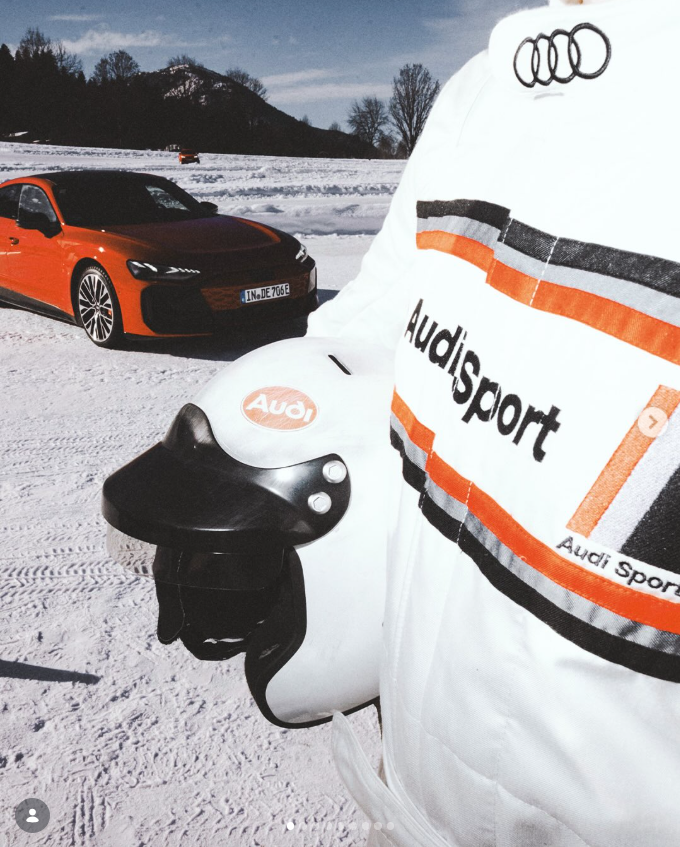
Image source: Official Audi Instagram page
Audi’s A Drift Through Time commercial illustrates how legacy automakers can use motorsport heritage as a live strategic asset to create desire for electric vehicles at a moment when Chinese EV manufacturers are rapidly compressing functional differentiation.
By translating rally-era credibility into a modern EV narrative, Audi demonstrates that the remaining defensible moat for established brands lies less in specifications and more in identity, continuity, and performance meaning.
Audi says it well in its own description:
One drift connecting decades. From Rally Group B in 1983 to electric precision in 2026. With Nico Hülkenberg and Gabriel Bortoleto behind the wheel, quattro evolves without losing its core.
The initiative highlights both the opportunity (and some risks) facing incumbents: heritage can protect pricing power only if it is actively and systematically converted into consumer-facing value.
Read the full article:
Audi’s A Drift Through Time Shows How Legacy Automotive Brands Can Create EV Desire
All Related Articles at a Glance
For ease of reference, here are the individual pieces that sit within this hub:
Strategic positioning via the Swiss luxury watch case study
The Swiss Watch Strategy: Why Legacy Automakers Must Pivot to It Now…Or Be Crushed by Chinese EVs
→ Read it hereLongevity and the “forever car”
The Forever Car: Why Longevity Is the Advantage Over Chinese EVs
→ Read it hereRacing as an emotion engine
Going Racing Is No Longer Optional: Why Emotion Will Decide the Future of Car Sales
→ Read it hereRegulation and metrics
What EU EV Rules Miss: The Concept of a 100-Year “Forever Car”
→ Read it hereFrom track to showroom
Going Racing Used to Sell Cars. It Still Can, Provided Brands Succeed in the Consumer Translation
→ Read it hereCase study: Audi’s A Drift Through Time
Audi’s “A Drift Through Time” Shows How Legacy Automotive Brands Can Create EV Desire
→ Read it hereThe influence of geopolitics on competition with Chinese EVs
Trade Deals Are Accelerating the Chinese EV Shock For Legacy Automakers
→ Read it here
How Vaucher Analytics Can Help
Vaucher Analytics focuses on the intersection of:
Cost structures and industrial constraints
Brand and motorsport
The specific pressures created by Chinese EV competition.
In practical terms, that can mean:
Pressure-testing a current strategy or racing programme against the scenarios outlined above.
Exploring what a longevity- or brand-led roadmap would look like for a given nameplate or segment.
Helping boards and leadership teams frame the right questions so that internal analyses are aligned with the realities of Chinese competition, not legacy assumptions.
If you’d like to explore this in a more applied way for your organisation, contact us.
Main image credit: Carlos Aranda via Unsplash