

The Death of the Iconic Racing Livery, And What Teams Must Change to Revive It
Watching the archival footage of Lancia in rallying in the documentary Lancia, Legend of Rally, what stands out is not only the performance of the cars but the coherence of their visual identity.
The Alitalia and Martini Racing liveries extended seamlessly from the bodywork to the mechanics’ overalls and support environment.
To me, a set of green Alitalia overalls in those service parks at that time does not read as a crude advertising vehicle; they feel like a natural expression of a shared world.
Naturally, that makes the underlying brand more desirable. Watching this footage forty years later, I did not feel I was being “sold to” at all; if anything, I found myself wanting to look up Alitalia flights.
By contrast, many contemporary programs, even at the very top of the sport, project a very different impression.
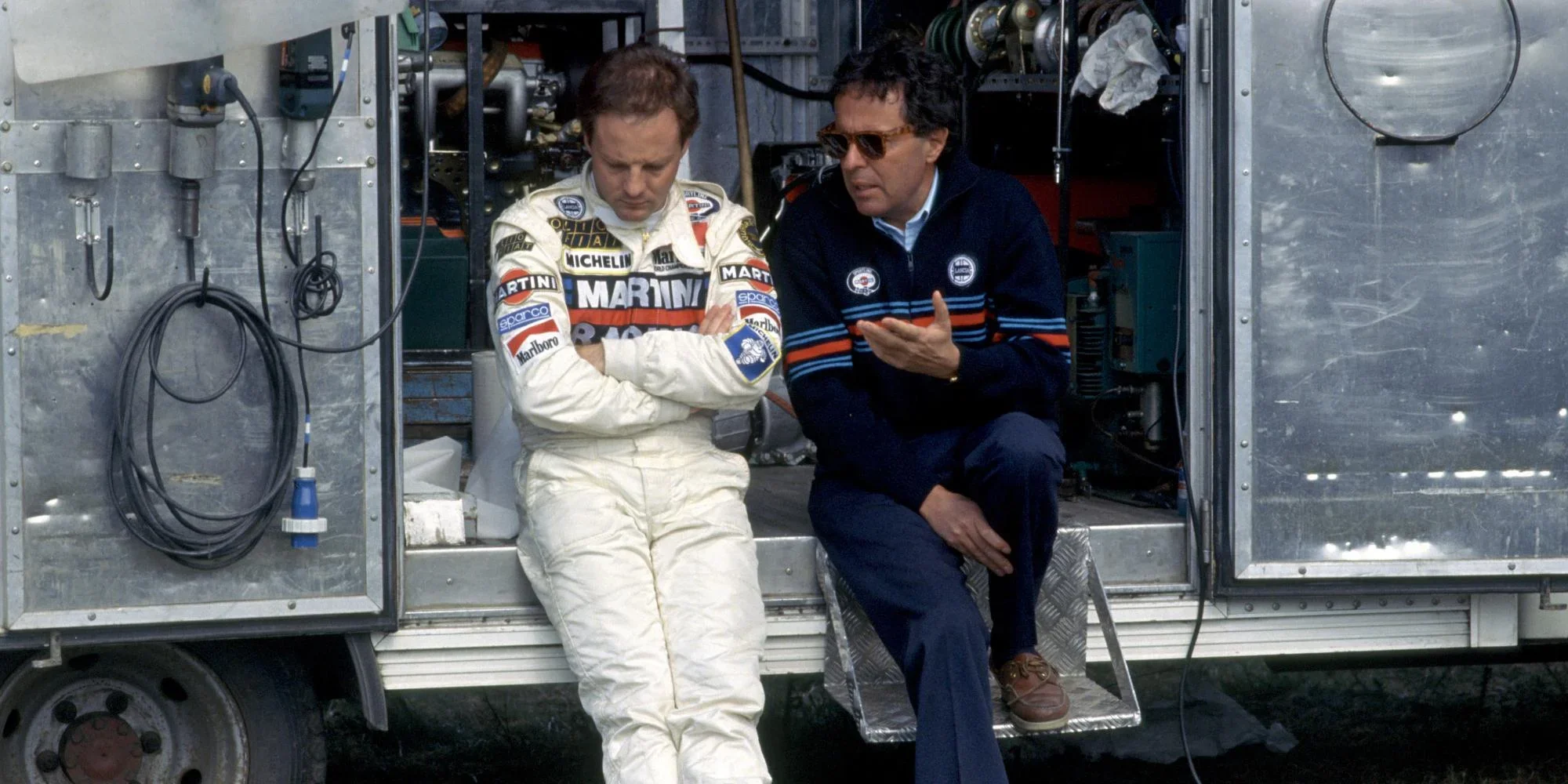
Image source: www.sparco-official.com
A modern Formula 1 car carrying a financial services or technology brand, among so many other logos, often appears visually fragmented, with sponsors assembled onto the chassis rather than integrated into a coherent identity.
This is particularly striking in the case of teams with historically rigorous commercial standards: the juxtaposition between the myth-making of a Lancia-era livery and a current, logo-heavy car highlights a clear perceptual gap.
That gap is not simply a matter of nostalgia or personal taste. It goes to the core of how motorsport sponsorship has evolved, from a small number of deep, identity-defining partnerships to a fragmented model built around “logo real estate” and short-term revenue optimization.
The difference is structural, rooted in the way deals are constructed, how design authority is exercised, which categories dominate the grid, and how risk and regulation are managed.
This article examines those underlying drivers and explores what teams can do, in practical terms, to recover some of the cultural and commercial power that liveries like Alitalia and Martini still command decades later.
Don’t want to be left behind?
Subscribe to Return On Racing — the weekly newsletter from Vaucher Analytics covering actionable motorsports strategy, cost breakdowns, and sponsor intel.
From Identity Partnerships to Logo Collages
The starting point is structural.
In the era of Lancia–Alitalia and Lancia–Martini, sponsorship meant a handful of major partners who effectively co-owned the team’s identity; the documentary states that team boss Cesare Fiorio’s aim was to land one major sponsor.
These sponsors were not simply “present on the car”; the entire aesthetic universe was built around them. The car, the mechanics’ overalls, the service trucks, the pit signage and printed posters all belonged to the same visual system.
In contemporary Formula 1, WEC and most professional series, the commercial logic is very different.
Budgets are much larger, scrutiny is higher, and teams close the gap not with one or two anchor partnerships but with a long tail of smaller deals. The commercial product is literally expressed in square centimetres of “inventory”: sidepods, rear wings, front wings, bibs, halo, undercut, overalls, caps, hospitality walls.
The resulting aesthetic is clear: when a car carries twenty-plus unrelated brands, it can only ever look like a collage.
When a team swaps sponsors every season or even mid-season, no visual identity has the time to become iconic.
The Lancia overalls you remember were not just beautifully designed; they were consistent, year on year, until they imprinted themselves on people’s minds. Most modern partnerships are too short-lived and too shallow to achieve the same effect.
With the cost of racing always increasing and sponsors’ marketing budgets squeezed constantly, it seems unlikely that racing teams, even at the top levels, will be able to secure single-payer, multi-year deals anymore. However, Vaucher Analytics has already outlined an alternate financial model in which top teams generate more of their revenue through owned intellectual property. With this approach, sponsors could provide the additional funds required to race and gain essentially exclusive access to the team’s ad surfaces.
Under this paradigm, the results would be synergistic: the effort required from each party would be substantial, but the potential to return to single company, iconic liveries, is increased, leading to more brand association for the sponsor.
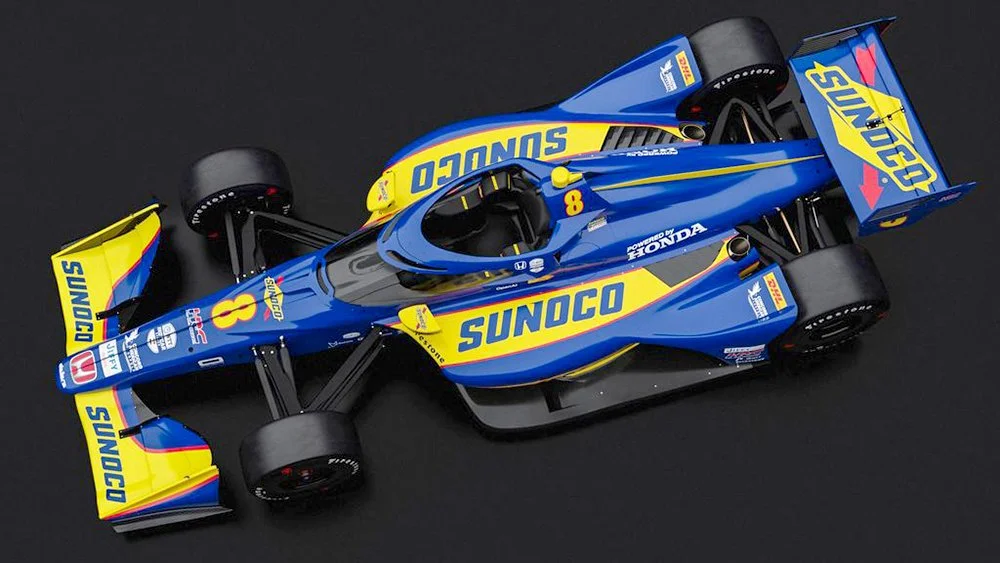
The Sunoco livery for Chip Ganassi’s number 8 IndyCar, set to race in 2026, made an immediate splash when it was revealed. The livery is unusual today in that it is designed almost entirely around one sponsor, though this was more commonplace decades ago (Image credit: www.indycar.com).
Design Logic: Worlds vs. PowerPoint
The second layer is design.
Classic liveries were conceived as coherent visual worlds. The Alitalia scheme is essentially a few strong elements: white as the base, Italian tricolore geometry, bold logotype.
Martini Racing is a disciplined rhythm of blue and red stripes, deployed with almost architectural rigor across different cars and series.
Those systems had a few common traits. Logos were simple, legible and designed for physical media. Colour palettes were restricted and carefully balanced; less really was more. Lines flowed with the shape of the car rather than fighting it. Crucially, the same logic extended to overalls, jackets, banners and trucks.
The result: a fan looking at the car and the crew saw a single, unified identity.
By contrast, much of today’s motorsport branding looks like the export of a corporate brand book onto a chassis. Many logos have been designed for websites and app icons rather than for a high-speed, three-dimensional object. They are long names, gradients, tiny trademark symbols and slogans that only read clearly on a laptop. The base livery is often developed first, then sponsors are dropped into pre-defined boxes according to a placement deck.
The result is very different: the car reads as visually restless rather than resolved.
One gets the impression that in the “golden age”, before racing became so corporatised, someone with aesthetic authority was clearly empowered to say: “This is what our world looks like.”
In the modern era, design is often a downstream function whose job is to accommodate the commercial plan. Fans instinctively feel that inversion.
A Lancia in Alitalia colours looks like it could not exist any other way, while a current car covered in unintegrated brands looks like it could have been something else until quite late in the process.
Category, Culture and Fit
Another driver of perception is category fit. The sponsors that defined the golden age of motorsport liveries were often tightly linked to the emotional territory of the sport.
Alitalia on a Lancia in the World Rally Championship feels logical at a narrative level. It is the national carrier backing an Italian car in a global competition. Speed and national pride align, and of course the glamour of the jet age was still present even in the early 1980’s.
Martini on Lancia or Porsche operates in the same space. It is a lifestyle brand associated with nightlife, glamour and risk. It makes intuitive sense that a Martini logo would appear on something noisy, dangerous and glamorous.
Cigarettes and alcohol are problematic categories for many reasons, but from a purely semiotic standpoint they fit. They are sensory, visceral products in categories where danger and reward are never far apart. They sit naturally alongside a sport built on noise, speed and controlled risk.
Modern sponsorship has migrated into very different categories. Payment networks, banks, cloud providers, software platforms, crypto exchanges and insurance companies dominate grid after grid. These businesses are absolutely rational partners: they have global footprints, marketing budgets and a need for differentiation. What they do not naturally bring is a strong sensory or emotional hook. They are selling intangible, often business-to-business services that feel increasingly distant from the average fan’s daily life.
In theory, using the sensory nature of racing to make these brands feel less abstract seems obvious. In practice, if the service remains intangible and the logo is simply “there”, do fans ever feel compelled to look the company up, let alone feel anything about it?
That mismatch is part of what you are reacting to when a card network logo appears on a papaya car. It does not feel like part of the fantasy; it feels like an advertisement dropped into the frame. The partner can still get business value, but the visual and cultural coherence that made Alitalia and Martini iconic is much harder to achieve.
Economics, Risk and Brand Guidelines
Behind all of this sit the unglamorous realities of money, risk and process.
Modern racing programs are expensive and heavily scrutinized by boards and shareholders. Even with cost controls, the pressure to maximize commercial revenue is relentless. The easiest levers to pull are to add more partners, to sell more surfaces, and to shorten commitments to keep options open.
None of those incentives favor clean, disciplined design.
At the same time, large global corporations enforce strict brand guidelines. They require unaltered, full-colour logos, minimum sizes, clear-space rules and tightly defined usage.
From a corporate control standpoint, this is rational, but from a livery standpoint (we can even use the term “artistic”), it is highly constraining. A team cannot recolour or reinterpret a mark to fit into a pre-existing visual system; it has to drop the logo somewhere that satisfies the guidelines, even if that breaks the aesthetic.
Regulatory and ESG constraints have also removed or restricted the categories that once brought a certain illicit edge. Tobacco is heavily restricted. Alcohol is tightly managed. Gambling is controversial. New sponsors often come from safer, more regulated sectors that carry different expectations around messaging and representation.
When you combine financial pressure, rigid guidelines and category shifts, the outcome is predictable. The car becomes a dense, risk-managed compilation of assets rather than a clean expression of a shared identity. The emotional impact suffers accordingly.
What Fans Are Actually Perceiving
When I wrote that I did not feel “marketed to” by the Alitalia or Martini overalls, what I’m conveying is coherence.
Everything in that world is speaking the same visual language, so it ceases to feel like persuasion and starts to feel like environment. The mechanics’ uniforms are simply what people wear in that universe. The airline and the car company are part of the same project.
Modern branding breaks that illusion. It is extremely obvious where the seams are between team identity and sponsor obligation; fans instantly recognize the car as a compilation of contracts. That is why a logo that might look unobjectionable on a card terminal or banner suddenly feels jarring on a sidepod.
How Teams Can Start Bringing the Magic Back
If teams genuinely want to bring some of that magic back, they have to accept that this is not primarily a design exercise. It is a commercial and governance decision. The product being sold to sponsors has to evolve.
The first change is to rebalance quantity and depth. Instead of aiming for maximum logo count, teams should aim for a small number of partners who are willing to co-own the identity over several seasons. That means structuring a top tier of agreements where the partner buys more than visibility. They buy long-term association with a visual and cultural asset that the team intends to protect and grow.
Again, this will be expensive up front, but the potential returns from a truly memorable livery are significant and compounding.
That in turn requires a shift in how value is presented. Many modern deals will evaporate the moment the contract ends. Teams can position integrated identity partnerships as a different asset class entirely.
Rather than leading with impressions and broadcast seconds, the conversation needs to include the long-tail value of iconic status: recurring merchandise sales years after the program ends, inclusion in media (not simple “content”) that stirs emotions, diecasts and retrospectives, and a place in the emotional memory of the sport.
Consider that the Alitalia livery still sells model cars and prints!
The second change is to elevate creative authority. There needs to be a clear creative director or design lead whose mandate is not just to “make it work” but to define a visual system and enforce it. Perhaps this person could even come from outside of the racing world.
If the team can show sponsors that their logo, when adapted carefully, will live longer and more powerfully in fans’ minds, many will accept thoughtful integration over brute-force size.
A third lever is the extension of identity beyond the car itself.
Classic programs made the entire environment part of the canvas. Workshops, pitwalls, transporters, hospitality units and mechanics’ clothing all followed the same logic. Modern teams can recover some of that by treating mechanics’ suits and team outerwear as hero products rather than as afterthoughts. Clean, bold, sponsor-integrated overalls that fans would actually want to wear as fashion items build far more equity than cluttered fireproof billboards.
The fourth element is how teams collaborate with sponsors on the narrative side. If a sponsor is willing to accept a more integrated, perhaps more subtle logo treatment, the team can repay that with richer storytelling. Instead of simply appearing in obligatory logo walls and lower-thirds, the partner can be woven into behind-the-scenes films about the design process, limited-edition merchandise drops, special event liveries at key rounds, and co-created content that explains the thinking behind the look. This is a very different proposition from buying a rectangle on the sidepod.
Finally, series themselves have tools they can use if they are serious about aesthetics as part of their product. They can set guidelines on maximum sponsor counts, restrict certain areas to maintain legibility, or even create awards and promotional bonuses for teams that demonstrate outstanding visual coherence and fan resonance. They do not have to turn every grid into a spec series visually, but they can tilt the system away from uncontrolled clutter.
A Strategic Choice, Not a Design Nostalgia Project
The key point for teams and sponsors is that this is not about retro for retro’s sake. It is about recognizing that some of the most valuable motorsport sponsorships in history achieved their status because they were treated as identity projects, not as media buys. Alitalia and Martini are still referenced, reproduced and monetized today because they were allowed to become part of the sport’s visual DNA.
In the modern off-track competitive landscape, where Chinese EVs threaten legacy automakers’ established markets, racing heritage is a crucial differentiator which must be reinforced at every opportunity, and this is a clear avenue by which to do that.
Modern teams are operating under much tougher constraints, but they are not powerless. They can decide to sell fewer but richer partnerships. They can enforce a visual system rather than surrender to a patchwork. They can present iconic status as a concrete, long-term asset to sponsors rather than a romantic side effect. And they can put someone in the organization whose job is to protect that asset with the same seriousness that a technical director protects performance.
If they do that, the next generation of fans may talk about a current livery with the same enthusiasm you feel watching Lancia footage now, not because someone cleverly optimized logo impressions, but because a car, a sponsor and a team agreed to build a world together and then had the discipline to stick to it.
Are you ready to optimize your motorsport potential?
At Vaucher Analytics, we help race teams and manufacturers turn racing ability into brand capital.
If you’re serious about making your motorsport team or series matter beyond the podium, let’s talk.
Book your 30-minute discovery call by contacting us today:
Through our website’s contact form, or
Via email at contact@vaucheranalytics.com
Main image source: Angel Luciano via Unsplash