

On February 9, 2026, two notable pieces of automotive history were made.
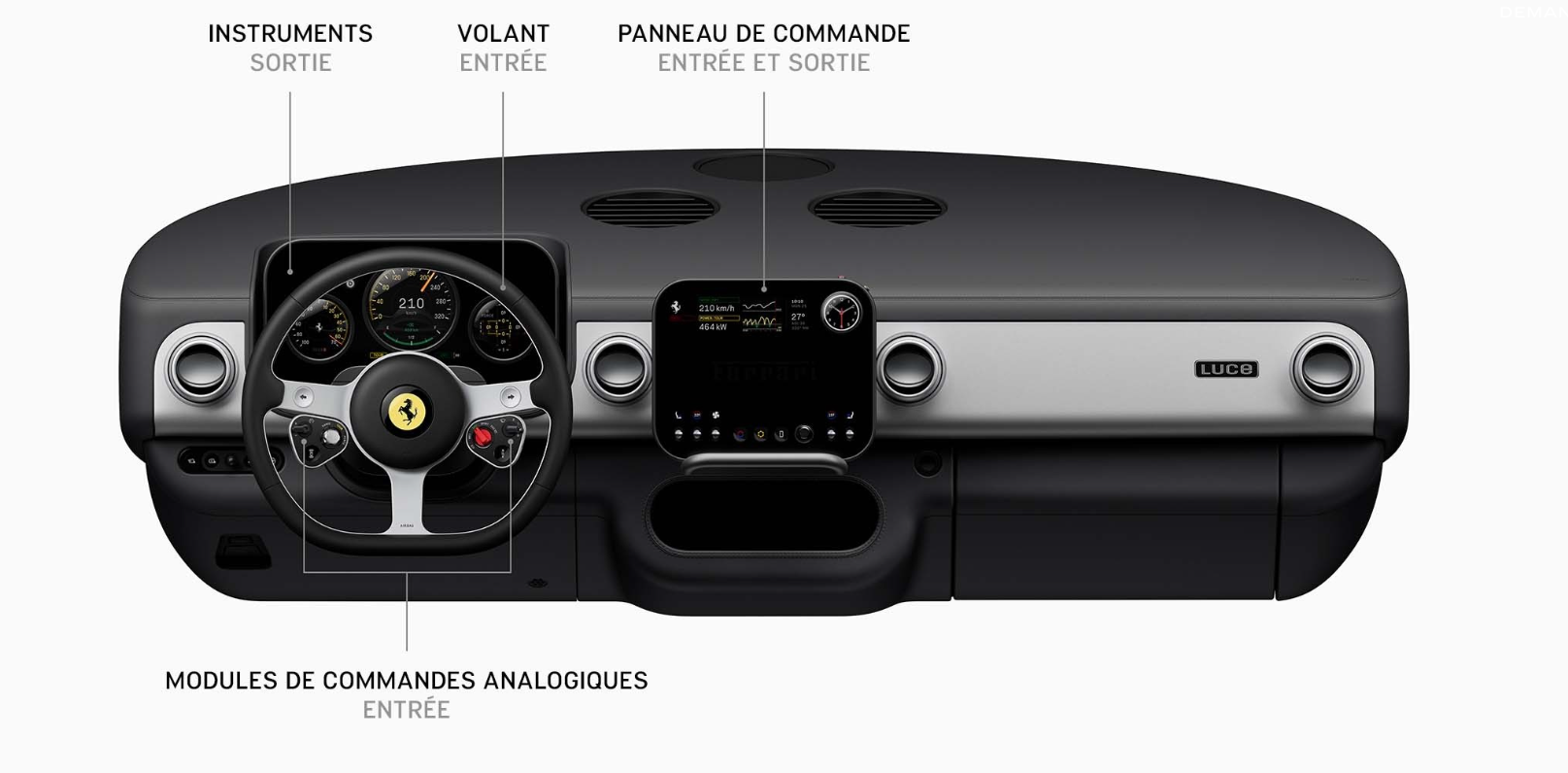
The dashboard of the upcoming Ferrari Luce (Image source: Ferrari.com)
The story that got all the attention was the reveal of the name, and some of the interior components of, Ferrari’s first all-electric car. The Luce’s interior was designed by LoveFrom, a design studio founded by ex-Apple star Jony Ive, and you don’t have to look too hard to see some of those influences.
There is no doubt that Ferrari’s electric car is being watched with great interest, and certainly premium design will be one way for car brands to make their EVs stand out in the face of Chinese competition.
But the news around the Luce still only concerns the car itself, and many car enthusiasts are still very skeptical about the idea of an all-electric Ferrari, no matter how many design gurus play a role in its final form.
Creating an EV is one thing, but creating the desire for it is entirely another, and this why the second piece of automotive history that happened on February 9, despite being far less-publicized, will arguably go down as the more significant.
Audi did something most legacy automakers talk about but almost none actually execute: it used motorsport heritage as a live asset, not a museum piece, to create desire for one of its EVs.
In a commercial starring Gabriel Bortoleto and Nico Hülkenberg, the new Audi F1 team’s drivers for 2026, the audience is treated to a joyful, cinematic setup: a Quattro drifting through what could be a part of a rally stage, accelerating through a tongue-in-cheek “time portal,” and then emerging to reveal a modern, electric Audi e-tron GT, going sideways just like its “ancestor”.
Strategically, this is far more than just an ad, or at least it should be.
A Drift Through Time is a case study in how legacy manufacturers can make electric cars desirable, defend pricing power, and stay ahead of the Chinese EV surge.
In fact, Audi makes this playbook completely explicit in its description for the YouTube video:
“One drift connecting decades. From Rally Group B in 1983 to electric precision in 2026. With Nico Hülkenberg and Gabriel Bortoleto behind the wheel, quattro evolves without losing its core.”
This commercial is the clearest demonstration to date of a concept formalized in Vaucher Analytics’ new white paper, The Quartz Protocol: Strategic Options For Surviving the Chinese EV Wave: motorsport “proof” is only valuable if you convert it into consumer-facing “halo.”
Well-executed heritage activation is the mechanism that does this, and, with only a few caveats Audi just put on a masterclass.
The Quartz Protocol: A Playbook For Legacy Automakers to Leverage Motorsport Against the Competition From Chinese EVs
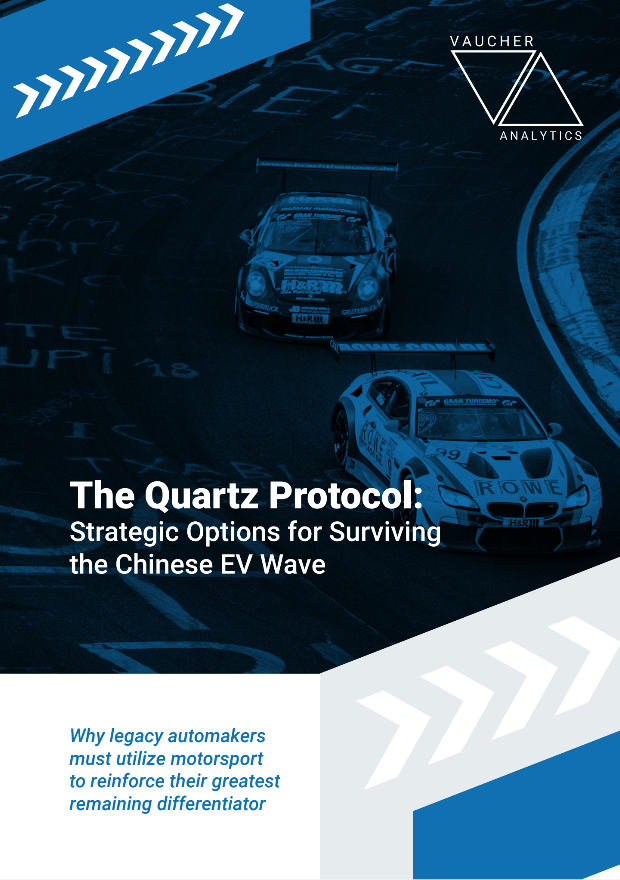
A practical framework (the Motorsport Value Capture Matrix) to see whether your brand is actually converting racing “proof” into consumer “halo”, or funding performance that never reaches the customer.
A clear strategic argument for why legacy OEMs can’t out-commodity Chinese EVs, and why motorsport-led emotion is their last defensible moat.
Tools for action, including a 10-question self-assessment plus a concrete audit approach to identify where motorsport value is lost in your racing program.
Chinese EVs Are Erasing Functional Differentiation
Europe’s legacy brands face a competitive threat they haven’t seen in decades, perhaps ever. After managing to coexist with Japanese brands on an internal combustion engine (ICE) playing field in the back half of the 20th century, the entire industry now faces high-quality, aggressively priced Chinese EVs competing with a technology that the Chinese themselves are perfecting.
When functional attributes converge, identity becomes the last defensible moat against commoditization, and Audi’s A Drift Through Time answers the question every OEM is now facing:
How do you make your EV desirable when numerous other EV companies can match your specifications, at a lower price?
The answer is the same as it has always been in the luxury goods industry: you don’t sell the EV, you sell everything that EV represents for you.
In other words, you don’t sell the EV, you sell its lineage.
A Quattro sliding sideways through snow communicates instantly what no spec sheet can: we, and we alone, have earned this.
So when a new Audi steps out of a fictional time portal, it inherits that credibility.
This is the proof-to-halo pathway described in The Quartz Protocol in its clearest form.
Don’t want to be left behind?
Subscribe to Return On Racing — the weekly newsletter from Vaucher Analytics covering actionable motorsports strategy
Audi Understands What Makes It Different
Many legacy brands will not change their marketing to adapt to the EV era. Rather, they will simply say “we are [brand], now we sell EVs, buy our EV”.
And what will this argument be based on? Most likely it will be easily replicated features and specifications: the number of screens, some software functionality, range, and accelerations.
The is a mistake that will be existential for many legacy brands because Chinese EVs can match all of this, and often beat it, and they are doing this now.
What they cannot copy is motorsport mythology built up over decades: Ferrari have F1 and Le Mans, Porsche have Le Mans, Audi have Le Mans also, and rallying, and now F1.
Audi’s motorsport heritage over decades is incredible, and that gives Audi access to a kind of desirability that cannot be commoditized, provided they leverage it properly.
This is the blueprint for A Drift Through Time:
The Quattro sequence telegraphs technical authority
The drivers provide current cultural legitimacy
The transition shot creates narrative continuity
The electric e-tron GT inherits emotional permission
This is not nostalgia for nostalgia’s sake, but rather the deployment of a brand strategy goldmine.
Audi’s A Drift Through Time Shows What Legacy Brands Are Missing
The data behind The Quartz Protocol shows a clear pattern:
Many brands race,
Many brands do have heritage
But very few brands convert that proof into halo that can the drive sales
Audi is doing what dozens of brands fail to do every year, it is leveraging its motorsport equity to elevate its entire modern lineup, including, crucially, its electric models.
If you’ve ever wondered why Alpine, Peugeot, Mitsubishi, Subaru, Alfa Romeo, or Citroën struggle to translate their massive motorsport past into modern desirability, this video is the answer: they have not built the historical bridge that Audi are building.
Speaking of Alpine, Audi are doing something the former has not: using F1 to sell cars
A Drift Through Time wasn’t just a heritage activation, it was Audi’s first visible step in leveraging its enormous, contemporary F1 investment to build mainstream desirability, before its cars have even hit the grid to start the 2026 season.
F1 is the single largest global motorsport platform, with an enormous price of entry to match. Car brands entering F1 must have correspondingly high ROI expectations, so it’s puzzling that Alpine, with several years of competition behind it, does not lean into F1 to sell its cars.
And yet, here are Audi’s F1 drivers having a ball in the brand’s heritage and modern cars. This is precisely the kind of motorsport-to-consumer translation that many OEMs, including Alpine, consistently fail to achieve.
F1, and motorsport generally, become expensive theater unless they are tied directly back into brand meaning, and Audi are showing that they have concrete plans to make back their investment.
Why Audi’s Emotion-Based Strategy Matters More Than Ever In the EV Era
Consumers don’t fall in love with battery chemistry, they fall in love with meaning, built on lineage, story, and mechanical identity.
Audi’s film succeeds because it uses heritage not as a retro aesthetic (though that is heavily present) but as an active ingredient:
It reminds us Audi invented an era
It asserts continuity with that era
It positions the modern lineup as the rightful heir
That’s how you make electric desirable.
You don’t ask consumers to make the link to what made the brand iconic, you show them it never went away.
Audi’s A Drift Through Time Is the Future of Automotive Marketing, Rooted In the Past, And Most Legacy Automakers Aren’t Optimizing For it
What Audi did in 60 seconds is what The Quartz Protocol argues automakers must do systematically:
Identify authentic motorsport proof (heritage or current programs)
Translate it into brand meaning consumers instantly understand
Use that meaning to defend pricing power in a world of spec-sheet parity
Turn motorsport into a compounding, commercial moat, not a cost center
Initial indications are that Audi have hit the bullseye, with one comment on one of its Instagram posts for A Drift Through Time saying it all: “I think I need to go and buy an Audi”.
The Gaps to Anticipate In Audi’s Strategy
Audi seems to have hit a home run with A Drift Through Time, but the more difficult work comes next. Indeed, a single viral reel can create attention, but it does not, on its own, create durable competitive advantage.
For that, the heritage-to-EV narrative must be sustained over time and across channels, rather than treated as a one-off activation. The Quattro-to-RS EV bridge, in particular, needs to recur consistently if it is to anchor consumer perception rather than momentarily excite it.
More broadly, the logic of motorsport-derived halo must be systematized across the lineup, so that bread-and-butter Audi models, not only the performance RS variants, inherit coherent elements of the same performance story.
Finally, the effect of this halo must be measured in commercial terms; not through engagement or sentiment alone, but through price realization, performance-package uptake, loyalty lift, cross-model spillover, and share gains in performance-adjacent segments.
Early indications are that people are already responding to A Drift Through Time, with one commenter for an Instagram post featuring the video writing “If you go back to the old ways, we’ll go crazy”, and Audi’s official account replying “Heritage is what we build on!”.
But…do they?
Time will tell whether Audi continues on this path, but the fact that these posts are occurring on Audi’s main account rather than the more enthusiast-focused Audi motorsport accounts is a positive indication.
The Risk Hidden Inside the Brilliance: Implied Knowledge
There is also a more structural risk embedded in Audi’s approach, one that reinforces the core argument of the Quartz Protocol.
A Drift Through Time assumes the audience understands what “Quattro” means, what the Quattro itself was, and what it represented for rallying (a literal paradigm shift with the introduction of four-wheel drive).
For enthusiasts, that assumption holds. For a broader, younger audience, the very audience F1 is supposed to help reach, a reasonable hypothesis is that it does not.
Group B dominance, the all-wheel-drive revolution, Audi’s rally-era mythology: these are not universally known reference points anymore.
This exposes that heritage only works if it is continually broadcast; it does not compound automatically.
When heritage storytelling becomes episodic rather than systematic, brands are forced to rely on implied knowledge.
That weakens halo transmission and limits commercial impact, unless the brand wants to reinvest heavily in getting everyone up to speed. If that doesn’t happen, the creative product may be excellent, but the conversion rate suffers.
This is why one-off campaigns, however well executed, are not enough.
Heritage needs infrastructure that is built and refined constantly.
Everyone Must Go Back to the Future To Survive the Competition from Chinese EVs
Audi just showed the rest of the industry what the EV era requires: not more technology, but more identity.
If legacy automakers hope to defend themselves from Chinese EVs that will rapidly commoditize hardware, the solution isn’t more screens or more range.
It’s Audi’s strategy: take your motorsport heritage, pull it through time, and make the future feel earned and special.
As a quick aside, Audi’s choice to spotlight rally rather than its dominant endurance-racing history is telling. Rallying remains one of the most visually efficient entry points into brand identity: snow, slides, and drama communicate capability and engineering excellence instantly. It’s a reminder not just for Audi, which long ago left rallying, but for the WRC, which could use a few more manufacturers competing at its highest level, that rally heritage is an underused access ramp to consumer desire, especially in a market where attention spans are short and Chinese EVs increasingly over-deliver on specifications.
So, who’ll be next?
Are you ready to optimize your motorsport potential?
At Vaucher Analytics, we help race teams and manufacturers turn racing ability into brand capital.
If you’re serious about making your motorsport team or series matter beyond the podium, let’s talk.
Book your 30-minute discovery call by contacting us today:
Through our website’s contact form, or
Via email at contact@vaucheranalytics.com
Main image source: Official Audi Instagram account
Disclaimer: No commercial affiliation is implied with any of the companies mentioned, or linked to, in this article. All names appear solely for commentary and educational purposes.