Racing Is Not About Lap Times: Why Factory Programs Exist to Solve Business Problems, Not Win Races
“Disappointment is the gap that exists between expectation and reality.”
Motorsport fans won’t like this, engineers won’t like it either.
But if you lament the loss of a factory program in your favorite racing series because you really wanted “your team” to put a painful season behind them and go for the championship some day, this is a view that you don’t want to hear, and is never said out loud.
What if I told you that sustainable (emphasis on “sustainable”) factory racing has almost nothing to do with lap times, and everything to do with solving a business problem?
Yes, even in the 24 Hours of Le Mans.
Yes, even in the FIA World Endurance Championship.
Yes, even in the World Rally Championship.
Lap time is an engineering metric, but it has nothing to do with actually staying on track; that sounds absurd at first but becomes apparent when you unpack the reason brands spend money to go racing in the first place.
Once you understand that distinction, the entire logic of factory racing shifts, including how you design the program, how you spend money, where you choose to compete, and what true return on investment actually looks like.
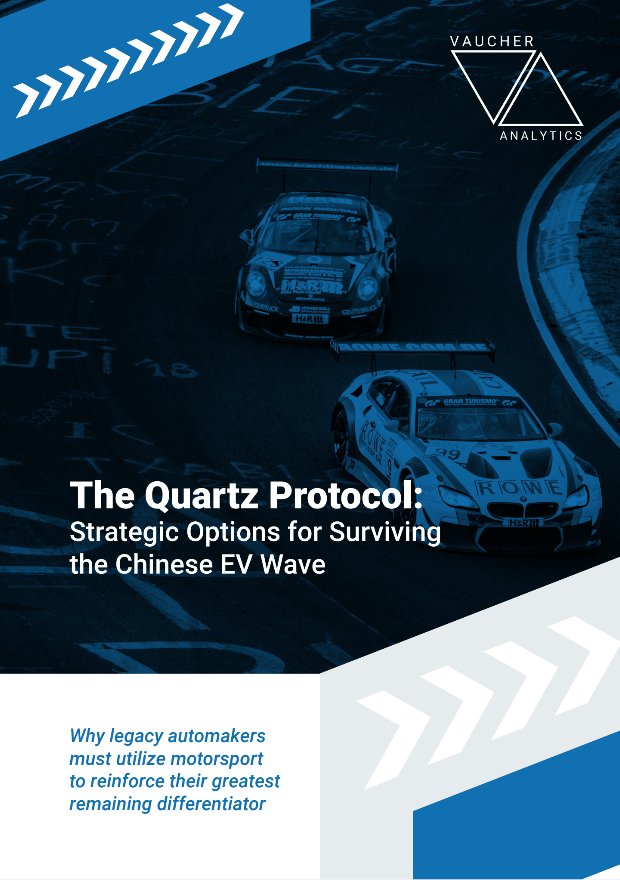
The Quartz Protocol: A Playbook For Legacy Automakers to Leverage Motorsport Against the Competition From Chinese EVs
A practical framework (the Motorsport Value Capture Matrix) to see whether your brand is actually converting racing “proof” into consumer “halo”, or funding performance that never reaches the customer.
A clear strategic argument for why legacy OEMs can’t out-commodity Chinese EVs, and why motorsport-led emotion is their last defensible moat.
Tools for action, including a 10-question self-assessment plus a concrete audit approach to identify where motorsport value is lost in your racing program.
Racing As a Business Asset, Not a Sport
Brands don’t go racing with the primary goal of being entertaining to fans, though that hopefully ends up being a positive by-product.
Rather, brands race because, in theory, on-track activities are part of a concerted corporate effort (usually marketing) to advance some internal agenda.
Boards do not approve €20M–€50M annual budgets because they necessarily care about keeping up with new regulations or pursuing some rivalry.
Again, those may end up being by-products of these investments, but boards approve these budgets because racing, when deployed correctly, unlocks business value that traditional marketing channels cannot touch.
Factory motorsport:
Provides justification for premium pricing, allowing performance variants and high-margin packages to make financial sense
Restores cultural authority among younger buyers, who associate motorsport with authenticity in a way polished ads cannot replicate (certainly not with AI)
Creates differentiation against Chinese EV entrants, who can match hardware but cannot easily buy heritage or racing credibility
Provides global media reach without global ad spend
Functions as a recruiting magnet for engineering talent in an era where automotive prestige competes with other, more lucrative options for bright graduates
Here is the key, which goes back to the quote at the top of this article: none of this depends on winning a championship, but it does depend on having a purpose (likely some combination from athe list above), which has been clearly defined upfront.
It’s a given that winning teams have a leg up, but there can only be one winner, and this brings us full circle to the quote at the top of the article.
With the right expectation of goals and packaging, mid-pack teams can still benefit greatly from their reality on-track, and in fact trying to chase the winners will not lower lap times, rather only accelerate their exit out of a racing series.
Don’t want to be left behind?
Subscribe to Return On Racing — the weekly newsletter from Vaucher Analytics covering actionable motorsports strategy
Decreasing Lap Times Requires Increasing Budgets
When you listen to a racing broadcast, you only hear about lap times, and, understandably, the motorsport industry and its fans treat lap time as the ultimate measure of success.
However, lap time is almost completely irrelevant to the goals of the business.
It is absolutely true that below a certain credibility threshold, performance matters; consumers will not buy from a brand that looks incompetent, and in today’s social media landscape, that hypothetical incompetence will bleed over into the mainstream.
Yet, once that threshold is crossed, each additional tenth becomes disproportionately more expensive while delivering marginal returns. So, as teams try to close in on the leading pace, everyone spends more money, the cost spiral starts, and when lagging teams realize they can’t keep up, they start heading for the exits.
In other words, if their expectation is the best lap time, the on-track reality is very different, and they leave disappointed.
This is the trap factory teams fall into:
A brand enters a series
They want to be competitive
They chase the possibility of winning
Budgets explode
ROI (if it was defined in the first place…) collapses, as does the internal justification to stay on-track
Fans celebrate the pursuit of perfection, but CFOs will see this otherwise, from the perspective for which they are hired: uncontrolled cost escalation.
If the only justification for a factory program’s existence is winning on-track, it is on very shaky ground.
But if that same factory program instead wants to win in a showroom, well, then the math shifts materially.
The Real Goal of Factory Racing: Solve a Defined Business Problem
Every OEM entering motorsport must answer one question upfront:
“What specific business problem(s) are we solving by going racing?”
This is where almost all racing programs fall apart: they do not clearly define what “success” looks like off-track, and therefore cannot articulate a commercial purpose.
This is a short, non-comprehensive list of problems that automobile brands might want to tackle:
A brand struggling with desirability among younger buyers uses racing to create cultural equity that no paid impression can replicate
A manufacturer trying to command premium pricing in an EV-flattened market uses motorsport to restore perceived engineering authority
A company facing aggressive Chinese competitors uses motorsport to create an emotional moat that cannot be reverse-engineered
Dealer networks that lack energy and engagement rely on factory programs for storytelling, events, and product activation
Performance sub-brands losing relevance use racing to regain narrative clarity and a clear identity
Not one of these business problems requires a championship, or even winning races.
However, each and every one of these requires very clear metrics to define what “doing well” looks like (e.g. increasing percentage of performance options packages, increased market share among Gen Z, etc), as well a clear plan that requires tight integration between all facets of the business.
Marketing, Finance, IT, these functions, among others, must be working in coordination to support and move forward on-track racing initiatives, and if factory teams leave with regularity, it’s precisely because this coordination doesn’t exist; budgets are unlocked, and racing teams go off to focus solely on winning because they’re competitive.
But the business itself has to be competitive as well, and here is a hypothesis that brands must test: does the average car buyer really care about, or even follow, the results of a brand’s involvement in a racing series?
Or will they be excited simply by seeing exciting content created off the back of that involvement?
Category Selection Matters More Than Winning Trophies
It’s with the mainstream car buyer in mind that automotive brands must realize that the category they enter, and the structure in-place around that participation, matter more than their finishing position within it.
For instance, finishing P10 in a prestigious platform such as the FIA World Endurance Championship or the World Rally Championship might be more valuable than winning a lower-tier series with minimal media presence, but only if a structure is in place to capitalize on that.
It may also turn out that the smaller regional series takes place in a target market, and simply participating will get a goodwill boost.
The public rewards prestige and emotions, not spreadsheets and certainly not lap times; consider that Audi has not been on a rally stage in decades and the average buyer has never heard of the Audi Quattro, yet that didn’t prevent the brand from placing its F1 drivers on a rally stage for a recent commercial.
Brands benefit from storytelling, cultural relevance, consistency, and heritage signals.
These can be amplified by the right platform, even when the results are modest.
The Minimum Competitive Threshold: The Most Misunderstood Concept in Motorsport Strategy
Here is the concept that separates lasting factory programs from financially unsustainable ones, and the one that is likely to anger many a motorsport fan and professional:
You only need enough performance, coupled with a plan, to remain commercially credible; you do not need to dominate.
Below the minimum threshold of competency, you are slow, invisible, unreliable, and unmarketable.
At the threshold (which really only comes down to finishing races cleanly), you are competitive, present in highlights, and authoritative enough to anchor brand messaging.
Above the threshold, you can secure occasional podiums, moments of heroism, and the kinds of storylines that marketing teams can stretch for an entire season, perhaps even years after the racing is finished.
Dominance, meanwhile, is expensive, rare, and almost never necessary from a business point of view.
Put simply: OEMs mistakenly target “dominant”, or even just “front-running” when “credible” would deliver much of the desired commercial impact at a fraction of the cost that starts to make boards ask questions.
Critics often misread this approach as an invitation to “accept mediocrity,” but the reality is the opposite.
A factory program built on clear commercial objectives and disciplined KPIs tends to earn more budget over time, not less. When a racing department consistently hits its targets (e.g. brand equity uplift, dealer activation, product upsell impact, engineering recruitment) executives gain confidence in the program, and confidence unlocks investment.
As investment grows predictably rather than emotionally, the team eventually moves from merely credible to genuinely competitive, with podiums and wins becoming achievable through compounded capability rather than panic spending.
In other words, the fastest path to sustainable success in motorsport is the slow and steady one; brands looking for overnight glory almost always end up losing faith quickly and, predictably, burning money with nothing to show for it.
What Racing With Real ROI Actually Looks Like
A motorsport program generates real value when it delivers measurable improvements to the business, as measured against a problem that was clearly defined before a even single CAD drawing was completed.
That includes increased brand desirability, clearer funnels into high-margin performance packages, stronger reasons for buyers to choose €10k–€15k upgrades, and dealership activation that fuels local enthusiasm.
A successful program also strengthens engineering recruitment, providing a halo that no LinkedIn campaign can imitate. And most importantly, it produces energy and excitement around the brand.
Lap time alone cannot do any of this.
A well-designed racing program magnifies the brand; a poorly designed one merely magnifies the budget.
Racing Is a Business Instrument, Not a Scoreboard
If you are running a factory racing program, you have two choices.
You can treat racing as a sport and chase tenths of a second, escalate budgets, and eventually ask why the CFO is furious.
Or you can treat racing as a business instrument; define the commercial objective, design the program around that objective, and measure ROI with discipline instead of emotion.
The first approach makes you popular with fans in the short-term, sure, but the second approach keeps you racing.
Final Word: Factory Racing Is Not About Being the Fastest
Factory motorsport is not about speed for speed’s sake, but rather margin, perception, cultural relevance, and brand authority.
Put into strict motorsport terms, a factory racing program has one main sponsor: the factory. In the same way that “conventional” sponsors will all have different desires that the team must satisfy, teams must treat the factory as a sponsor that needs to be delighted in its own way, and that doesn’t necessarily involve being the fastest on-track.
Motorsport remains an emotionally efficient form of brand building, but only if that’s how it’s approached, not as a way for a small group of people to satiate their competitive desires, but rather making your brand matter in a world where everything else feels the same.
Are you ready to optimize your motorsport potential?
At Vaucher Analytics, we help race teams and manufacturers turn racing ability into brand capital.
If you’re serious about making your motorsport team or series matter beyond the podium, let’s talk.
Book your 30-minute discovery call by contacting us today:
Through our website’s contact form, or
Via email at contact@vaucheranalytics.com
Main image credit: Sara Ruffoni via Unsplash