

Motorsport After Ownership: Why Racing Now Decides Whether Car Brands Still Matter
Motorsport, Freedom, and the Death of Car Ownership Romance
For most of the 20th century, the car symbolized freedom. It meant escape, autonomy, adulthood, and social mobility.
For young people today however, that meaning has eroded, with licensed teenage drivers in the US (a large market very closely associated with car culture) dropping from 64% of teenagers in 1995 to less than 40% in 2021.
The factors underpinning this trend (ride-sharing, cost pressure, climate anxiety, and digital-first lifestyles) have stripped car ownership of its emotional charge, and for car brands, the consequence is existential: a car is no longer a rite of passage, it is a tool, sometimes even an inconvenient one.
Vaucher Analytics devotes significant thought to the competitive earthquake that Chinese EVs represent, but the shift in the view of car ownership creates an even more existential problem for car brands: what if the question for young people isn’t whether to buy a Chinese EV or a model from a legacy car brand, but rather whether to own a car at all?
If ownership no longer excites younger buyers, how do you sustain desire, justify premium positioning, and defend long-term brand value?
In other words, can a car brand still be desirable when the very products it sells appear to be less and less so?
Yes, it can, provided it leans heavily on the elements that it used to sell cars and create dreams in the first place, throughout the middle of the 20th century.
Motorsport was key to creating these mythologies, and when used correctly, it is one of the few remaining levers capable of addressing this gap.
But it only works if brands stop evaluating motorsport on the merits of a sales channel and start using it as what it really is: a meaning engine.
Don’t want to be left behind?
Subscribe to Return On Racing — the weekly newsletter from Vaucher Analytics covering actionable motorsports strategy
Why Car Ownership No Longer Signals Freedom
The decline in emotional attachment to cars is certainly tied to the rise of technology, which leads many young people to prefer staying home to going out.
However, technology is only one aspect of what freedom now represents.
For younger generations, freedom is flexibility, access, identity alignment, and low friction, not necessarily transportation via automobile (we can note that appetite for air travel remains strong).
For many young people, car ownership no longer means freedom alone, quite the opposite in fact: it introduces friction: cost, maintenance, parking, insurance, and long-term commitment (the very opposite of “freedom”…).
To this group, the costs of car ownership outweigh the benefits, and viewed in this way, the rise of ride-sharing makes complete sense: the oft-touted freedom without the ever-growing list of constraints.
This is the critical insight many OEMs miss. young buyers have not rejected cars outright.
They have rejected the new meaning of car ownership and what it represents.
Fortunately for car makers, this meaning can be rebuilt and re-shaped, even if ownership itself does not return to center stage.
The Quartz Protocol: A Playbook For Legacy Automakers to Leverage Motorsport Against the Competition From Chinese EVs
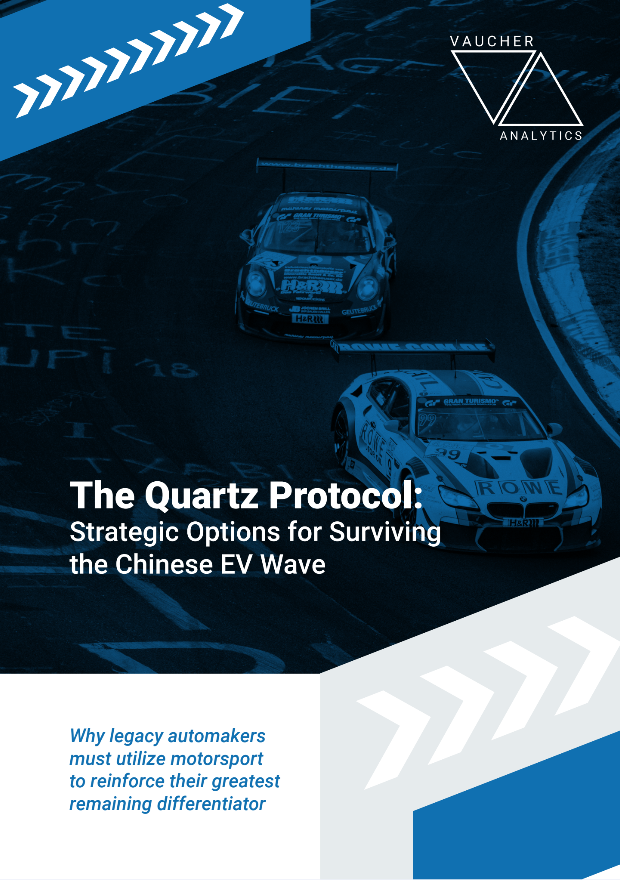
A practical framework (the Motorsport Value Capture Matrix) to see whether your brand is actually converting racing “proof” into consumer “halo”, or funding performance that never reaches the customer.
A clear strategic argument for why legacy OEMs can’t out-commodity Chinese EVs, and why motorsport-led emotion is their last defensible moat.
Tools for action, including a 10-question self-assessment plus a concrete audit approach to identify where motorsport value is lost in your racing program.
Motorsport’s New Role in a Post-Ownership World
Motorsport cannot single-handedly make young people want to own cars again, that era is over because of all the pressures listed above.
What motorsport can do is far more valuable: it can restore aspiration, cultural relevance, and emotional permission in a world where access to experiences is increasingly overshadowing possession of luxury goods.
Motorsport creates what we can call “symbolic surplus”, or quite simply brand equity.
It produces stories, spectacle, drama, and identity at a scale no marketing campaign can replicate.
Even AI can’t match this symbolic surplus, and that is exactly the point: as younger generations become digitally saturated and crave a return to analogue, real-life experiences, motorsport can satisfy that demand.
When brands rely on motorsport merely to “sell cars,” ROI has the potential to look weak because it doesn’t fully capture what is being achieved.
Indeed, when they use motorsport to rebuild meaning upstream of the transaction, ROI becomes structural, because it is embedded in the minds of future car buyers, or just people who are now enthusiastic about the brand, and who are therefore positively primed for other initiatives and products besides cars.
The strategic reframing is simple but unconventional for many legacy brands:
Motorsport is no longer about convincing someone to want a specific vehicle, but rather convincing them that this brand matters, even if they never own its primary products.
Two Audiences, Two Strategic Jobs
Of course, not everyone wants to follow a driver or team over the course of the season, but this doesn’t mean that legacy automobile brands can’t still leverage motorsport to create positive associations across a spectrum of consumers.
Motorsport for the inclined fan
For enthusiasts and already-inclined fans, motorsport still functions as a “deepening” mechanism. This audience values technical literacy, heritage, and authenticity, and its members respond to motorsport when it rewards understanding rather than mass appeal.
Brands like Porsche have mastered this dynamic.
Customer racing, long-form technical storytelling, and visible development cycles transform motorsport from entertainment into belonging, leading to the expression “Porsche Guy”.
Even fans who never buy a 911 can still internalize the brand as serious, credible, and worth aligning with over decades (to be clear, Porsche is not the only brand with this effect, Ferrari and Lamborghini, among a short-list ofthers, also have this brand power).
Here, motorsport sustains lifetime value by reinforcing a self-image: “I am the kind of person who understands and appreciates this.”
Motorsport for the general buyer
For the broader audience, motorsport performs a different job entirely; this group does not want to understand racing.
Its members are, however, open to feeling strong experiences in a general sense, the kind that motorsport is uniquely primed to provide.
For general buyers, motorsport becomes a cultural signal rather than a technical proof.
This is why different series matter for different strategic reasons.
Formula 1 functions as global luxury theater, associating brands with scale, excellence, and elite performance
Formula E embeds brands in urban, sustainability-focused narratives that resonate with city-based younger consumers
The WEC communicates seriousness, engineering depth, and long-term commitment.
The mistake brands repeatedly make is trying to explain motorsport to this audience, because explanation dilutes impact; the best path forward is often just to let the on-track action do the talking.
Motorsport As More Than a Sales Funnel; It’s An Identity Layer
The most important shift brands must internalize is that motorsport’s output is not conversion; it is identity scaffolding.
In a world of leasing, subscriptions, and shared mobility, motorsport allows people to feel affiliated without owning.
After all, does every tifosi own a Ferrari? Does a tifosi need to own a Ferrari to feel strong passion for the Scuderia Ferrari?
If a young consumer leases occasionally, uses car-sharing, or never owns an automobile at all, but still says, “I’m a [Brand] person,” motorsport has succeeded.
It has made access feel like participation and non-ownership feel like proximity rather than exclusion.
This is how motorsport mitigates the loss of ownership excitement: it decouples desire from possession.
Where Automotive Brands Are Currently Failing
Most OEM motorsport programs underperform, not on-track but commercially, because they are structurally mismanaged; this is why motorsport programs tend to be first on the chopping block when a company’s fortunes take a turn for the worst.
Motorsport is often siloed within racing departments, disconnected from brand, product, retail, and digital experience teams. KPIs focus on podiums, impressions, and hospitality satisfaction; metrics that say nothing about identity formation or long-term brand elasticity.
The result is awareness without attachment and cost without leverage.
Motorsport becomes a “nice to have” internally, vulnerable during budget reviews precisely because its full value is never measured or articulated.
What Effective Motorsport Strategy Actually Looks Like
When motorsport is working as intended, it creates a coherent loop between racing, brand perception, and everyday interaction, so its narrative is clear and defensible: visual language carries from track to product to digital touchpoints, merchandising feels cultural rather than promotional, and experiences prioritize belonging over transactions (keeping the potential open for transactions down the line).
Crucially, performance is not abandoned.
In an era of EV transition, competition from Chinese EVs and software-defined vehicles, motorsport remains one of the few credible environments where brands can prove engineering seriousness under pressure, and then imbue that “halo effect” on the rest of their line.
The Strategic Bottom Line
Motorsport will not restore the golden age of car ownership, but that is not its job anymore because that golden age was tied to a very specific moment in time.
The job of motorsport is to ensure that automotive brands remain emotionally relevant in a world where ownership is optional, access is fragmented, and meaning is scarce.
Brands that understand this will continue to justify motorsport investment as a long-term strategic asset.
Brands that do not will keep asking why motorsport “doesn’t convert,” slowly retreating from the very arena that could have preserved their relevance.
The future of motorsport is not directly about selling cars, it is about making cars (and the brands behind them) worth caring about.
The Choice Automotive Brands Must Make
Every OEM running a motorsport program today is already making a choice, whether they admit it or not.
They are either using motorsport as a long-term meaning and identity platform, or they are using it as a discrete visibility exercise.
The first path requires uncomfortable change:
Motorsport must be owned jointly by brand, product, and strategy teams
Success must be measured in cultural relevance, pricing power, and identity pull, not just podiums and impressions
This path is harder to explain internally in the moment, but it is defensible over the next decade.
The second path feels safer:
It preserves familiar KPIs, legacy structures, and comforting narratives about “brand exposure”
It also leads to an inevitable outcome: declining relevance, soft ROI, and eventual budget cuts justified by the very metrics used to defend the program
Motorsport is no longer expensive because it fails to convert. It is expensive because most brands refuse to decide what it is for, and capital is ultimately under-utilized.
Brands that make that decision will still be racing ten years from now, and will also have primed a new generation of buyers, or devoted evangelists.
Because the only thing more tragic for legacy brands than young car owners not buying cars, is young buyers finally deciding to buy a car, and opting for a Chinese EV.
Are you ready to optimize your motorsport potential?
At Vaucher Analytics, we help race teams and manufacturers turn racing ability into brand capital.
If you’re serious about making your motorsport team or series matter beyond the podium, let’s talk.
Book your 30-minute discovery call by contacting us today:
Through our website’s contact form, or
Via email at contact@vaucheranalytics.com
Main image source: Aimé Leon Dore
Image is used solely for illustrative and informational purposes, no commercial affiliation with Vaucher Analytics is implied.