The Brand Every Racing Team Should Aspire to Be Is…
Motorsport can evolve from a marketing expense into a strategic asset, but only when it is embedded within a broader system of capital, timing, and organizational design.
Racing teams believe they exist to win races.
Manufacturers believe they exist to market cars.
Both are operating within a constrained, isolated view of what motorsport actually enables, because the industry continues to treat racing as either a competitive exercise or a marketing expense, when in reality it can function as something potentially far more valuable: the foundation of an entirely new business.
The existence of Polestar should force a reassessment of these assumptions. Indeed, Polestar did not begin as a design studio, a product roadmap, or a strategic pivot into electrification.
It began, very simply, as a racing team.
Motorsport is not a money sink, but it is often misused capital.
It can create value, but not everyone sees just how far that value creation can be pushed quite like the minds behind Polestar.
The Quartz Protocol: A Playbook For Legacy Automakers to Leverage Motorsport Against the Competition From Chinese EVs
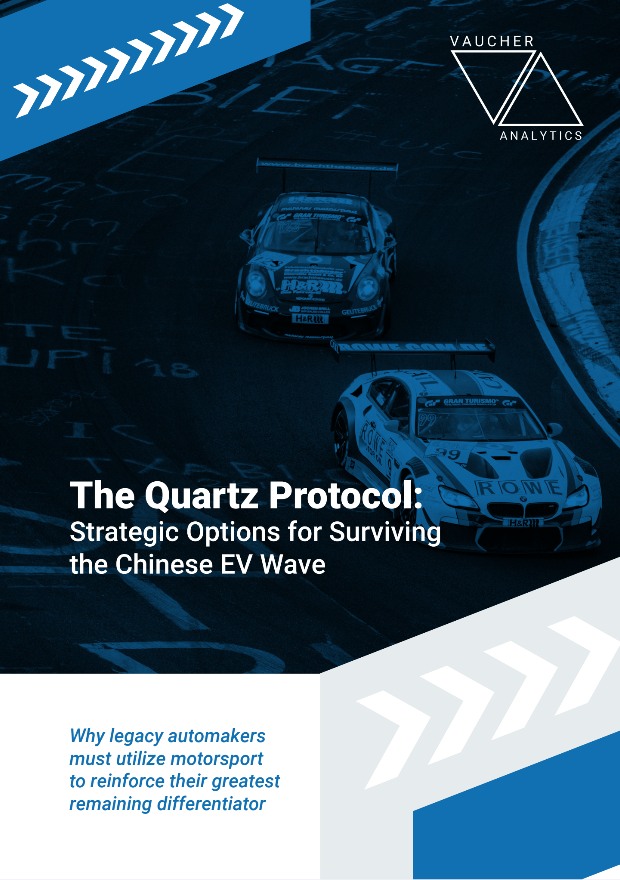
A practical framework (the Motorsport Value Capture Matrix) to see whether your brand is actually converting racing “proof” into consumer “halo”, or funding performance that never reaches the customer.
A clear strategic argument for why legacy OEMs can’t out-commodity Chinese EVs, and why motorsport-led emotion is their last defensible moat.
Tools for action, including a 10-question self-assessment plus a concrete audit approach to identify where motorsport value is lost in your racing program.
From Touring Cars to Transferable Performance Authority…
Polestar traces its origins to Flash Engineering, a team founded in 1996 that competed in the Swedish Touring Car Championship using Volvo machinery.
The team did well, winning races and building a reputation over time.
Following its sale in 2005, the operation was rebranded as Polestar Racing and deepened its collaboration with Volvo; what began as a racing relationship evolved into something more integrated.
Polestar started modifying road cars, delivering improvements in what were usually considered “staid” Volvo models.
This was the beginning of motorsport’s arc in creating value for Volvo: motorsport credibility was no longer confined to the track, it was actually starting to be embedded into the road-going, consumer product itself.
The next step was decisive.
Polestar developed its own prototype vehicles in the late 2000’s and early 2010’s, demonstrating that it was not merely a tuning partner but rather a performance authority capable of standing on its own.
Limited production models followed, and market demand validated the proposition.
By 2015, Volvo moved to acquire the brand outright, thus securing an asset that had already proven its ability to generate value beyond going racing.
…And From Division to Standalone Brand
In 2017, Polestar was repositioned as a standalone electric performance brand.
Rather than integrating Polestar into Volvo as a sub-division or performance trim (for instance M for BMW, AMG for Mercedes), as other luxury brands continue to do, the company chose to elevate it into an independent entity focused on the future of the industry: electric vehicles.
This was the inflection point for the brand, right before an inflection point for automobiles broadly, since this occurred at a relatively early time in the Western EV transition.
This move, while bold, becomes a little less so when you realize that Volvo had been bought by Chinese automanufacturer Geely in 2010; in other words, China’s EV transition was moving full power ahead and Geely made a decision to utilize an existing legacy name to continue that trajectory.
At the same time, the original racing activities continued separately, but this time under the name Cyan Racing, maintaining continuity of technical credibility while allowing the Polestar brand to evolve independently (we’ll come back to Cyan Racing later…).
Polestar’s operating model benefitted from its parent companies’ structure. It leveraged Volvo and Geely’s manufacturing infrastructure rather than building its own. This allowed the brand to scale quickly, focus on design and positioning, and enter the EV market without the burden of legacy manufacturing constraints.
In other words, Polestar really was one of the first hybrid companies to reconcile the advantages of both Western design sensibilities with the Chinese operating model.
What this wasn’t was a marketing exercise: yes, Polestar was an EV company, but any motorsport pedigree assigned to it was totally legitimate, and derived from “respected”, internal combustion heritage.
Don’t want to be left behind?
Subscribe to Business Of Motorsport — the newsletter from Vaucher Analytics covering actionable motorsports strategy
Motorsport as a Mechanism for Brand Creation
The conventional view of motorsport is that its returns are linear. In theory, teams compete, brands gain exposure, and some portion of that exposure is meant to translate into sales.
Polestar demonstrates a fundamentally different model.
Motorsport, utilized properly, can function as a credibility engine; over time, that credibility can be formalized into a distinct identity.
For the most part, that distinct identity stops at factory tuning groups.
Volvo and Geely, however, saw themselves at a pivotal moment for the automobile industry and basically spun off their performance line, transforming it into a standalone brand with its own products, pricing logic, and customer base.
This is a non-linear process. It does not end with improved brand perception. It culminates in the creation of a new revenue-generating entity.
For better, and for worse.
The Conditions Required to “Become Polestar”
The Polestar trajectory is not easily replicable, but it is not accidental either. It does, however, rest on a set of conditions that most racing teams fail to meet.
First, the team must build non-transferable credibility. This goes beyond participation or visibility. It requires sustained competitive performance, a recognizable technical identity, and a reputation that cannot be easily replicated by another organization. Polestar achieved this through years of racing success and engineering development. The association between team and brand is paramount, and today only a handful of teams come close to fulfilling this first condition (AF Corse with Ferrari and Manthey Racing with Porsche are two of the most obvious examples).
Second, the team must align itself with a manufacturer’s future problem, meaning timing must be exactly right. In Polestar’s case, Volvo was facing the need to reposition itself in a rapidly evolving market defined by electrification and new competitive dynamics. Polestar became valuable not because it enhanced existing products, but because it provided a pathway into the future.
Third, the team must become the default performance layer within the manufacturer’s ecosystem. Polestar moved from external partner to internal authority, shaping how performance was defined and delivered across Volvo’s product range.
Finally, the team must demonstrate separation potential. This is the most challenging requirement. It involves building a distinct identity, a coherent narrative, and a product vision that can stand independently. Once this threshold is crossed, the team is no longer a supplier. It becomes a strategic asset with its own trajectory.
Why This Model Matters in the EV Era
The emergence of Chinese electric vehicle manufacturers such as BYD and NIO has fundamentally altered the competitive landscape. These companies are able to deliver high levels of performance and technology at significantly lower cost, compressing margins and challenging traditional notions of brand value.
For legacy automakers, this creates a structural problem. Competing on product alone becomes increasingly difficult. Competing on cost is often impossible. The remaining lever is brand equity, so the strategic paths hinge how to leverage it.
This brand equity is often a double-edged sword. On one hand, many more people have heard of Porsche than Yangwang, but the reason for that is wrapped up in a massive amount of expectations; Porsche can’t just sell EVs because it’s Porsche, and the market has been harshly reminding them of that for the past several years.
So the other option is create a sub-brand, which in theory would transmit the best qualities of the parent company while freeing it from the risks of brand equity harm should the bet go sideways (incidentally, in the other direction this is what legacy firms have started to do sell vehicles into the Chinese market).
Polestar provided Volvo with a mechanism to reset its positioning in this manner. By creating a new brand anchored in performance and electrification, Volvo was able to target a different customer segment, establish new pricing benchmarks, and avoid diluting its core identity.
Implications for Racing Teams and Manufacturers
The implications of this model extend beyond Volvo and Polestar. They apply to any manufacturer engaged in motorsport and any team seeking to define its long-term role.
To be clear, examples of such a progression are rare, but they do exist.
Alpine started out in the 1950’s as a Renault tuner and today it is also being re-oriented to a performance EV brand under Renault, but its racing heritage could be called into question in the future as the company has backed out of the WEC and its F1 future looks uncertain.
Toyota, through Gazoo Racing, has built substantial credibility but has not pursued full brand separation, and Gazoo Racing is internal anyways (an equivalent move to Polestar’s evolution would start via a hypothetical acquisition of Japanese team TOMS).
Cadillac is investing heavily in motorsport and could, under the right conditions, evolve its programs into something more structurally significant.
Perhaps a “Blackwing” sub-brand?
But even though it does partner with racing teams in IMSA, it seems highly unlikely that Cadillac will go any further than a temporary agreement with those organizations.
Regardless, the question is not whether motorsport delivers value. In fact, GM CEO Mary Barra said as much recently:
“We work very closely [with motorsports], and there are learnings you see on the track that first find their way into vehicles like the CT5-V Blackwing, then into Corvette, into Camaro—all across the portfolio...What we learn makes our vehicles better, and it does make its way [to production cars]. What we learn from a validation and simulation perspective, especially, is very important.”
So motorsport absolutely can create value, but the vision that companies have to take that value from track all the way to the consumer, is often lacking.
The Cost of Independence: Why the Polestar Endgame Is Risky
This all sounds great so far, but the Polestar model is not for the faint of heart.
It is easy to look at the trajectory, from racing team to standalone EV brand, and see a clean, repeatable process.
Motorsport builds credibility, credibility becomes brand equity, and brand equity translates into pricing power. That narrative is directionally correct, but it hides the most important reality of the entire strategy:independence comes at a cost that most organizations cannot survive.
Polestar itself illustrates this. While it operates as a standalone brand, it has never truly been independent in financial terms. Its manufacturing structure, leveraging manufacturing and infrastructure from Volvo and Geely, is not just an efficiency choice, it is actually a necessity.
Even then, the financial burden has been significant, with sustained losses as the company invests in growth, product development, and brand positioning.
More importantly, the ownership structure has evolved in a way that reveals the underlying dynamic. Volvo has reduced its stake over time, while Geely, through its founder’s investment vehicle, has taken on a larger role as the primary financial backer.
This is not a minor detail, it is indeed the very mechanism that allows the Polestar model to function.
So, unsurprisingly, a standalone brand does not survive on credibility alone; credibility is a necessary but not sufficient condition. Creating value from motorsport in the way Polestar hopes to do really does require a backer with the balance sheet and long-term vision to absorb years of losses.
For racing teams looking at this model, the implication is clear.
The endgame is not simply to “become a brand”, but rather to become a brand that a larger entity is willing to fund as a long-term strategic bet.
In practice, this means going way beyond the traditional, transactional sponsorship model. Rather than trying to be seen as merely a marketing partner, teams looking to join a larger organization in perpetuity must first prove their expertise on the track, then their ability to translate that knowledge to a company’s existing vehicles via performance tuning, then ascend even further to be platform for capital deployment, whether that takes the form of an IPO, a portfolio expansion, or a technological pivot.
The Credibility Trap: When Performance Stops Meaning What You Think It Means
So far, Polestar’s racing origins have been taken as a given, but they are far less visible than this narrative, written for motorsport insiders, might suggest.
Even among Volvo enthusiasts, Polestar as a standalone racing entity is not widely recognized, and Polestar-tuned road cars have historically occupied a relatively niche position. Today, Polestar, and even Volvo’s on-track involvement are distant memories.
In other words, Volvo and Geely did not inherit a fully formed, consumer-facing performance brand; they started with a foundation of technical credibility that was largely opaque to the market. The work, then, was, and continues to be, not just to build on motorsport, but to translate and reattach that automotive credibility to a new brand in the minds of consumers, many of whom may not even be aware of Polestar’s connection to Volvo, let alone its origins on the track.
There is another, more subtle risk embedded in the Polestar model, and it has nothing to do with financing.
It has to do with the definition of performance itself.
Polestar’s origins are rooted in motorsport. Its credibility was built on engine tuning, chassis dynamics, and race-winning capability. Those attributes translated effectively into early road cars, where performance was still largely defined by mechanical excellence.
But the industry has shifted.
In a software-defined vehicle landscape, performance is no longer limited to acceleration, handling, or lap times. It is increasingly defined by user interface, connectivity, over-the-air updates, and ecosystem integration. The “technical identity” that once differentiated a racing team is being redefined at the level of operating systems and digital architecture.
Polestar recognized this early (likely owing to its Chinese ownership which would have been in tune with trends developing in its home market) by integrating advanced software platforms such as Android Automotive into its vehicles, positioning itself as a technologically progressive brand rather than a purely mechanical one.
But this pivot is not trivial.
A racing team is built to optimize hardware, whereas the future of the car is increasingly software.
This creates a credibility trap. The very expertise that makes a racing team valuable, its mastery of physical performance, may not translate into the domains that now matter most to customers.
For teams aspiring to follow the Polestar path, this raises a fundamental question: are they equipped to lead in a world where performance is defined as much by code as by engineering?
If not, their credibility risks becoming obsolete, or at best, incomplete.
The Middle Path: Why Not Everyone Needs to Become Polestar
The Polestar model is compelling precisely because it is extreme. It represents the full conversion of motorsport credibility into a standalone commercial entity.
But it is not the only viable model.
Alpine, despite the uncertainties surrounding its racing involvement, provides an example.
In many ways, it has followed a similar script as Polestar: a distinct brand, deep motorsport involvement, and an ambition to transition into an electric future. How successful their new, electric A290 and A390 models end up being remains to be seen, but today the brand is on-track, and anecdotally, the uptake of the “Esprit Alpine” packages on Renault cars seems healthy.
For some manufacturers, the Polestar path, full separation and brand creation, will make sense in this time of industry upheaval.
For others, the optimal strategy may be to transform motorsport into an internal cultural and engineering engine that elevates the entire portfolio.
Revisiting the Endgame
Polestar remains a powerful example of what motorsport can become.
It demonstrates that a racing-derived entity can evolve into a fully fledged automaker with its own identity, products, and strategic purpose.
But it also reveals the constraints of that path:
Independence requires capital.
Credibility must evolve beyond hardware.
Brand creation does not guarantee commercial success, certainly not in the immediate term.
For racing teams and manufacturers, this does not invalidate the Polestar model, but rather it refines it.
The endgame is not simply to “become Polestar”, it is to understand what made Polestar possible, and what continues to make it fragile.
Only then can the model be applied with any degree of realism.
Final Thoughts
The motorsport industry continues to frame its challenges in defensive terms: budgets must be justified, sponsorship must be secured, performance must be maintained.
These are necessary concerns, but they are not sufficient.
The Polestar case suggests a different endgame. It asks whether a racing team can become the foundation for something larger: a brand, a product line, or even an entirely new company.
And, back to Cyan Racing. Ultimately, the Polestar acquisition paid out twice.
It first gave Geely a polished, Western-facing brand to breach the gates of the premium EV market.
And now Cyan is Geely’s official factory team, running Lynk & Co (another Geely brand) vehicles in touring car races, while setting their sights on rally and endurance racing.
While legacy brands are busy defending their past, Geely is using Polestar’s old racing DNA to pave a high-speed road for the next wave of Chinese brands.
This is not a bad ROI for a Swedish touring car team!
And from a broader, aggregate perspective, if Geely and its sub-brands do end up selling more cars down the line as a result of this motorsport participation, it will make Polestar’s current financial struggles seem far less significant.
All of these developments are not part of the expected outcome of a racing program. This outcome is improbable, certainly, but not impossible.
And in an industry facing structural disruption like it has never before, it may become an increasingly relevant one to consider, for both racing teams and legacy manufacturers alike.
Are You Ready to Optimize Your Motorsport Potential?
At Vaucher Analytics, we help manufacturers and racing organizations turn motorsport investment into brand, commercial, and strategic value.
If your motorsport programme is generating attention but not converting it into brand growth, the problem is not performance, it’s value capture.
Book your 30-minute discovery call by contacting us today:
Through our website’s contact form, or
Via email at contact@vaucheranalytics.com
Main image source: Sam Freeman via Unsplash