A Motorsport Strategy Framework for Creating Brand Value, Technology Credibility, and Commercial Return
Table of Contents:
Quick Motorsport ROI “Acid Test” To Determine The Effectiveness Of Your Motorsport Program
Leveraging Motorsport Effectively Is a Multi-Faceted Problem
Motorsport Is A Value Stack, Not An Isolated Marketing Channel
When automotive brands go racing, the costs escalate quickly. Boards and executive teams therefore expect a clear return on investment, often on a compressed timeline.
Yet the repeated exits and returns of legacy manufacturers suggest that, in many cases, the return on investment simply isn’t clear.
But an unclear ROI does not mean absence of ROI; the issue comes down to the fact that most automotive brands do not have a motorsport ROI problem.
They have a motorsport integration problem.
Brands spend enormous sums to race, then fail to convert that investment into:
Stronger pricing power
Clearer product storytelling
Deeper customer engagement
Richer dealer activity
More valuable partnerships
Credible technology narratives
The race team performs on one side of the business while marketing, product, engineering, retail, and finance operate on the other.
Value, beyond direct revenue, is created at the track and lost almost everywhere else.
That is why so many CEOs eventually decide to leave racing, when decisions made much earlier could have prevented that outcome and created value across the entire organization.
These decisions all derive from one, straightforward question:
How can we leverage our motorsport program better?
The Quartz Protocol: A Playbook For Legacy Automakers to Leverage Motorsport Against the Competition From Chinese EVs
A practical framework (the Motorsport Value Capture Matrix) to see whether your brand is actually converting racing “proof” into consumer “halo”, or funding performance that never reaches the customer.
A clear strategic argument for why legacy OEMs can’t out-commodity Chinese EVs, and why motorsport-led emotion is their last defensible moat.
Tools for action, including a 10-question self-assessment plus a concrete audit approach to identify where motorsport value is lost in your racing program.
Acid test
Quick “Acid Test” To Determine The Effectiveness Of Your Motorsport Program
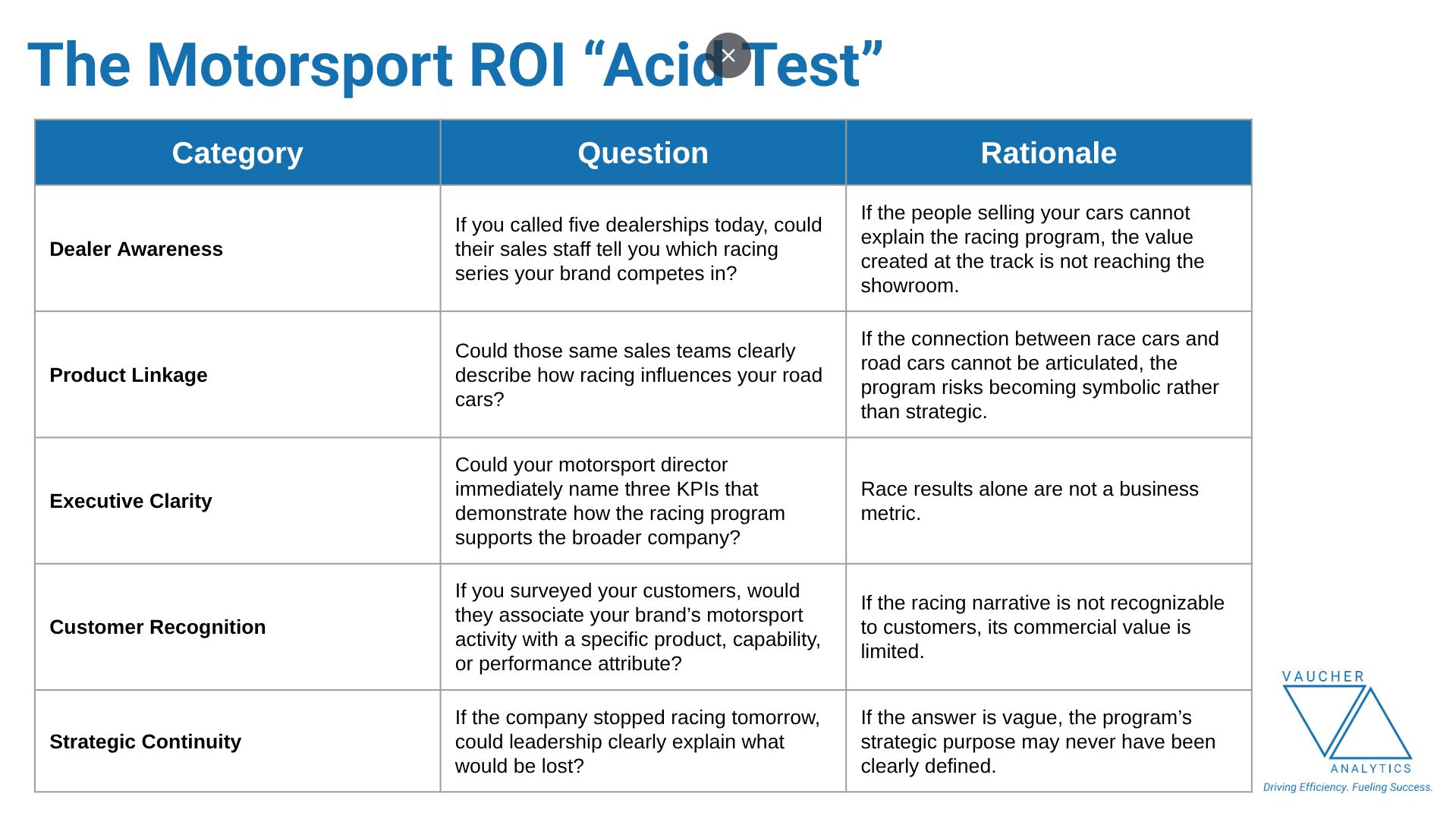
Before discussing playbooks, activation strategies, or ROI frameworks, there is a simple way to assess whether a motorsport program is actually integrated into the business.
Ask five straightforward questions.
If the answer to most of them is no, the program is destined for the chopping block.
Dealer Awareness
Question: If you called your five most successful dealerships today, could the majority of their sales staff tell you which racing series your brand competes in?
Rationale: If the people selling your cars cannot explain the racing program, the value created at the track is not reaching the showroom.
Product Linkage
Question: Could those same sales teams clearly describe how technologies, engineering lessons, or performance narratives from racing influence your road cars?
Rationale: If the connection between race cars and road cars cannot be articulated, the program risks becoming symbolic rather than strategic.
Executive Clarity
Question: If you asked your team principal or motorsport director right now, could they immediately name three business KPIs that demonstrate how the racing program supports the broader company?
Rationale: Race results alone are not a business metric.
Customer Recognition
Question: If you surveyed your customers, would they associate your brand’s motorsport activity with a specific product, capability, or performance attribute?
Rationale: If the racing narrative is not recognizable to customers, its commercial value is limited.
Strategic Continuity
Question: Finally, if the company stopped racing tomorrow, could leadership clearly explain what would be lost, in brand perception, technology credibility, dealer energy, or customer engagement?
Rationale: If the answer is vague, the program’s strategic purpose may never have been clearly defined.
Baselin
Establishing The Baseline
Passing or failing the acid test is only the starting point. Knowing where you want to go is important, but knowing precisely where you started is what allows motorsport to be managed as a strategic investment rather than an act of faith.
Before any effort to “better leverage” a motorsport program begins, leadership must establish a clear baseline of how the program currently performs across the business.
That means documenting, as objectively as possible, the present state of brand perception, dealer engagement, customer activity, partner value, technology narratives, and internal alignment around the racing effort.
Without this baseline, improvement becomes impossible to measure: initiatives may create real value, but the organization will have no way to prove it, and skeptics will assume nothing has changed.
Better motorsport leverage
How Can We Leverage Our Motorsport Program “Better”?
The answer is not nearly as straightforward as the question, because before a brand can leverage motorsport more effectively, it has to define:
What/who the program is actually for
What kind of value it is supposed to create
Who inside and outside the company it is supposed to influence
How that value is meant to enter the commercial system
Without that clarity, even a winning program can become an expensive, if still glorious, money-sink.
The answer to the question of how to leverage motorsport better is a playbook, which does far more than outline, for instance, how to “do more marketing around racing”.
Multi-faceted problem
Leveraging Motorsport Effectively Is A Multi-Faceted Problem
When a CEO says, “We have a motorsport program, but we are not leveraging it enough,” that is not yet a defined business problem.
It is an observation, and that observation can hide several very different issues.
No Proof-To-Halo mechanism: In some companies, motorsport creates awareness and prestige but fails to influence purchase behavior. The racing program may be strong, yet customers do not see a convincing connection between the race cars and the road cars.
No motorsport “Big Picture”: In other organizations, going racing is treated as a cost center or PR exercise rather than as a commercial platform. Sponsorship, hospitality, fan monetization, licensing, and customer experiences remain weak, so the program looks like pure spend.
No technology transfer: In certain instances the problem is technology transfer. Motorsport can accelerate work in aerodynamics, battery systems, software, thermal management, lightweight materials, and simulation, but race engineers and road-car engineers operate in separate worlds. The company talks about “technology derived from racing” without any visible proof, and certainly no communication to mainstream consumers.
Unadapted audience fit: In other cases, the issue is audience fit. The fan base of the series may not overlap much with the brand’s customer base, which means the program is not a direct acquisition channel at all. It may still have strategic value, but the logic needs to be re-evaluated.
Unadapted reporting strategy: Very often the issue is simpler than all of that; the automotive company does not measure the right things. It tracks race results, media impressions, and maybe sponsorship value, but not dealer traffic, configurator activity, event-to-purchase conversion, owner engagement, talent attraction, technology adoption, merchandise revenue, or brand premium. The result is predictable: the company concludes that motorsport is hard to justify because it never built the machinery to capture or measure what the program actually produces.
So the core truth is this: the problem is rarely that the racing program creates no value.
The problem is that the organization has no structured way to define, extract, and scale that value.
Don’t want to be left behind?
Subscribe to Business Of Motorsport — the newsletter from Vaucher Analytics covering actionable motorsports strategy
Strategic justification
Start With the Strategic Justification, Not the Activation
Most companies naturally rush straight to activation ideas because it’s tangible and it’s what their competitors are doing as well; they want more social content, more hospitality, more trackside experiences, more influencers.
Those ideas matter, but they are secondary; indeed, the first question is far more fundamental:
Why does this company race at all?
Motorsport typically survives inside a major automotive brand for four strategic reasons:
The first is brand permission: Racing proves that the brand deserves to be seen as premium, high performance, serious, or technically credible.
The second is as an engineering showcase: Racing functions as a live demonstration that the company can develop, test, and refine advanced systems under extreme conditions.
The third is the customer ecosystem: Motorsport creates owners, enthusiasts, communities, experiences, and aspirational pathways into the brand.
The fourth is corporate signaling: Racing helps the company signal ambition, engineering seriousness, and relevance to talent, partners, governments, investors, and the board.
If leadership cannot clearly choose the primary reason, the program is usually running on heritage, habit, ego, or internal politics rather than strategy.
That matters because different strategic logics imply different success definitions:
A Ferrari-style model uses racing to justify myth, exclusivity, and pricing power.
A Porsche-style model uses it to feed a customer ecosystem of track experiences, clubs, performance identity, and loyalty.
A Mercedes-AMG style model uses it as a halo platform to reinforce performance credibility across the product range.
A Toyota-style model can use it to strengthen engineering and durability credibility.
A Red Bull model treats motorsport first and foremost as a content and media platform, which in turn helps sell a product that has nothing inherently to do with racing at all.
These models are only examples, what matters is that any brand looking to leverage motorsport better has a strategic model in mind at all.
Tangible outcomes
What Does “Better” Motorsport Leverage Produce Tangibly?
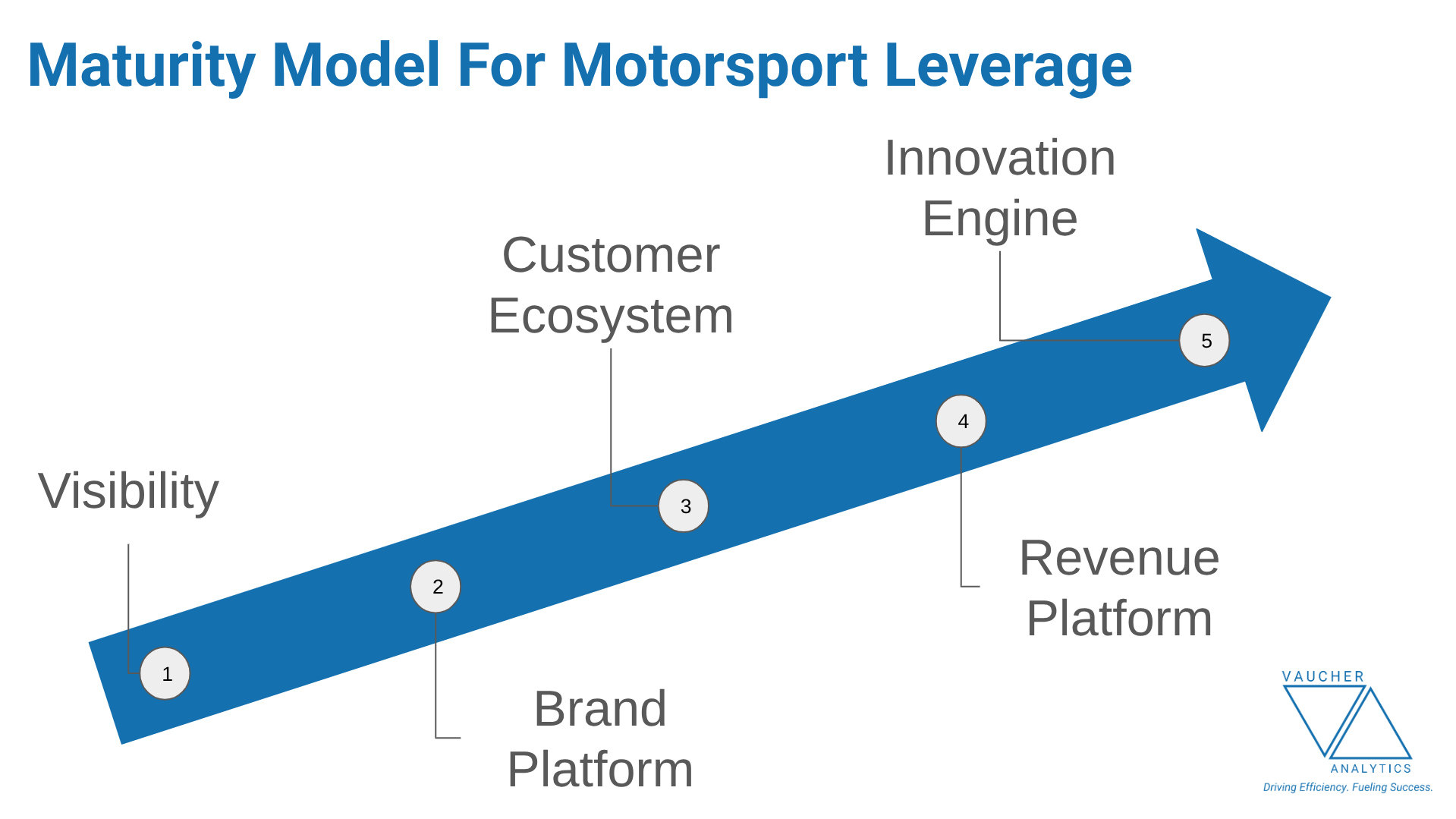
Most motorsport programs can be placed on a maturity ladder.
At the lowest level, racing is treated as visibility. The company buys exposure and hopes some halo effect happens.
The next level treats racing as a brand platform with more deliberate storytelling and identity linkage.
Higher still, the program becomes a customer ecosystem through events, experiences, communities, and owner pathways.
Above that, it becomes a revenue platform through sponsorship, customer racing, licensing, hospitality, and content.
At the highest level, motorsport functions as an innovation engine integrated into the broader business, the two are inseparable (Toyota’s evolution over the past decade or so is a good example).
The best-known motorsport brands tend to operate at the top end of this ladder. The average OEM often thinks it is higher on the curve than it really is.
The phrase “better leverage” is meaningless until it is translated into a desired change in behavior.
A motorsport program should not be judged only by exposure (outlined by the four reasons above explaining why brands go racing). It should be judged by what it causes:
Does it increase willingness to pay?
Does it make customers more likely to consider the brand?
Does it push more people into dealerships on race weekends?
Does it make a performance sub-brand feel culturally relevant again?
Does it help customers believe that the brand’s EVs, hybrids, or software-defined products are genuinely performance-led (especially in light of competition from aggressively priced Chinese EVs)?
Does it help dealers sell, or upsell?
Does it help recruit better talent?
Does it help attract partners?
This is where many programs fail. They measure what the race team did, not what the business did differently because the race team exists.
A useful executive discipline is to force leadership to complete one sentence:
“This motorsport program is successful if it results in ______ within ______ years.”
That sentence matters because it reveals succinctly whether or not the motorsport program is associated with a long term strategy, or any strategy at all.
Brand overlap
Are Motorsport Fans Potential Buyers Of Your Brand?
This is the first hypothesis to test before a single CAD drawing is completed, because not every motorsport audience overlaps strongly with a brand’s buyers.
For brands like Ferrari or Porsche, that overlap is relatively high. For broader or more mainstream brands, or for Chinese EV manufacturers who are looking to create their own on-track narratives, it may be much weaker.
That does not mean a racing program is not worth pursuing, but it does mean the value logic changes. Instead of direct customer acquisition, the program may function more as narrative infrastructure, dealer energy, engineering proof, or corporate signaling.
This is why leadership needs to understand the fan-to-buyer relationship and overlap clearly, and then evaluate a plan to generate ROI from there.
Time horizon
The Time Horizon Problem
An aspect beyond the results themselves is the timeline in which those results appear, and motorsport as it relates to commercial rather than financial goals is often judged on the wrong time horizon.
Some value streams move quickly. Sponsorship deals, hospitality income, and merchandise programs can show results within one or two seasons.
Dealer activations and customer events can create near-term commercial movement. But fan ecosystem development, brand premium, technology credibility, and cultural relevance are slower.
They compound over years, not months.
This is one reason brands get confused and frustrated before ultimately giving up: they build or inherit a racing program that might matter over a five-to-ten-year horizon, then demand proof on an annual planning cycle.
That is not “financial discipline” but category error, a fundamental, upfront misunderstanding of the investment thesis.
Even the most storied racing programs have experienced setbacks and periods of wasted spending, but the bigger picture is that they stayed in the game and built their reputations over decades of participation.
Wasted money or not, the investment was undoubtedly expensive, and if a company evaluates a long-term brand platform like a three-month YouTube ad campaign, the analysis will be wrong from the start.
ROI types
The Different Types Of Motorsport ROI
If “better” leverage from a racing program comes from what behaviours and actions it causes, across multiple settings, it follows that no one metric will indicate efficient use of racing spend.
A major source of confusion in boardrooms is that executives talk about ROI as if it were one metric.
It is not.
Motorsport creates several different types of return, and mixing them together (if they are even defined at all) creates an incomplete picture of the value of going racing in the short-term, which in the long-term brings up the risk of exiting a series, or racing generally.
Financial ROI is the simplest. This includes direct revenue from sponsorship, licensing, customer racing, experiences, hospitality, factory tours, merchandising, and content.
Commercial ROI is broader. It includes revenue influence through dealer traffic, conversion uplift, B2B relationships, partner acquisition, and product sales that are helped by racing activity.
Brand ROI is more indirect but often more powerful. This is where motorsport supports pricing power, desirability, premium perception, and willingness to pay. Strategic ROI is the longest-term and often the hardest to prove with clean attribution. This includes talent attraction, technology legitimacy, regulatory relevance, corporate signaling, and the long-build effect of brand myth.
Most companies make a basic mistake in mixing measured metrics with observable results. For instance, they try to prove short-term financial ROI for a program whose main output is actually brand or strategic ROI.
That is how good programs get killed by bad framing.
Value stack
Motorsport Is A Value Stack, Not An Isolated Marketing Channel
The most useful way to think about racing is as a layered business system. Motorsport does not create one kind of value. It creates several, at once:
At the strategic layer, leadership defines why the company races and what role the program plays.
At the platform layer, motorsport produces assets: content, physical infrastructure, fan communities, brand mythology, and technology knowledge.
At the technology layer, it converts racing knowledge into production engineering, product proof, and innovation storytelling.
At the activation layer, the company pushes those assets into the market through events, retail, products, digital content, and customer programs.
At the monetization layer, it captures direct revenues from sponsors, experiences, licensing, customer racing, content, and premium services.
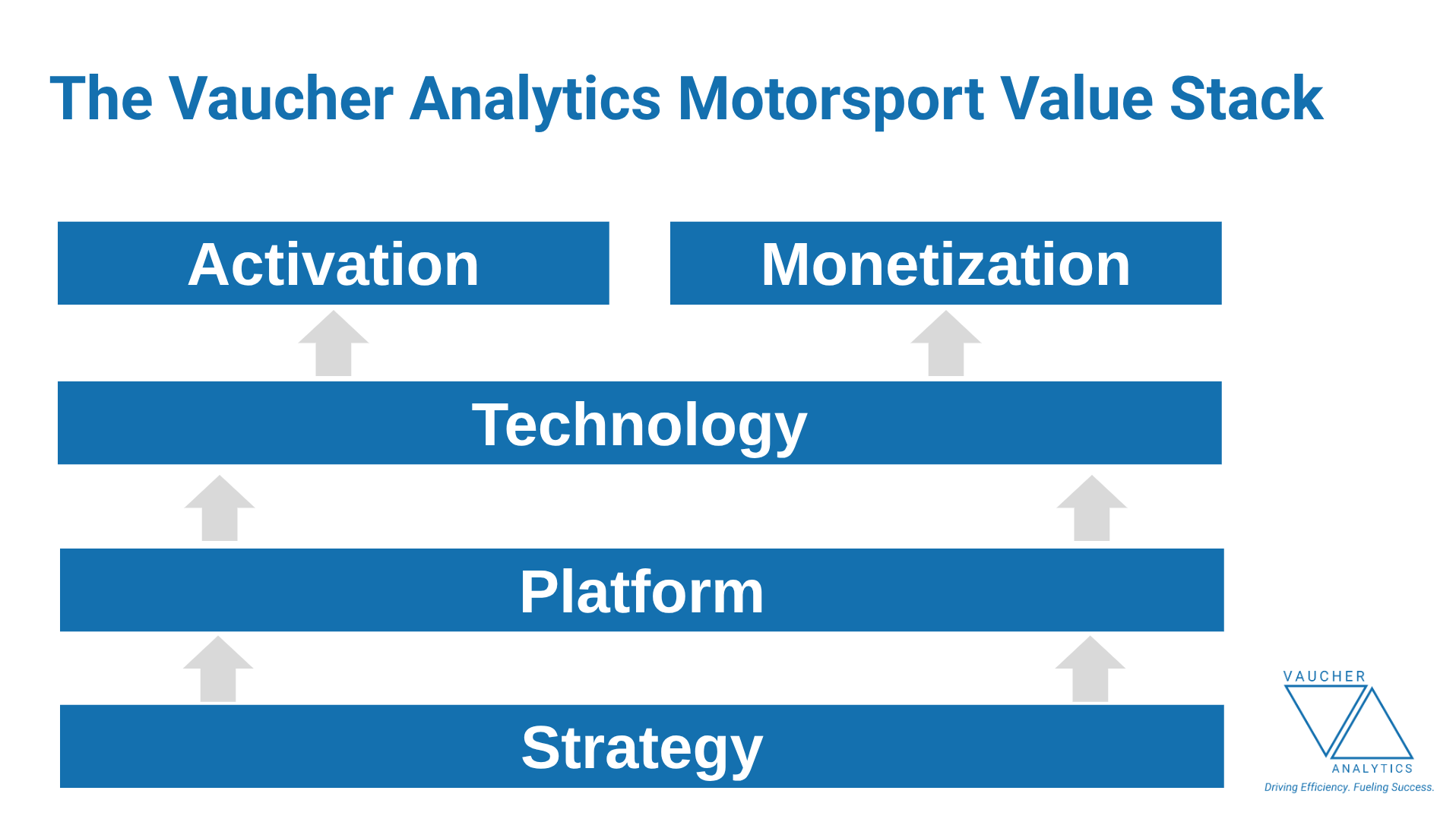
Most brands operate with more or less success in one or two of these layers, and that is why motorsport looks expensive: all the layers are not accounted for to maximize value capture.
The strongest brands work across all of them, and that is why these brands are inseparable from the idea of motorsport. The commercial consequence is that they don’t so much sell cars as they have customers that buy them.
Winning leveraging
“Winning” Is Not The Same As “Leveraging”
It’s possible that someone reading this will think: “I have to set up all this internal infrastructure, and that’s before I even get to the hard work of winning on-track?”
You might be surprised to hear that being the series champion and beating your competitors is not necessarily part of leveraging motorsport effectively.
This distinction needs to be stated bluntly because too many executives still confuse the two, and in fact, if brands can get away with being mid-tier competitors, it’s precisely because they have done the work of setting up all the necessary corporate infrastructure.
Winning races can help, there’s no doubt; success amplifies proof, prestige, media attention, and internal morale.
But winning is not the same as leveraging.
A company can win and still fail commercially if it never converts the moment into product storytelling, customer experiences, dealer activation, sponsor value, or technology credibility. Success on-track does not guarantee a continued presence on-track, as Porsche illustrated recently when it announced it was leaving the WEC.
Another brand can have more modest on-track performance and still extract enormous business value because it built the system around the program properly (and of course, as its successes snowball, the program can secure more funds that allow it to become more and more competitive in later seasons).
A racing program creates business value when it changes perception, behavior, and economics in the company’s favor.
Trophies help, but they are not the system.
Activation
Activation: Where Motorsport Meets The Market
Once the strategic logic and asset base are clear, activation becomes the visible part of the playbook, and the idea is for every aspect of the race and showroom experiences to reinforce each other mutually.
If the race-car and the road-car lineup never speak to each other, the value transfer stays weak, but conversely if they do, the synergies will be material.
The objective is straightforward: convert fans into prospects, and prospects into customers.
Race weekends should be treated as live showrooms, not isolated sporting events:
The brand should have road cars onsite, especially the models that are supposed to benefit from the racing halo
Technology exhibits should explain in concrete terms how race engineering connects to road-car development
Customer drives, VIP hospitality, product demonstrations, media hosting, and influencer events should be built around race weekends
Dealerships should not be disconnected from the racing program:
Race cars should appear in showrooms when possible
Dealerships should host race-viewing events
Race footage should be visible in the background of the retail environment
Trophies, engineering displays, historical material, and motorsport-themed zones can all reinforce performance heritage
Showroom storytelling should connect racing achievements to real product features
Salespeople should be able to explain the motorsport link clearly, not vaguely
Product activation matters just as much:
Motorsport editions, race-inspired colors and liveries, track-focused packages, telemetry-driven apps, limited runs tied to major results, and launch calendars aligned with race moments all help close the gap between the race program and the product line.
Content
Motorsport Is About Content That Dwarfs The Actual Racing
Activation does not have to happen in person, and one of the biggest changes in modern motorsport is that competition alone no longer maximizes value.
Motorsport has become a content engine, and anyone with a passing interest in Formula 1 knows that it’s possible to engage far, far more deeply with the sport than simply watching a given race; though there is only one Drive To Survive, that hasn’t stopped other series from seeing such an initiative as a viable effort to reach a broader audience.
Digital activation is now mandatory because motorsport is no longer just a competition platform but rather the starting point of almost limitless content.
This is why teams and brands that understand entertainment logic can outperform those that think race results alone will carry the message. A strong content studio around the program can generate documentaries, digital series, engineering features, driver stories, technical breakdowns, and social clips that keep the brand culturally present between races and between seasons.
Of course, drivers should not be treated as mere athletes; in many cases they are brand media assets with real influence potential and going back to a previous point, they don’t have to be the most successful on-track to be the most engaging.
Customer community programs deepen the relationship further.
Owner track days, driving academies, racing schools, factory tours, paddock access, simulator competitions, VIP clubs, and performance-focused owner experiences all move racing from spectacle to participation.
This is where aspiration becomes loyalty, and it’s that access that can drive synergies even further, but it is absolutely critical that every one of these initiatives be planned upfront.
With the overall strategy for the race program set (including the target audience), an appropriate communications plan should be set with relevant metrics and desired outcomes.
Real life access
Fans Want Real-Life Access As Well
A parallel shift is that audiences increasingly want access, not just observation, so there has to be a bridge from the digital world to the physical world in which motorsport can create strong experiences.
The more a brand can move people closer to the action, the more likely it is to build emotional depth, data capture, advocacy, and monetization (that is especially true for Gen Z which is feeling more and more “digital fatigue”).
That has implications for brand strategy. Simulators, paddock experiences, garage tours, factory visits, owner clubs, track time, coaching, race-weekend hospitality, and digital community programs matter because they turn the fan relationship from passive to active.
This is also why sim racing and esports matter. Yes, they are digital experiences, but for many audiences, gaming is not a sideshow to motorsport. It is both an entry point and an ongoing passion, so a modern brand cannot ignore that pathway if it wants long-term relevance.
Additional strategic factors
Additional Strategic Factors
The Dealer Economics Layer
Dealerships play a critical role in turning motorsport from a distant spectacle into something customers experience directly. If racing is meant to become part of a brand’s DNA, the retail network must be deeply involved in the initiative.
When dealers actively participate in motorsport activation, they gain powerful tools that can energize the showroom environment and strengthen their relationship with customers, and racing naturally creates moments that dealerships can use to engage audiences.
Race weekends, major victories, and championship narratives provide built-in occasions for customer events, showroom activations, and storytelling around performance heritage. Displaying race cars, hosting viewing events, or highlighting the connection between competition technology and road cars can generate excitement and draw enthusiasts into the dealership environment.
This dynamic also supports the commercial side of the business. Motorsport narratives can help sales teams explain performance features more convincingly, reinforce the value of higher-spec models, and create momentum around performance variants, special editions, and track-oriented options. In other words, motorsport can help dealerships sell not just vehicles, but the brand’s performance identity.
Because of this, motorsport should not be treated as something that exists only at the factory or the race track. The retail network is one of the primary places where the racing story becomes tangible for customers. When dealers are fully integrated into the program (through events, showroom experiences, and coordinated marketing) the impact of motorsport extends far beyond the paddock and into the everyday customer journey.
For this reason, the dealer dimension deserves careful attention when evaluating the business impact of a racing program. Metrics such as showroom traffic during race weekends, attendance at motorsport-themed events, engagement with performance models, and the effectiveness of motorsport storytelling at retail can all help reveal how racing supports the broader commercial ecosystem of the brand.
The Cost Structure Problem
Leverage depends not only on what value motorsport can create but on where the money actually goes.
In major OEM programs, engineering and R&D command significant budget allocations because brands assume that if they race, they must race to win.
Frequently lost in this competitive arms race is that the marginal cost of extra places at the top of the rankings table climbs steeply, not only in terms of direct, technical spending but also in terms of commercial opportunity costs.
If a brand is spending hundreds of millions on competition and only a fractional amount on activation, retail integration, content, customer experiences, and monetization capability, it should not be surprised when the program looks under-leveraged.
Indeed, under those conditions, under-leveraging is not an accident but an expected outcome.
Put in consumer packaged goods terms: from toothpaste to soda, every product requires marketing support. If motorsport is the product a brand is selling, why would it not require its own marketing campaign?
Governance and Decision Rights
A surprising number of motorsport programs fail not because the race team is weak, but because nobody truly owns the value platform:
If motorsport sits only under marketing, the technology side is lost
If it sits only under engineering, the commercial side is lost
If the race team is too autonomous, brand and retail integration remain weak
If finance only sees cost lines, the strategic logic never gets translated into the right metrics
The solution is appropriate governance, decided upfront. One single point of accountability needs to own the platform across commercialization, activation, integration, and measurement.
This does not have to be one person necessarily. There could be a steering committee made up of representatives from all the functions named above, with the ability to evaluate a motorsport program’s ROI cross-functionally, and take quick actions accordingly.
Without decision rights and coordination, value leakage becomes structural.
Organizational Silos Are the Real Enemy
A corollary to the need for a unified steering committee is that a motorsport program should in no way be separate from the “regular” functions of an automobile brand.
Benchmarking: Learn From the Right Archetype
Competitive benchmarking is essential, but it needs to be done properly. The goal is not to copy superficial tactics. It is to understand the strategic model.
The real question is not “what are our competitors doing?” The real question is “which model are we actually trying to emulate, and is it coherent with who we are?”
Without that clarity, brands mix strategies and dilute the message.
Portfolio Strategy Across Racing Series
All of these tenets become important when a manufacturer competes in multiple championships, and all the relevant parties should be crystal-clear as to the ROI of each and every grid position across a variety of series.
Every series presents opportunities to convey different messages:
Formula One tends to emphasize global prestige, celebrity, and scale of visibility
Endurance racing can emphasize engineering credibility, reliability, and technological seriousness
Formula E supports EV narratives, software, and electrification positioning
Rally reinforces toughness, durability, and real-world capability
GT racing and customer racing are especially strong for owner engagement and enthusiast ecosystems
The decision should not be driven only by audience size or executive taste. The real question is which series best proves what the company needs the market to believe:
A rugged, utility-oriented brand may gain more from rally-style proof than from polished prestige
A performance EV strategy may require a different motorsport logic than a heritage combustion story
A luxury brand seeking myth and aspiration will need yet another different platform
Portfolio coherence matters. If the narratives across series conflict, the whole motorsport presence becomes muddled and ROI suffers.
Risk Management and Downside Control
Boards care about upside, but they also care about risk, and motorsport participation brings several beyond what the drivers face.
Among these risks:
There is sporting risk: poor performance can reduce marketing impact
There is reputational risk from crashes, controversy, driver behavior, governance issues, or broader crisis events
There is regulatory risk because series rules, cost structures, and technical direction can change, leading to switching costs
There is strategic obsolescence risk if the company remains invested in a form of racing that no longer matches its product future
This does not mean companies should avoid risk entirely, rather they should recognize that motorsport is not only a value platform but also a live exposure platform.
That requires governance, scenario thinking, and proactive preparation.
Talent, Regulation, and Corporate Signaling
Some of the most valuable effects of racing are not immediately visible in sales data.
A serious motorsport program can attract elite engineers, simulation specialists, control-systems talent, software developers, aerodynamicists, and creatives who want to work where performance is taken seriously.
It can also strengthen the company’s credibility with partners, suppliers, and institutions. In the right contexts, it supports regulatory narratives around innovation, sustainability, or advanced technology. That can matter during periods of industrial change such as electrification.
These effects are real even when they do not show up neatly in an attribution model.
They can certainly be boiled down to a number, but executive teams must nevertheless keep in mind the qualitative benefits of such effects.
Measurement: What a Serious KPI System Looks Like
A major racing program should have a measurement system that reflects how it actually creates value.
Brand metrics should include awareness, consideration, desirability, and premium perception
Commercial metrics should include dealer traffic, event conversion, configurator activity, sales of motorsport-linked products, partner development, and experience revenue
Fan ecosystem metrics should include database growth, engagement, repeat participation, and community depth
Technology metrics should include transfer rate, adoption into production, development speed improvements, and the visibility of the narrative externally
Talent and employer-branding metrics may matter too
Just as important, the company needs to know who reviews these metrics, how often, and what decisions they inform; every tracked metric should inform action to be taken for its relevant functional area.
Failure modes
The Typical Failure Modes
When a motorsport program fails to create enough business value, the causes are usually familiar:
The company treats racing as marketing only and ignores its role as platform, proof, community, and technology engine
The race cars and road cars are weakly connected
Dealerships are barely integrated into the campaign
The technology narrative is vague
The content machine is weak
The audience fit is misunderstood
Measurement is not sufficiently rigorous
Functions operate in silos and nobody owns the whole system
The program is judged on the wrong time horizon
Internal politics cloud strategic clarity
Capital Allocation Discipline and Exit Logic
A mature motorsport strategy requires not only enthusiasm but discipline.
Leadership should review the portfolio regularly and ask:
Are we in the right series?
Is the scale of spending aligned with the value logic?
Are we building the right capabilities around activation and monetization?
Are we making progress on the outcomes that justified the program in the first place?
What are the conditions under which we would expand, reposition, reduce, or exit?
This matters because some brands exit quickly, while others allow racing programs to become legacy spending that continues simply because it has always existed.
That is not strategy, it is waste, purely and simply.
Exit planning therefore matters as well.
If a company ever leaves a series, it should understand how to do so without signaling weakness, panic, or strategic confusion.
Good exits reposition around a new narrative, preserve heritage value, and maintain continuity where necessary.
Bad exits look like retreat, but exits done well can absolutely create a credible new strategic narrative.
The “Stop Racing” Test
One of the cleanest diagnostics in the whole subject is also the simplest.
What would materially break if the company stopped racing tomorrow?
There are several cases to consider:
If the answer is that brand prestige would erode, racing is brand infrastructure, which is actually not a terrible place in which a company can find itself. If this is the case, there should be other pathways to generate funds and exiting should only be the most distant of options.
If engineering credibility would weaken, racing is a technology platform, and with Chinese EVs competing heavily on technology, management of the brand exiting a racing series should have a solid plan on how to mitigate the gap that will almost certainly close between it and new competitors.
If dealers would lose energy and differentiation, racing is retail support, so these dealers should be consulted early and openly about any such decision as leaving motorsport, wholly or partly.
If partnerships would suffer, racing is a commercial relationship platform.
These all imply some sort of loss if motorsport efforts are scaled back, so consider the hardest question of all:
What happens if nothing is expected to change?
Then the company needs to ask what the program actually achieves other than incorrectly allocating capital, and quick exit is a valid option to prevent further waste.
Conclusions
Conclusion
Motorsport remains one of the most powerful strategic tools available to an automotive brand because it combines proof, myth, access, and platform in a single system. It can validate engineering, create emotional desire, energize dealers, attract talent, support premium pricing, build communities, generate revenue, and feed a modern content machine.
But none of that happens automatically.
If a company cannot explain why it races, who it is trying to influence, what behavior it wants to change, how the racing program connects to products and customers, and how the resulting value will be measured and captured, then the problem is not leverage.
The problem is strategic ambiguity.
And if that ambiguity persists, motorsport becomes what skeptics always say it is: expensive, hard to justify, and vulnerable when budgets tighten.
When the strategy is clear, the organization is integrated, the assets are activated, and the value system is real, motorsport becomes something else entirely: it becomes a durable engine of brand power, commercial opportunity, innovation, and competitive advantage.
That is what it means for an automotive brand to truly leverage motorsport.
Are you ready to optimize your motorsport potential?
At Vaucher Analytics, we help manufacturers and racing organizations turn motorsport investment into brand, commercial, and strategic value.
If you’re serious about making your motorsport team or series matter beyond the podium, let’s talk.
Book your 30-minute discovery call by contacting us today:
Through our website’s contact form, or
Via email at contact@vaucheranalytics.com
Main image credit: Edgar via Unsplash