

History rarely repeats itself exactly, but it often rhymes.
In the 1970s, two major oil shocks bookended the decade, causing a considerable shift in the automotive market of the time, particularly in the US.
Indeed, the US was known for producing large displacement muscle cars which, while impressive, were not fuel efficient. If consumers believed the worst was over after the 1973 crisis, the 1979 oil shock likely forced them to reconsider their usual choices and give smaller, more fuel-efficient Japanese cars a chance.
The result was one of the most consequential shifts in automotive history: Japanese automakers rapidly gained credibility, market share, and eventually global leadership.
Today, another period of oil price volatility is raising an interesting question: could the current moment do for Chinese electric vehicle (EV) manufacturers what the oil crises of the 1970s did for Japanese carmakers?
The parallels are not perfect, but they are certainly striking.
The parallels between the current energy shock and the transformation of the automotive industry are visible both on the road and on the race track.
The 1970s Oil Shocks and the Rise of Japanese Automakers
Before the oil crises of the 1970s, Japanese cars had already begun entering Western markets, with models like the Toyota Corolla and the Datsun 510 gaining a foothold in export markets, particularly in North America and Europe.
However, these vehicles were rarely viewed as aspirational products; Western consumers often regarded them as inexpensive economy cars rather than serious alternatives to domestic brands.
Fuel prices changed that calculation almost overnight.
When oil prices spiked and shortages appeared across the Western world, consumers suddenly prioritized fuel economy in a way they never had before, simply because they never had to.
Large V8-powered sedans that had dominated American roads became expensive to operate, and smaller, more efficient cars suddenly looked attractive.
Japanese manufacturers were perfectly positioned for this shift: their vehicles were designed around efficiency and practicality rather than size and power.
Their cars had attributes that made them attractive in the immediate term, but they had to have something else to help them maintain their foothold, in the long-term, and in fact this competitive advantage (and the perception of it) persists to this day: reliability.
The reputation of Japanese vehicles for durability and dependability spread rapidly. While Western manufacturers were struggling with quality control issues, Japanese automakers were implementing disciplined manufacturing systems such as the Toyota Production System, which emphasized continuous improvement and defect reduction.
In short, fuel economy brought customers through the door, and reliability ensured they never left.
Over the following decades, Japanese manufacturers expanded their presence dramatically, eventually launching luxury divisions such as Acura, Lexus, and Infiniti.
What began as a small-car export strategy ultimately reshaped the global automotive hierarchy, with Japanese brands frequently topping best-reviewed or most-sold lists around the world.
The Quartz Protocol: A Playbook For Legacy Automakers to Leverage Motorsport Against the Competition From Chinese EVs
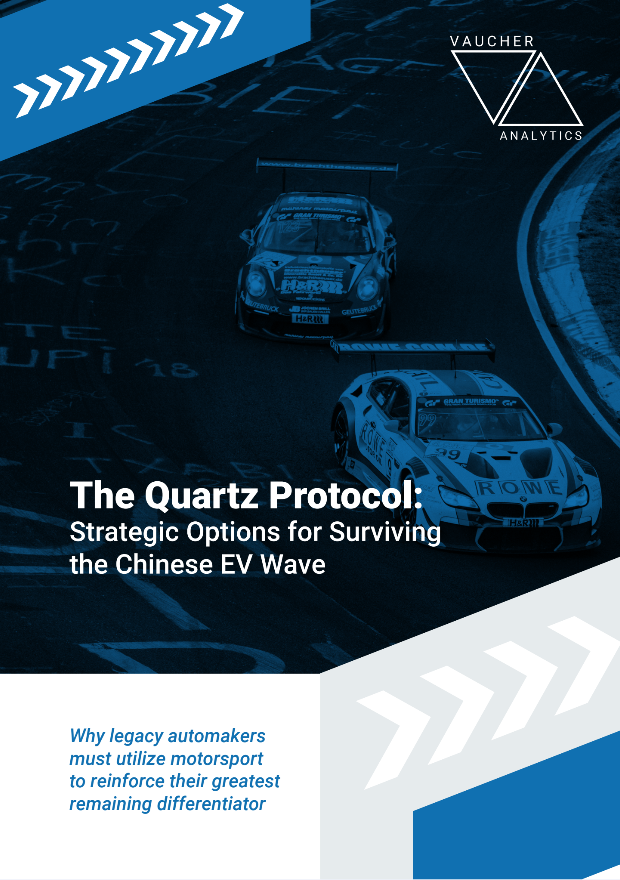
A practical framework (the Motorsport Value Capture Matrix) to see whether your brand is actually converting racing “proof” into consumer “halo”, or funding performance that never reaches the customer.
A clear strategic argument for why legacy OEMs can’t out-commodity Chinese EVs, and why motorsport-led emotion is their last defensible moat.
Tools for action, including a 10-question self-assessment plus a concrete audit approach to identify where motorsport value is lost in your racing program.
Oil Price Volatility Is Back
In 2026, conflict in the Middle East is once again causing upwards volatility in the oil market, raising concerns about inflation, fuel costs, and economic stability.
The oil price volatility and economic turbulence of the 1970s confirmed that when purchasing power is squeezed, consumers begin to scrutinize the cost of operating their vehicles.
This creates conditions that are remarkably similar to those that existed in the 1970s, with the key difference being that the disruptive technology is no longer small, efficient gasoline engines from Japan.
It is electric vehicles, likely aggressively priced models from China.
Chinese manufacturers have already developed a formidable cost advantage over much of the global, legacy auto industry, with companies such as BYD, SAIC Motor, and Geely building massive scale in production thanks to vertically integrated supply chains.
Just as past oil shocks were the “perfect storm” necessary to reveal the advantages of new entrants to the vehicle market, a modern period of sustained and acute oil price volatility could permanently highlight the advantages of Chinese EV platforms.
The Modern Equivalent of Reliability
In the 1970s, the hidden advantage of Japanese cars was reliability.
Today, reliability is largely a baseline expectation across the industry, so modern vehicles from most major manufacturers are dependable and such statistics form an integral part of the research done by vehicle-shopping consumers.
EVs nevertheless present another historical parallel, an attribute already praised by early adopters that could become widely appreciated if the current oil price volatility leads to increased adoption.
Electric vehicles are mechanically simpler machines than internal combustion cars; they contain fewer moving parts and require less routine maintenance.
Owners of EVs typically avoid many of the traditional service requirements of gasoline-powered vehicles; over time this translates into fewer trips to the dealer and lower total operating costs.
In this sense, operating simplicity may play the same role in the EV era that reliability played during the rise of Japanese cars. It is not always the first factor consumers consider, but it becomes increasingly important once they experience it firsthand.
Don’t want to be left behind?
Subscribe to Business Of Motorsport — the newsletter from Vaucher Analytics covering actionable motorsports strategy
A Critical Difference: Industrial Policy
Despite the strong historical parallels, there is one major difference between the 1970s and today, because one could make the case that the major automobile markets are today more closed off to Chinese EVs than they were to Japanese small cars.
During the rise of Japanese automakers, Western markets were relatively accessible to foreign competitors. Japanese vehicles were able to compete directly with American and European brands and it was only when their competitive credibility, dismissed prior to more widespread consumer adoption, was realized that governments and industry bosses started to take note.
In 1981, under pressure from Washington, Japan agreed to voluntary export restraints that limited the number of cars it could ship to the United States. These measures were protectionist in practice, but they still allowed Japanese manufacturers to maintain a meaningful presence in the U.S. market.
Today’s situation appears more restrictive:
Tariffs of 100% on Chinese electric vehicles effectively shut them out of the American market altogether unless manufacturers of these vehicles can build up an adequate in-country supply and manufacturing base
Canada only recently made certain concessions with respect to EVs as part of a broader trade deal
The European Union is in discussions with China concerning EV tariffs while also taking steps to shore up its own manufacturing base against cheaper Chinese alternatives
Nevertheless, of the major automotive markets, the US is the most closed off and the current administration is loathe to pursue any form of non-combustion transportation, even going so far as to roll back steps taken by previous administrations to raise fuel efficiency standards.
As a result, the global automotive industry may not experience a single unified disruption. Instead, the world could be splitting into distinct automotive ecosystems.
Two Emerging Automotive Worlds
If energy prices remain volatile and electrification continues to accelerate, the global market could begin to diverge.
In many regions, including China, Europe, Southeast Asia, and Latin America, electric vehicle adoption is likely to continue growing. These markets combine strong environmental policies, high fuel prices, and access to Chinese EV supply chains.
In these regions, while legacy automakers will of course sell their own EV options. However, Chinese manufacturers, with their advantageous cost structure, may become the dominant exporters of affordable electric vehicles, and therefore become established entities in the transportation markets, much as Japanese automakers became highly-respected vehicle manufacturers in the second half of the 20th century.
At the same time, other markets may evolve differently.
The United States remains heavily protected from Chinese EV imports. Even if there is latent consumer demand for affordable EVs, whether that be out of preference or necessity when faced with high energy prices, a breakthrough seems unlikely due to these protectionist measures.
The Real Strategic Battleground: Batteries
While oil prices may accelerate consumer interest in electric vehicles, the deeper structural shift lies elsewhere.
In the 1970s, the key technological advantage was engine efficiency, but keep in mind that a third party, the Middle East, was providing, or preventing, access to energy supplies in the form of oil.
Today, the critical technology is battery manufacturing, and China has a sizeable advantage here as well in addition to manufacturing the vehicles themselves.
In this sense, the modern equivalent of Japan’s manufacturing discipline may be China’s battery ecosystem, and this may cause the country to gain significant control over the global transportation landscape.
When Energy Shocks Reveal Industrial Advantages
Looking back, the oil crises of the 1970s did not create Japanese competitiveness, but rather revealed it by forcing consumers to consider what these manufacturers might have to offer.
Japanese manufacturers had already built efficient production systems and competitive vehicles. The oil shocks simply forced consumers to try them.
Once they did, the shift in market perception became permanent.
The same dynamic may be unfolding today and if legacy automakers aren’t ready to respond with an attractive value proposition to consumers looking for price relief, they may find their market share permanently ceded to Chinese manufacturers who are ready now.
In fact, there is a second parallel worth noting. The oil crisis of the 1970s did not just make efficient Japanese road cars more attractive; it also helped shape the motorsport ecosystem that turned brands like Toyota into cultural icons.
In that more constrained environment, TOM’S emerged, earned factory backing, and became central to Toyota’s motorsport rise. Over time, that partnership helped create the rivalries, victories, and mythology that cemented Toyota (and other Japanese brands) not just as a maker of sensible cars, but as a serious performance brand. That is the deeper lesson: macroeconomic shocks can open the door, but motorsport helps turn market entry into legend, and it wouldn’t be surprising at all to see similar trajectories from Chinese EV brands seizing the opportunities presented to them today.
Broadly speaking, if oil prices remain elevated for a sustained period, the day-to-day economics of electric vehicles will become increasingly difficult to ignore, as will the cost competitiveness of Chinese EVs.
Half a century ago, that advantage belonged to Japan.
Today, it may belong to China, and consumers may once again be poised to discover the advantages of a dynamic new market entrant.
Is the legacy automobile market ready?
Main image source: Wikipedia
Are you ready to optimize your motorsport potential?
At Vaucher Analytics, we help manufacturers and racing organizations turn motorsport investment into brand, commercial, and strategic value.
If you’re serious about making your motorsport team or series matter beyond the podium, let’s talk.
Book your 30-minute discovery call by contacting us today:
Through our website’s contact form, or
Via email at contact@vaucheranalytics.com
Disclaimer: No commercial relationship or endorsement exists between TOM’S, Toyota and Vaucher Analytics, image is used purely for illustrative purposes.