The rumor that should terrify legacy automakers
Reports surfaced on March 10th that BYD is exploring an entry into Formula One as well as endurance racing, these should be treated as a flashing warning sign for legacy automotive brands.
Many legacy automotive brands today sell cars based on their decades of investment on the race track; going racing created mythology, mythology created brand equity, and brand equity allowed manufacturers to charge prices above what objective specifications alone would justify.
If that sounds like the pricing strategy for luxury goods - sell the dream not the product - that’s exactly what it is. In the face of growing competition from aggressively priced Chinese EVs, it is a strategy that legacy automakers will have to adopt even more strongly to stay ahead, maybe just to sell cars, full stop.
Chinese electric vehicle manufacturers have disrupted many parts of the automotive industry in recent years. They have challenged incumbents on cost, production scale, battery technology, and speed of innovation.
Until now, however, they have largely stayed out of the one arena that sustains the emotional dimension of automotive brands: global motorsport.
The Quartz Protocol: A Playbook For Legacy Automakers to Leverage Motorsport Against the Competition From Chinese EVs
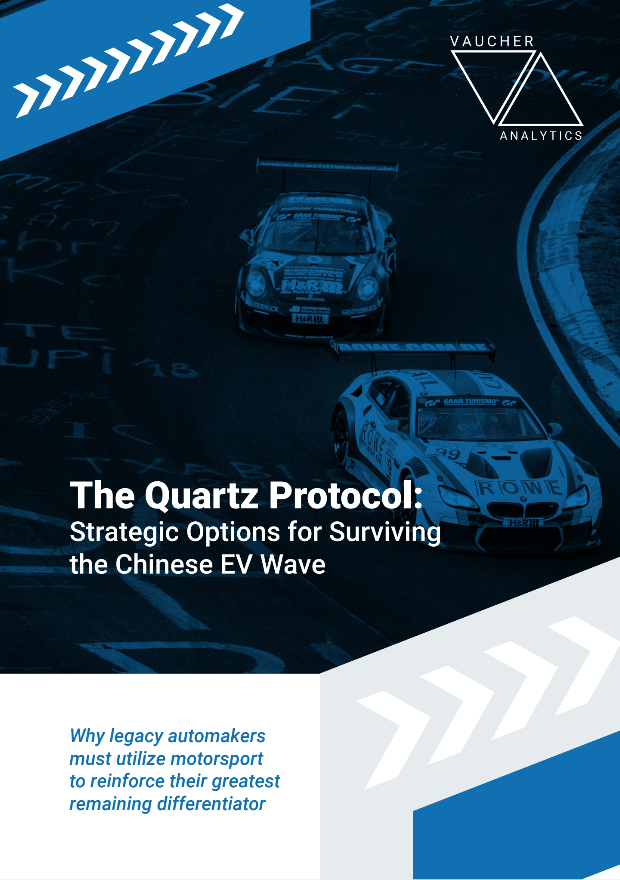
A practical framework (the Motorsport Value Capture Matrix) to see whether your brand is actually converting racing “proof” into consumer “halo”, or funding performance that never reaches the customer.
A clear strategic argument for why legacy OEMs can’t out-commodity Chinese EVs, and why motorsport-led emotion is their last defensible moat.
Tools for action, including a 10-question self-assessment plus a concrete audit approach to identify where motorsport value is lost in your racing program.
The Chinese EV Challenge Is Already Structural
The rise of Chinese electric vehicle manufacturers is not simply a matter of new competitors appearing in a crowded market. It represents a structural shift in how cars are designed, manufactured, and brought to market.
Chinese EV leaders operate with advantages that legacy automakers cannot easily replicate: vertically integrated supply chains, close coordination with domestic battery ecosystems, rapid product iteration cycles, and cost structures optimized for electric platforms from the outset (along with, of course, government support and laws which don’t look like those in historical automotive production centers).
These advantages make direct competition on traditional industrial metrics extremely difficult. Attempting to beat Chinese manufacturers on price or production velocity is unlikely to succeed for established brands.
As argued in The Quartz Protocol, the global automotive industry is experiencing a dynamic similar to the disruption that quartz technology brought to Swiss watchmaking in the 1970s. When Japanese manufacturers introduced highly accurate, battery-powered watches at dramatically lower prices, the Swiss could not win the competition on objective performance. Their survival depended on redefining what watches represented: not tools, but objects of desire.
Automakers today face an analogous choice.
They can either attempt to compete with Chinese EV manufacturers on commodity metrics such as price, software features, and hardware specifications, or they can pivot toward emotional differentiation and brand mythology.
Motorsport has historically been the engine of that mythology, serving to build the industry’s emotional infrastructure.
Indeed, victory at Le Mans reinforced Porsche’s identity as a benchmark for engineering excellence. Dominance in Formula 1 helped cement the performance credibility of Mercedes-Benz AMG. Rally success turned Subaru and Mitsubishi into cultural icons among enthusiasts.
These stories are only a tiny handful among so many, and they were not merely marketing exercises. They became foundational elements of brand equity, enabling manufacturers to sell road cars at premium prices while maintaining customer loyalty and cultural relevance.
Motorsport created what might be called the “soul” of automotive brands.
Chinese manufacturers lack the historical presence required to participate in that mythology, but that will not be the case for long.
Today, their products compete on price and features, and perhaps for a time still they will be perceived as appliances, tools for transportation, rather than aspirational objects.
That perception gap could function as an invisible shield for legacy automakers, but a serious Chinese entry into Formula 1 would begin to erode that shield.
Don’t want to be left behind?
Subscribe to Business Of Motorsport — the newsletter from Vaucher Analytics covering actionable motorsports strategy
Why a Hypothetical BYD Formula 1 Entry Would Matter Far Beyond Racing
If BYD were to enter Formula 1, the implications would extend well beyond the addition of another team to the grid.
It would signal that Chinese EV manufacturers are beginning to address the final weakness in their global brand strategies: emotional legitimacy.
In Western markets, consumers still associate motorsport with engineering excellence, performance credibility, and technological leadership, and participation in Formula 1 carries symbolic weight that extends far beyond lap times. It is a very expensive gamble, certainly, but the calculus is obvious
For a company like BYD, which already commands enormous manufacturing scale and technical capability, a racing program would serve as a cultural accelerator.
It would allow the company to reposition itself not merely as a producer of efficient electric vehicles, but as a technologically sophisticated performance brand capable of competing on the most prestigious stage in automotive engineering, against some of the biggest brands in the world.
And that narrative will be even more pronounced if they participate in endurance racing, which features an even greater number of manufacturers.
In other words, motorsport could transform Chinese EV companies from efficient challengers into aspirational competitors.
The moment Chinese brands begin building racing mythology, the industry’s historical hierarchy begins to collapse.
At that point, legacy automakers can no longer rely on heritage alone to justify premium positioning, and they will compete directly with companies that may already hold structural advantages in cost, production speed, and supply chain integration.
Racing will no longer be a “nice to have” activity when times are good, it will literally become existential in the long run.
There is no time to waste either, because with oil prices spiking in March 2026, customers may be starting their EV research now for a purchase down the line. If a Chinese EV looks good on paper, what will stop them from making that choice?
Legacy Automakers Must Have a Plan To Go Racing, And Make the Most Of Their Campaigns
For many legacy automakers, motorsport has long been treated as a marketing expense that can be expanded or reduced depending on economic conditions.
That mindset is increasingly risky.
As functional differentiation between vehicles narrows, especially in the electric vehicle era, the emotional dimension of automotive brands becomes more important, not less.
Motorsport provides one of the few scalable ways to generate that emotional differentiation at a global level.
If Chinese manufacturers begin to build their own racing narratives while legacy brands retreat from competition or fail to translate racing success into product strategy, the balance of cultural power in the industry will shift.
And once that shift occurs, it will be extremely difficult to reverse.
Brand mythology compounds over decades. It cannot be rebuilt overnight.
The window for legacy brands is closing and the strategic implication is straightforward but difficult to face: motorsport should no longer be viewed as a discretionary activity justified primarily by marketing exposure or engineering experimentation.
It must instead be treated as a core element of brand strategy and competitive positioning.
Racing programs must be integrated into product development, marketing architecture, dealer activation, and long-term brand storytelling.
The companies that treat motorsport as a systemic asset will strengthen their ability to defend pricing power and maintain cultural relevance.
Those that treat it as entertainment risk watching competitors, perhaps including Chinese EV manufacturers, capture the narrative terrain that once belonged to them.
The Next Phase Of Global Automotive Competition
The global automotive industry is entering a new phase.
The first phase of the EV transition revolved around technology: batteries, software, and manufacturing scale.
The second phase will revolve around culture.
If Chinese EV manufacturers begin competing in global motorsport, they will no longer be fighting solely on the industrial battlefield, they will also be competing for the emotional loyalty of drivers and enthusiasts worldwide.
That competition could redefine how the next generation of consumers perceives automotive brands.
For legacy automakers, the lesson is clear: the moment Chinese manufacturers begin building their own racing mythology, the industry’s final psychological advantage begins to disappear.
And if that happens, the last automotive advantage for legacy automotive brands may disappear with it.
Are you ready to optimize your motorsport potential?
At Vaucher Analytics, we help manufacturers and racing organizations turn motorsport investment into brand, commercial, and strategic value.
If you’re serious about making your motorsport team or series matter beyond the podium, let’s talk.
Book your 30-minute discovery call by contacting us today:
Through our website’s contact form, or
Via email at contact@vaucheranalytics.com
Main image source: Michael Marais via Unsplash