

Formula E’s Moment: Why Rising Energy Prices Could Make Electric Motorsport Strategically Essential For Automakers
For most of its existence, the ABB FIA Formula E World Championship has existed in an unusual position within global motorsport. It has attracted major automotive manufacturers, global technology partners, and races in some of the world’s largest cities, yet it has often struggled to convince motorsport fans that it belongs alongside established championships.
But judging Formula E purely as a racing product may miss the point entirely.
The championship was not created primarily to compete with other motorsports for entertainment value. It was designed as a strategic platform for electrification, one that connects automotive manufacturers, energy companies, and urban mobility ecosystems around the transition to electric vehicles.
If global energy markets shift again, that strategic positioning could suddenly become extremely important.
With geopolitical tensions pushing oil prices upward and consumers once again confronting rising fuel costs, the conditions that accelerate electric vehicle adoption may be returning. If that happens, the decade-plus of investment automakers have made in Formula E could finally deliver its intended value.
Because Formula E was built for exactly this moment.
The Quartz Protocol: A Playbook For Legacy Automakers to Leverage Motorsport Against the Competition From Chinese EVs
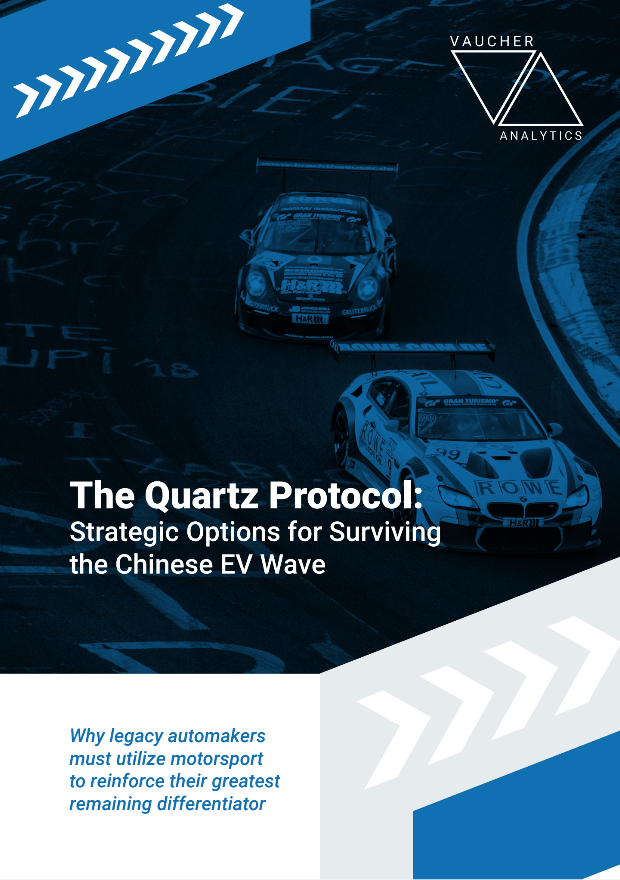
A practical framework (the Motorsport Value Capture Matrix) to see whether your brand is actually converting racing “proof” into consumer “halo”, or funding performance that never reaches the customer.
A clear strategic argument for why legacy OEMs can’t out-commodity Chinese EVs, and why motorsport-led emotion is their last defensible moat.
Tools for action, including a 10-question self-assessment plus a concrete audit approach to identify where motorsport value is lost in your racing program.
Energy Shocks Have Reshaped the Auto Industry Before
History shows that disruptions in global energy markets can rapidly reshape the competitive landscape of the automotive industry.
The oil crises of the 1970s fundamentally altered consumer preferences. As fuel prices soared, buyers began prioritizing efficiency and reliability over size and power. Japanese manufacturers such as Toyota, Honda, and Nissan were well positioned to meet that demand. Their smaller, fuel-efficient cars gained global popularity, dramatically shifting market share away from traditional American and European manufacturers.
This historical precedent illustrates an important principle: energy shocks can accelerate technological transitions already underway.
Today, a similar dynamic may be emerging around electrification.
Rising gasoline prices are already encouraging some consumers to reconsider electric vehicles as a way to reduce operating costs. Recent reporting shows that high fuel prices are pushing more drivers to explore EV ownership, particularly as they seek protection from volatile energy markets.
In other words, the same economic mechanism that accelerated the rise of fuel-efficient Japanese cars in the 1970s could now accelerate the adoption of electric vehicles.
If that happens, the strategic landscape of the automotive industry will shift once again.
And when it does, the importance of platforms that showcase electric performance and innovation should grow significantly, but will they?
Don’t want to be left behind?
Subscribe to Business Of Motorsport — the newsletter from Vaucher Analytics covering actionable motorsports strategy
Formula E Was Created for the Electrification Era
Unlike most racing series, Formula E was not built around an existing motorsport tradition.
It was created specifically to promote electric mobility and accelerate innovation in electric powertrain technology. Since its inaugural race in Beijing in 2014, the championship has served as a testbed for EV development and a global showcase for electrified performance.
Over the past decade, the series has evolved rapidly. The current generation of race cars, known as Gen3, represents the most advanced electric racing platform yet, capable of producing 350 kW of power while recovering significant energy through regenerative braking, and Gen4 is expected to be even more capable when it debuts for the 2026-2027 season.
This focus on efficiency and energy management reflects the engineering challenges that define modern electric vehicles.
In fact, Formula E’s technology is designed around precisely the same parameters that matter for road EVs: battery efficiency, software-driven energy management, regenerative braking systems, and power electronics.
Manufacturers participating in the championship have repeatedly emphasized that this technical relevance is the primary reason for their involvement.
DS Automobiles, for example, states explicitly that its long-term engagement in Formula E exists to prepare the brand for the future of electrified mobility and to transfer lessons learned from racing directly into road cars.
These statements reveal an important reality: Formula E participation is not intended to be simply a marketing exercise.
It is meant to be embedded within corporate strategies focused on electrification, but that isn’t necessarily obvious from the consumers’ point of view.
A Motorsport Platform Built Around Electric Performance
Formula E’s manufacturer roster further illustrates its strategic role.
Over the years, the championship has attracted participation from some of the most prominent names in the automotive industry, including Porsche, Jaguar, Nissan, and several brands within the Stellantis group such as DS Automobiles and Maserati.
Major technology partners have also joined the ecosystem.
The championship’s title sponsor, ABB, is one of the world’s leading electrification and energy technology companies. ABB’s involvement highlights the broader industrial context of Formula E, linking the series not only to automotive development but also to energy infrastructure and urban electrification systems.
This combination of automotive manufacturers and energy technology firms reflects Formula E’s underlying mission: to serve as a global platform demonstrating the potential of electric mobility.
Unlike traditional racing championships that focus primarily on speed and spectacle, Formula E emphasizes efficiency, software innovation, and energy management, precisely the areas that will define competition in the electric vehicle era.
Audience Growth Suggests the Platform Is Gaining Momentum
Despite persistent skepticism from some motorsport fans, Formula E has continued to grow its global reach.
According to the championship, Season 11 achieved a cumulative television audience that exceeded 500 million viewers worldwide while also recording its largest digital audience and fan base to date.
Attendance across race events has also been strong, reflecting growing interest in the series’ unique urban racing format.
While Formula E may still trail more established championships such as Formula 1 in viewership, the trajectory is important.
It demonstrates that the platform already possesses significant global visibility; visibility that automotive manufacturers can leverage to communicate their commitment to electrification.
Why Rising Energy Prices Could Make Formula E Strategically Relevant
For much of its history, you could make the case that Formula E has existed somewhat apart from the broader automotive market, but as it turns out, it was just ahead of it, and this has been put into stark relief by current events.
When the championship launched in 2014, electric vehicles were still a relatively small segment of global car sales. While EV adoption has grown steadily over the past decade, the transition has been uneven, influenced by factors such as government incentives, charging infrastructure, and battery costs.
Energy prices, however, can dramatically accelerate that transition.
When gasoline prices rise sharply, consumers begin reassessing the economics of internal combustion vehicles. Electric vehicles become more attractive not only for environmental reasons but also for financial ones.
If energy markets remain volatile, or if geopolitical tensions continue to threaten oil supply, EV adoption could accelerate more rapidly than many analysts expect.
The urgency becomes clearer when considering the competitive landscape facing legacy manufacturers. Indeed, China’s EV manufacturers are expanding rapidly, and in many markets their growth has been constrained more by trade policy than by consumer demand. Legacy automakers will need an emotional connection to differentiate themselves, because on specifications and price, they are at a disadvantage.
Somewhat ironically, they can have this with the racing platform that is criticized for not creating these emotions.
Formula E as a Strategic Signaling Platform
For automakers, motorsport has always served as more than just entertainment.
Racing is a signaling mechanism.
Participation is about creating entertainment for fans, certainly, but it also communicates technological leadership, engineering capability, and brand identity; for decades, championships such as Formula 1 and Le Mans have served as platforms where manufacturers demonstrate performance credentials to customers and investors alike.
In the electrification era, Formula E fulfills a similar role.
The championship provides a visible stage where manufacturers can demonstrate their commitment to electric performance and innovation.
This symbolic value becomes especially important in a competitive landscape increasingly influenced by new entrants.
Chinese electric vehicle manufacturers, for example, are rapidly expanding their global presence. Companies such as BYD have already established themselves as major players in EV production and technology.
If these emerging manufacturers eventually expand into global motorsport, they could challenge one of the last symbolic advantages legacy brands still hold: motorsport credibility (as it turns out, it was rumored recently that BYD may be looking to enter Formula 1, and Nio was active in previous seasons).
In that context, Formula E becomes more than just another racing series.
It becomes a strategic asset in the broader narrative battle over the future of automotive performance.
The Risk of Walking Away Too Early
Over the past decade, some manufacturers have entered and exited racing series, Formula E included, as corporate priorities shifted.
These decisions often reflected short-term financial considerations or changing marketing strategies.
But if energy markets accelerate the transition toward electrification, the strategic value of Formula E participation could increase significantly.
Automakers that have spent years building engineering teams, developing electric racing technology, and associating their brands with electric performance may find themselves uniquely positioned to benefit.
Walking away from the championship just as electrification becomes the defining story of the automotive industry would mean abandoning the platform that was built specifically to tell that story.
A Championship Built for the Moment Ahead
Formula E’s critics often judge the series against traditional motorsport benchmarks such as television ratings, race spectacle, or fan engagement.
Those metrics matter, but they may not fully capture the championship’s strategic purpose.
Formula E exists because the automotive industry is undergoing a fundamental technological transition.
It was created to accelerate innovation, showcase electric performance, and build credibility for electrified mobility.
For much of the past decade, the series has been preparing for a future that had not yet fully arrived.
But as energy markets shift and electrification becomes increasingly central to automotive strategy, that future may be approaching faster than expected.
If rising fuel prices accelerate EV adoption once again, Formula E’s role as the global stage for electric performance could suddenly become far more important than its current popularity suggests.
And for the manufacturers that have already invested in the championship, that moment may finally allow the platform to deliver the strategic value it was always meant to provide.
Are You Leveraging Your Formula E Investment Adequately?
For the manufacturers already competing in Formula E, the most important question may not be whether the championship is strategically valuable.
The more urgent question is whether they are extracting enough value from the investment they have already made.
Factory Formula E programs require 8 figure budgets annually once engineering development, operations, logistics, and marketing are included.
Yet in many organizations the racing effort remains largely isolated from the rest of the company. The team competes on track, marketing departments publish occasional race highlights, and the broader organization continues operating as if the racing program were simply another sponsorship asset.
Consider this: when was the last time you saw any of the brands who participate(d) in Formula E so far tie any of their on-track exploits back to their broader, sustained marketing efforts?
That approach, or, more accurately, lack of approach, leaves enormous strategic value on the table.
Formula E was designed as a platform connecting multiple parts of the electrification ecosystem: automotive engineering, energy infrastructure, urban mobility, and digital technology. When manufacturers treat the championship as merely a racing program, they fail to exploit its potential as a strategic communications platform.
The more useful way to evaluate a Formula E investment is not through podium finishes or television ratings alone, but through questions such as:
Is the program reinforcing the company’s electric performance credentials?
Are engineering insights from racing visibly informing road-car development?
Does the racing effort strengthen the broader electrification narrative of the brand?
In other words, the key metric is not whether the team wins races.
The real metric is whether the racing program strengthens the brand’s credibility in the electric era. The story Formula E lays out is right there: cutting edge electric cars made to operate at a high-level in the city.
Despite this, for manufacturers, the honest answer is that far more could be done to leverage their Formula E investments. At a time when every manufacturer now claims electric performance while continuing to advertise their cars in very similar fashions, motorsport remains one of the few arenas where those claims can be demonstrated tangibly, in exciting and unique ways.
What Should Brands Be Doing More Of?
If electrification accelerates again because of energy economics, Formula E could quickly become one of the most visible stages for demonstrating electric performance.
But that only matters if brands actively use the platform.
Too often, motorsport programs operate in isolation from the rest of the organization. The racing team competes, the communications department publishes race reports, and the broader brand strategy moves forward independently.
To extract strategic value from Formula E, manufacturers must think more holistically about how the platform supports their electrification story.
For example, Formula E should not exist only on the racetrack. It should appear in dealerships, product launches, engineering storytelling, and digital marketing.
Customers considering an electric vehicle purchase should encounter a clear narrative linking the brand’s racing activity to its road-car technology.
Similarly, engineering insights from the racing program should be communicated internally and externally. Energy management strategies, software innovations, and powertrain developments developed in competition provide powerful examples of technological leadership.
Even the physical presence of the racing program can be leveraged more effectively. Race cars appearing at dealerships, engineers participating in customer events, and racing data used in product demonstrations all reinforce the connection between motorsport and road vehicles.
In short, the goal should be to transform Formula E from a racing program into a strategic storytelling platform for electric performance.
When electrification becomes the defining competitive battleground of the automotive industry, that narrative advantage does matter; if companies themselves didn’t believe this, why would they be on-track in the first place?
Should Your Brand Be in Formula E?
For manufacturers not currently participating in Formula E, the strategic question is slightly different.
Rather than asking whether the championship is popular enough to justify entry, executives should consider whether the platform aligns with their long-term positioning in the electric vehicle market.
Formula E remains the only global motorsport championship built entirely around electric performance, so for brands attempting to establish credibility in the EV era, that platform may prove increasingly valuable, if they have a system in place to leverage and quantify that participation.
Participation signals commitment to electrification not only to customers, but also to engineers, investors, regulators, and industry partners. It places the brand within a global ecosystem of automotive manufacturers, energy technology companies, and urban mobility initiatives.
Of course, joining any factory racing series requires significant investment. Budgets must be justified against other priorities such as product development, marketing, and infrastructure.
But the strategic calculation should not be limited to short-term marketing exposure.
The more relevant question is whether participation helps shape the narrative of the company’s technological future.
In a market where electric vehicles are becoming central to competition between automakers, the ability to demonstrate electric performance and engineering credibility may prove more valuable than ever.
And if energy prices accelerate the global shift toward electrification, the importance of that narrative could increase dramatically.
The Strategic Question Ahead
Ultimately, Formula E forces automotive executives to confront a broader question.
If electrification becomes the defining story of the automotive industry, which brands will be seen as leaders in that transition?
Over the past decade, manufacturers have invested significant resources building a global electric racing platform intended to answer that question.
As energy markets shift and EV adoption accelerates, the moment may be arriving when that platform matters more than ever.
The real question now is whether the companies that built it are prepared to fully utilize it.
Are you ready to optimize your motorsport potential?
At Vaucher Analytics, we help manufacturers and racing organizations turn motorsport investment into brand, commercial, and strategic value.
If you’re serious about making your motorsport team or series matter beyond the podium, let’s talk.
Book your 30-minute discovery call by contacting us today:
Through our website’s contact form, or
Via email at contact@vaucheranalytics.com
Main image source: Rico Reynaldi via Unsplash