Alpine’s WEC Exit Raises a Bigger Question About the Value of Its Formula 1 Investment
This insight piece is adapted from “The Quartz Protocol” white paper, which can be downloaded via a call-out section below.
Alpine was built on motorsport.
Since its founding in 1953 by Jean Rédélé, the brand has been defined by its principles of lightness, agility, and the spirit of competition, principles reflected in some of the sport’s most demanding successes, from winning the inaugural World Rally Championship constructor’s title in 1973 to victory at the 24 Hours of Le Mans.
That heritage was central to Alpine’s relaunch in 2018 via the critically acclaimed A110, and has since been reinforced, again, through participation at the highest levels of global racing, including Formula 1 and the World Endurance Championship.
Recent developments suggest a strategic shift.
Alpine has announced its withdrawal from the WEC after the 2026 season, while its Formula 1 programme has been subject to persistent uncertainty, including speculation around a potential sale (rumors have named Chinese EV giant BYD).
This raises a fundamental question: can Alpine credibly position itself as a performance brand without continuing to build that performance on track?
The implicit bet is a risky one: that past success has created enough brand equity to sustain future demand.
Vaucher Analytics’ data suggests this is rarely the case. For a brand like Alpine, which apparently wants to become the “French Porsche”, is this viable, considering the Stuttgart brand is so desired today precisely because of its own on-track exploits?
Alpine’s exit from the WEC and its Formula 1 involvement highlight a failure mode that is easy to miss inside a racing organisation: it is possible to outspend your ability to convert attention into brand value.
Alpine may already be in that position, and, somewhat ironically, it is in fact following Porsche, which announced its own WEC departure in 2025.
Alpine is therefore an example of a brand that built a top-tier motorsport programme that generates a large standalone audience, without doing the only thing a corporate motorsport programme ultimately needs to do: establish a system whereby the motorsport programme enables the brand to sell more cars.
The data set collected for The Quartz Protocol highlights the gap in Alpine’s motorsport efforts: they are active on a global stage, but have not converted this to mass-market awareness. After a few years, to a board or a C-Suite, the racing programmes look like nothing more than frivolous spend rather than the marketing “cheat-codes” they should actually be.
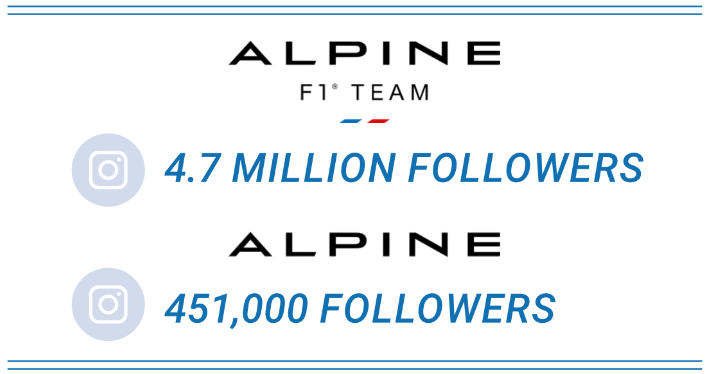
While social media followers are not a perfect metric, it is interesting to note that as of January 2026 the Alpine F1 team had roughly 4.7 million followers on Instagram (the WEC endurance programme added about 173,000 racing-focused followers), while the main Alpine brand account sat at around 451,000.
That is not a healthy proportion.
F1 involvement costs upwards of $200 million a year, excluding what’s not covered under the cost cap. For that investment, Alpine’s main brand can only convert 1 follower for every 10 that show interest in its F1 efforts.
This suggests that the racing audience is not being systematically converted into broader brand equity, brand following, and ultimately product demand.
It is even possible to hypothesize that the main brand’s social media following would be about the same even without the Formula 1 involvement (Lotus, a similar type of motorsport-focused brand, has over 900,000 followers, nearly double that of Alpine’s account).
If Alpine’s core brand audience would look largely the same without its Formula 1 involvement, then the programme is failing its primary commercial objective: it is not creating growth, only cost.
What makes this strategically uncomfortable is that, again, Formula 1 is not a marginal investment. It is a high recurring-cost platform that only makes sense if it accelerates a brand’s commercial ambitions: awareness, desirability, premiumization, and conversion.
At Formula 1 cost levels, even small inefficiencies in value capture translate into tens of millions in unrealized brand return, and with Alpine, it looks as if there are large oversights in how to take customers who may not even know that Alpine makes road cars on their journey to a dealership.
If Alpine had only an endurance programme, the relationship between racing audience and brand audience would look broadly coherent: proof and halo would be proportionate. That campaign would have been a good program to pilot before embarking on a larger F1 effort.
But Alpine has decided to leave the WEC, and when the F1 team’s following is an order of magnitude larger than the brand’s, the diagnosis is hard to avoid: the motorsport audience is being captured by the team as a standalone entertainment product, not by Alpine as a consumer brand.
Alpine is effectively subsidizing a global entertainment asset, Formula 1, it does not fully own commercially. It would be doing that anyway just by being on track, but it is not going the step further to leverage that exclusive platform to further its own marketing goals.
The Quartz Protocol: A Playbook For Legacy Automakers to Leverage Motorsport Against the Competition From Chinese EVs
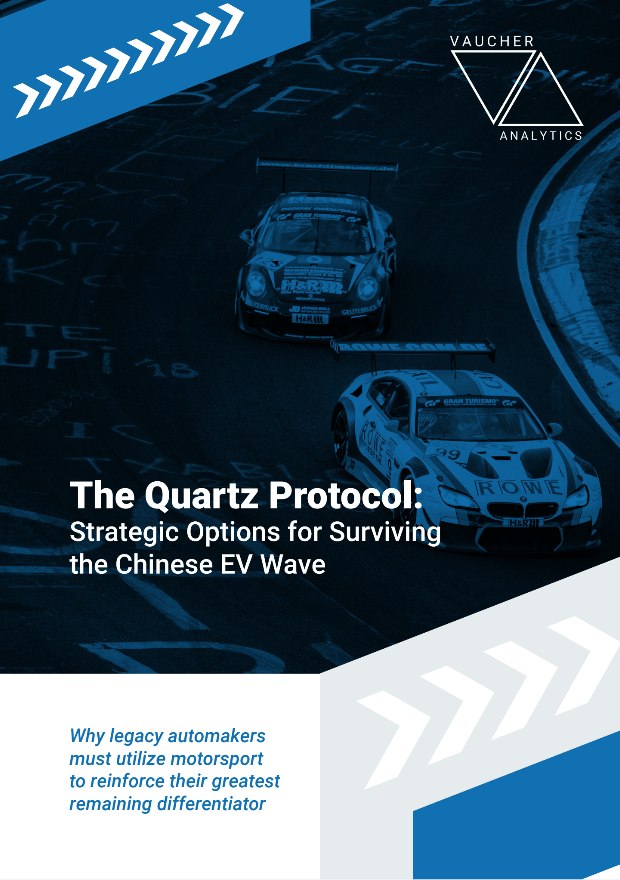
A practical framework (the Motorsport Value Capture Matrix) to see whether your brand is actually converting racing “proof” into consumer “halo”, or funding performance that never reaches the customer.
A clear strategic argument for why legacy OEMs can’t out-commodity Chinese EVs, and why motorsport-led emotion is their last defensible moat.
Tools for action, including a 10-question self-assessment plus a concrete audit approach to identify where motorsport value is lost in your racing program.
In contrast, Vaucher Analytics’ data indicates that Mercedes demonstrates what Alpine lacks: a system where motorsport visibility compounds brand equity instead of sitting adjacent to it.
The F1 team’s audience is large, but it sits at a more defensible relationship to the main brand’s scale, partly due to Mercedes’ broader equity, and also because the organization has decades of experience turning performance identity into a scalable brand asset.
The implication is not that Alpine should not be in Formula 1; the implication is that F1 without a strong translation architecture becomes an expensive way to build someone else’s audience.
There is work to do, because this is now the situation in which Alpine finds itself:
The brand wants to go fully electric, with premium-priced electric vehicles, at a time when highly-spec’d, very competitively priced Chinese EVs are poised to enter global markets in full force
The way to address this should be textbook application of the luxury industry’s playbook, creating desire. In the automobile industry, this is done on the racetrack, and Alpine is either pulling away from or not leveraging its on-track activities.
Alpine also wants to enter the US market. This is the exact market F1 cracked to achieve its current trajectory and it therefore should be the perfect platform for Alpine’s efforts, and yet the brand’s F1 team finds itself entertaining rumors of a sale to, ironically enough, a Chinese EV giant.
Crucially, even while Alpine are currently under-converting their racing reach into masterbrand growth, the association is already translating into product-level traction: the data collected for the analysis in The Quartz Protocol suggests Esprit Alpine trims are taken up materially across new Renault models.
More importantly, the naming is the motorsport-led strategy in miniature: Alpine’s motorsport halo is being used to lend performance meaning and desirability to the wider range.
If the strategic intent is to grow awareness and desirability, then the spend needs to be matched by a conversion system: a clear performance ladder, product and option strategy that customers can buy into, and a content and retail pipeline that converts racing attention into purchase intent.
Without that, Alpine risks paying for global reach while capturing only a fraction of its potential return, especially when on-track results do not provide a compensating performance narrative.
It has already ceded what could have been a valuable equity builder in its WEC campaign, and its F1 program risks following the same path.
Are you ready to optimize your motorsport potential?
At Vaucher Analytics, we help manufacturers and racing organizations turn motorsport investment into brand, commercial, and strategic value.
If your motorsport programme is generating attention but not converting it into brand growth, the problem is not performance, it’s value capture.
Book your 30-minute discovery call by contacting us today:
Through our website’s contact form, or
Via email at contact@vaucheranalytics.com
Main image source: Thibault Lam Tran via Unsplash