
The recently published Quartz Protocol white paper rests on the thesis that Chinese EVs meet or exceed the objective metrics of legacy automakers’ offerings, so these established players must differentiate themselves by leveraging their heritage, which is usually built off of decades of motorsport participation.
This speaks to the sensibilities of consumers outside of China, but to the extent that China is the world’s largest car market, legacy automakers need to be competitive there, and now is the time to leverage motorsport to appeal to Chinese consumers as well.
The Chinese Motorsport Landscape
In the book The Future of Motorsports: Business, Politics and Society, contributor Ren Huitao gives an overview of a country whose lack of historical passion for motorsport does not appear to be a hindrance to a bright future for the industry; quite the contrary, despite a relative lack of interest up until now, the stage is set for a strong upswing in consumers attuned to all the emotional qualities that motorsport imbues on car culture, and indeed the broader popular culture.
First, it’s necessary to understand that motorsport in China has followed a fundamentally different path from its Western counterparts. It did not emerge from grassroots enthusiasm or decades of embedded racing culture, but from deliberate alignment with economic development, infrastructure expansion, and state coordination.
From early events like the Hong Kong–Beijing Rally to the establishment of Formula 1 in Shanghai in the early 2000s, motorsport has tracked closely alongside rising incomes, mass vehicle adoption, and rapid urbanization as part of the Chinese government’s plans for the country. It is telling that plans to develop motorsport and related infrastructure actually appeared in many official policy documents, including notably the 14th 5-Year Plan in 2021.
In short, European car culture developed naturally from the region’s significance as the birthplace of cars and the subsequent progression of consumer tastes, whereas China built the market first out of an economic need and a desire and is now layering motorsport on top of it.
The integration of motorsport into China’s greater economic strategy is the foundational pillar of the thesis that motorsport will eventually take off in a much larger way than it exists today, and policy remains the primary growth engine, with national strategies positioning motorsport as a lever for consumption, regional development, and industrial upgrading, particularly in the context of new energy vehicles.
To those in the West who view government involvement in any market with suspicion, it would seem as if motorsport were actually at a disadvantage in China, but make no mistake, the future will show otherwise.
China is not the first to follow this model. France, for instance, has the French Federation for Auto Sports (FFSA) which has successfully nurtured and guided several French drivers to sometimes historic results.
However, the FFSA is an isolated group with association to the French government, whereas the Chinese government will take a much tighter approach. The result is a model where racing is not just a sport or a media product, but an experience-driven platform tied directly to economic and technological objectives, and the indications so far are that China’s consumers and homegrown brands are absolutely responding.
The Quartz Protocol: A Playbook For Legacy Automakers to Leverage Motorsport Against the Competition From Chinese EVs
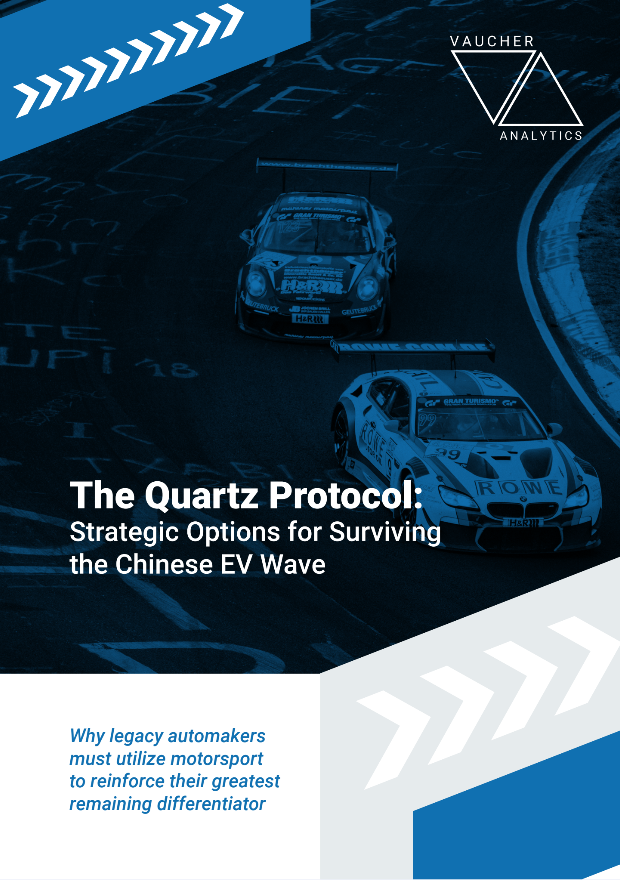
A practical framework (the Motorsport Value Capture Matrix) to see whether your brand is actually converting racing “proof” into consumer “halo”, or funding performance that never reaches the customer.
A clear strategic argument for why legacy OEMs can’t out-commodity Chinese EVs, and why motorsport-led emotion is their last defensible moat.
Tools for action, including a 10-question self-assessment plus a concrete audit approach to identify where motorsport value is lost in your racing program.
China’s Motorsport Moment Is Beginning to Take Shape
Relative to its importance as a consumer market, particularly for cars, motorsport in China is underdeveloped, and this likely has to do with how cars, and consumer goods specifically, have been consumed there for the past decades.
China started its ascent as “the world’s factory”, a somewhat derisive and dismissive term which acknowledged China’s ability to produce, but only what they were told to produce because they were a source of cheap labor; the idea that China would have a production base of its own, let alone that it could be capable of producing compelling products of its own volition wasn’t really considered.
Now, it is true that from the mid-20th century onwards, China did not have any global brands of its own to rival the Nikes, YSLs and Ferraris of the world, so as China’s consumer base grew, it was natural that particularly well-off Chinese consumers would go after those brands for the same reason that consumers elsewhere did: those brands stand for certain qualities, and the thinking was that if you bought into those brands, you would also be perceived as having those qualities as well.
Of course, China’s culture and crafts heritage is millennia old, and if China is still the world’s factory today, it is simply because their engineers and craftspeople are highly competent, so it is natural that the country is developing its own brands. And, crucially, these brands are now being chosen by Chinese consumers who, now wanting to express their own values rather than those imparted by Western brands, can support their country’s industries as part of their consumption decisions.
This is arguably no more pertinent and, for legacy automakers, no more pressing, than in the automobile market, and this should prompt a fundamental rethinking of what led to their success in the past.
Motorsport played a key role in building these mythologies, and recent signals point to a clear inflection point in China. Chinese interest in global motorsport is rising, not just in passive viewership but in relevance to broader culture and identity.
Chinese drivers such as Zhou Guanyu in Formula 1 and Ye Yifei, fresh off overall victory at the 24 Hours of Le Mans, are no longer symbolic participants; they are becoming anchors for national pride and narrative. The recent Shanghai Grand Prix 2026 provides an acutely clear picture of this growing interest:
The Chinese Grand Prix attracted a record 230,000 attendees, with ticket revenue up by over 30% from the previous year
Only 16% of the audience was from overseas
F1’s official data indicates that China’s fan base is over 220 million, nearly half of which are female
The majority of fans are under 35 years old
More than half of those Chinese fans started following the sport less than five years ago
Those two final bullet points imply significant lifetime value from those fans thanks to the emotions that motorsport creates, if it is leveraged properly.
Just like Chinese consumers started their pivot to homegrown consumer brands, Formula 1 is preparing to offer the same pivot.
Reports that BYD is exploring a potential Formula 1 entry are not an isolated curiosity, but rather they are a logical extension of China’s broader automotive ambitions. Chinese manufacturers are no longer content with competing on cost and technology alone; they are increasingly seeking legitimacy, desirability, and global brand status.
Motorsport sits directly at the intersection of those objectives.
The BYD Signal: A Catalyst, Not an Exception
The potential entry of BYD into Formula 1 should be understood in this context.
It is not simply a branding exercise or a speculative marketing move. It is a signal that Chinese automakers are evaluating motorsport as a strategic lever in their global expansion.
If one major player commits, others are likely to follow.
To be clear, Chinese automakers do already participate in motorsport around the world, but the result of a Chinese presence would be a further increase in Chinese participation across top-tier racing series, accompanied by parallel growth in domestic engagement, infrastructure, and media coverage.
For legacy brands, this creates a new layer of competitive pressure from new brands who would only be applying the same playbook companies such as Porsche, BMW and Ferrari have followed essentially since their inception.
Now, legacy automakers will find themselves no longer defending motorsport as a historical advantage in established markets. They are competing for relevance in a market where that advantage is still being formed, and where new entrants will shape the tastes of their home market.
The Macau Grand Prix is another example. This is primarily a GT event whose popularity has grown with the rising tide of motorsport generally; what happens when more and more Chinese fans take interest in this event on their home soil, and see, perhaps sometime in the near future, one of their own brands mixing it up with the usual Porsches, Ferraris and McLaren competitors?
The Strategic Shift: Legacy Brands Must Race For the Excitement of Chinese Motorsport Fans
Legacy automakers must not only race to defend themselves from Chinese brands globally, but they must also race and translate those efforts appropriately to remain competitive within the world’s largest automotive market.
China is not just another geography.
It is the largest car market in the world and increasingly a cultural export engine; what wins in China will not stay in China for much longer. Perhaps what South Korea saw happen to its image abroad via K-Pop will happen to China via its cars, and this is entirely plausible thanks to the combination of swelling domestic fandom coupled with the focus of China’s government, which has every incentive to deploy its might behind motorsport.
Indeed, K-Pop isn’t just music, it’s soft power. Cars are not just means of transportation, they are emotional objects and have been since their beginnings.
If there is a way for China’s cars to create enough delight in consumers around the world to soften its global image while also putting money in domestic companies’ bank accounts, the Chinese government will pursue that by every avenue possible, motorsport included.
From Structural Weakness to Strategic Advantage
China’s top-down, policy-influenced development model could be viewed as incompatible with motorsport’s traditionally bottom-up culture.
But, China’s economic rise demonstrates that country-wide plans dictated to a market economy can work, and in the current context, that model may become a decisive advantage.
China has demonstrated repeatedly that once an industry aligns with national strategic priorities (electric vehicles, batteries, solar), it can scale at a pace that outstrips global competitors.
The logic is simple:
Chinese automakers need global credibility and cultural cachet
Motorsport provides a proven pathway to both
The state and industrial ecosystem are capable of accelerating adoption
What was once an underdeveloped ecosystem can become, very quickly, a coordinated growth engine, so while legacy automakers pull out of motorsport to shore up share prices or dividends, Chinese companies will come in, eventually perform well enough to fill the emotional vacuum, and that mindshare (and subsequent market share) will be very difficult to get back.
In short, when (not if) Chinese manufacturers commit to motorsport in a serious way, the development curve will not be gradual, it will be highly compressed.
Desire Is the Real Battleground and If Chinese Brands Win There, The Game Is Over For Legacy Automakers
This matters because the competitive dynamic between legacy automakers and Chinese brands is shifting.
On purely functional dimensions of range, software, pricing, production speed, Chinese EV manufacturers are already highly competitive and many cases, they are setting the pace, and the price.
The remaining defensible territory for legacy brands lies elsewhere: desire, identity, and brand meaning.
Motorsport has historically been one of the most effective systems for creating that kind of differentiation. It provides:
Proof of performance under extreme conditions
Narrative continuity across generations
Emotional engagement that extends beyond the product
For legacy automakers, not being on track and telling those stories effectively will quickly become existential. It is no longer enough for car marketing to look interchangeable from one brand to another.
Motorsport as a Cultural Multiplier in China
The early signs suggest that motorsport in China will not necessarily replicate Western models, but rather it will integrate into a broader cultural and digital ecosystem.
Global fan data already points to a shift in how motorsport is consumed. Younger audiences engage continuously through social media, follow personalities as much as teams, and integrate motorsport into lifestyle and identity rather than treating it as a purely sporting event.
China is uniquely positioned to amplify this model.
Its digital platforms, influencer ecosystems, and rapid content cycles allow narratives to scale at extraordinary speed, all targeted at consumers who are gravitating towards luxury experiences.
When combined with national pride and industrial ambition, motorsport can become as much a cultural symbol as it is a sport.
This is where drivers like Zhou Guanyu and Ye Yifei matter. They are not just competitors; they are entry points into a broader narrative of Chinese participation and success at the highest levels of global motorsport.
A New Competitive Arena
China is emerging as a critical arena in the global competition for automotive brand power.
Motorsport, long underdeveloped in the region, is poised to grow as Chinese manufacturers seek to elevate their brands beyond functional value and into cultural relevance.
For legacy automakers, the implication is clear:
Racing is no longer just a tool for defending brand equity in traditional markets. It is a necessary investment to remain competitive in China itself.
Those that recognize this shift early can help shape how motorsport develops in the market, and secure a position within it.
Those that do not risk watching that ecosystem evolve without them.
Are you ready to optimize your motorsport potential?
At Vaucher Analytics, we help manufacturers and racing organizations turn motorsport investment into brand, commercial, and strategic value.
If your motorsport programme is generating attention but not converting it into brand growth, the problem is not performance, it’s value capture.
Book your 30-minute discovery call by contacting us today:
Through our website’s contact form, or
Via email at contact@vaucheranalytics.com
Main image source: Edward He via Unsplash