
Especially in this period of high oil prices, the difficult conversations in auto industry boardrooms are having to do with the transition from internal combustion engines (ICE) vehicles to electric vehicles (EVs).
This is certainly a massive shift, but on a fundamental level it’s still nothing more than swapping power trains.
Nevertheless, there are absolutely implications for the environment and the economies of entire countries, but my hypothesis is that EVs are actually just one step towards the seismically disruptive technology of fully self driving, autonomous cars.
While it might seem unimaginable now, especially if you love cars and car culture, it is absolutely possible to sketch out a rough roadmap that gets us to a world like the one seen in the movie Minority Report, where passengers buzz around in autonomous cars (flying ones, no less).
In broad strokes, that hypothetical journey would resemble this sequence:
The self-driving technology that we have today becomes more widespread, with hardware increasingly built into all car models but staying “locked” until activated via a subscription
As the technology continues to improve, it begins to show that it materially and positively affects accident, injury and mortality rates
Self-driving technology becomes mandatory, just as ABS was made mandatory decades ago
As self-driving cars become more capable, standards emerge allowing cars to not only navigate roads themselves, but also to communicate with other cars on the road; this leads to another step change in safety
Governments realize just how much money and human potential is being saved with these self-driving cars, and countries eventually ban all human-driven cars outside of track environments
This journey sounds even more plausible when you consider that any reservations we feel are, in fact, ours.
The generation born today will come of age with AI, and the thought of outsourcing a task to a machine will be no less strange to them than turning on the television is to us.
Furthermore, Kelley Blue Book data from 2023 indicates that customers who buy an EV are highly likely to stick with EVs for future purchases, on the order of 60%.
If this trend continues, in the coming future there will be a tipping point where, for the majority, there will be no going back, and this is the future in which younger generations will grow up: for them, a car will be an electric car, and the act of physically operating a moving vehicle will be seen as equally foolish as not wearing a seatbelt today, or as socially inconsiderate as smoking inside an elevator.
So, in this world, perhaps 50 years or so from now with the tipping points occurring sooner, cars will indeed be no different than Roombas: charging somewhere around town, waiting for a job to do, and then heading back autonomously to do it all over again, just like those famous appliances.
This is the point where we will see massive changes not just in the car market, but in society as a whole.
The Quartz Protocol: A Playbook For Legacy Automakers to Leverage Motorsport Against the Competition From Chinese EVs
A practical framework (the Motorsport Value Capture Matrix) to see whether your brand is actually converting racing “proof” into consumer “halo”, or funding performance that never reaches the customer.
A clear strategic argument for why legacy OEMs can’t out-commodity Chinese EVs, and why motorsport-led emotion is their last defensible moat.
Tools for action, including a 10-question self-assessment plus a concrete audit approach to identify where motorsport value is lost in your racing program.
1 - Simracing will become more prevalent as a means of experience preservation, and a potential pivot point for legacy automobile brands
In a previous insight piece covering what motorsport might look like in 2125, I spent a lot of time covering the importance of simracing; this is a field that is poised to gain even more importance to the broader car market outside of motorsport.
If society bans human-driven cars and only allows them on-track, the experience of car ownership becomes like that of horse ownership today: rewarding, but only for those who can afford it.
Everything that supports owning a car will be expensive, even more so than it is today. In a world with no manually operated cars, with only a relatively small number of them being ICE, the number of maintenance facilities shrinks, as does the availability of parts and of course, expertise becomes more and more scarce as time goes on.
So, from an individual consumer’s point of view, why not have a simulator instead, or even just as a complement to an actual, valuable car?
In 50 years, technology and manufacturing will have advanced to a point where software and hardware will simulate any race track or environment with a level of fidelity basically indistinguishable from reality, but…
Only provided the right people with the right expertise are working on the development of such equipment, exactly the types of people you’d find working today at legacy brand with motorsport heritage.
BMW’s slogan is The Ultimate Driving Machine; the word “machine” has until now been a stand-in for “automobile”, but why couldn’t the company lean on their expertise as engineers and manufacturers more broadly to make another type of driving machine?
2 - We will see companies pivoting in directions that seem unimaginable today
If we pull on the thread of BMW utilizing their core competency of engineering driving pleasure to develop high-end simulators, we end up with some truly astonishing lines of thought.
In Elysium, another enjoyable sci-fi movie, the antagonist is ferried from Earth to the movie’s namesake space station via a Bugatti-branded space shuttle.
Space tourism could be within regular reach of the very wealthy in the next 50 years, and this would be an avenue for today’s high-end car brands to anticipate.
Indeed, cars originally started as transportation for the wealthy. If space tourism picks up, there will again be a new need for associated products and services.
Porsche is today facing difficulties in its electrification plans. Going forward, in the near-term Chinese competition will be difficult for all legacy car makers, and there may be a future in which Porsche’s unique selling proposition, its driving experience, is banned completely.
What if we argue that Porsche is really an engineering firm that today just happens to make cars. Under this assumption, could they not pivot in the future towards being a high-end engineering company that happens to make transportation, in this case to space?
If it sounds crazy, remember that we live in a world where Allbirds, a shoe company, just announced a pivot towards AI. Whether that works or not remains to be seen, but another example with proven success is that of Garmin: previously a maker of aftermarket car-navigation systems, its very existence was threatened by smartphones hosting navigation apps, so the company used its core competency of making electronics and software to pivot towards being a maker of athletics accessories such as running watches.
Don’t want to be left behind?
Subscribe to Business Of Motorsport — the newsletter from Vaucher Analytics covering actionable motorsports strategy
3 - The car insurance industry will become a niche business, and other sectors might disappear entirely
In a world with a fully autonomous network of cars, there will be practically zero car accidents.
There also won’t be any road-rage.
There very likely won’t even be any fender-benders anymore.
So, what will be the point of car insurance?
The US Treasury released a report in 2025 stating that in 2023, US auto premiums alone accounted for $318 billion.
If we broaden this to the entire world, that is a vast number which represents perhaps hundreds of thousands of jobs, with even more downstream effects if we consider consumption by the people holding those jobs.
And yet, personal car insurance may be a thing of the past in an autonomous future, existing only as a very niche service providing very high insurance packages for those with the means to drive a car on-track.
More broadly, insurance will shift from personal liability (you hit someone) to product liability (the software glitched).
Instead of millions of individual drivers buying insurance, a handful of fleet operators will buy massive "systemic risk" policies. In currency amounts, perhaps the market ends up roughly the same size, but in terms of jobs, it would be much smaller.
If we follow this line of thought, perhaps other, safety and accident-related industries go away as well: how many airbags will be needed if cars don’t crash?
The World Health Organization (WHO) found that in 2021, there were about 1.2 million road-traffic fatalities around the world and keep in mind that’s only fatalities, so injuries, particularly life altering ones, are not included.
That is just one year’s worth of motoring. If this number could be dropped substantially, and be maintained or improved indefinitely, the downstream effects on hospital capacity and health technology would be huge.
For instance, car crashes are a major source of organ donations, so a future with autonomous transportation would cause a drop in fatal crashes which causes a donor shortage that then spurs new, substitutional technologies.
Perhaps such breakthroughs will come from those who are “saved” by a future with driverless cars, because in a world with no crash victims, there is an almost incalculable gain in human potential.
4 - Autonomous vehicles will give people back their own autonomy
Keeping to the human benefits and impacts of fully autonomous vehicle networks, societies will see whole new markets created, simply by allowing people to get around more easily, or just get around full-stop.
In 50 years, I will be in my 90s. Whereas people of that age today likely stopped driving long ago, a world where I could just request a car to come pick me up, at any time, for a flat monthly usage fee would mean I am able to go out into the world and, of course, consume, opening up a large market of consumers who previously might have been ignored.
Parents’ time could also be freed from things like routine runs to after-school activities, and conversely, children and young adults could participate in activities in which they couldn’t otherwise due to lack of transportation.
And in a world where autonomous cars are sitting still for as little as possible, there will be far less need for parking lots and other car-related infrastructure, so there should be plenty more usable space for such activities.
5 - There won’t be just one type of autonomous vehicle, and this will create new vehicle empires
In a world where cars don't crash, the interior becomes an unconstrained architectural space. Seats can face each other, campfire- style, or the car could be a rolling bed or office, opening up the possibility of entirely new industries fitting autonomous cars for various purposes.
The car won’t actually be a car anymore, it will be a means of transportation, a platform, for many different software applications, or indeed physical ones if you stretch the term to include new ways of outfitting a moving interior.
Indeed, with industry standards for sensors and communication established, the many functions that we use our own car today for can be “unbundled”, so consumers would pay only for the type of functionality they need, when they need it.
For instance, going back to the example of seniors regaining their autonomy, perhaps there will be a fleet of vehicles optimized for their comfort and health, allowing them to easily get in and out while constantly sending their health data back to their care facility or automated home health assistant.
There could be autonomous vehicles perfected for grocery delivery, or for allowing consumers to get their groceries in the most efficient way possible if they still prefer to shop themselves.
In small towns, it is easy to imagine a limited fleet of autonomous vehicles similar to Renault Twizy’s, zipping around to manage the demand not filled by autonomous buses.
Today, with some exceptions, it is almost impossible for someone to envisage starting their own car company; the financial and regulatory hurdles are just too big.
But if the paradigm is autonomous vehicles that fulfill much more limited functions, with regulations that have yet to be crystallized, then the opportunity is there to create new, global companies; a small autonomous vehicle to move quickly around small towns might not seem like a big deal, but multiply that by the number of small towns around the world, and the potential becomes quickly apparent.
The switch from the car industry to the mobility industry will be world altering
For 100 years, the auto industry has been obsessed with the mechanics of powered movement.
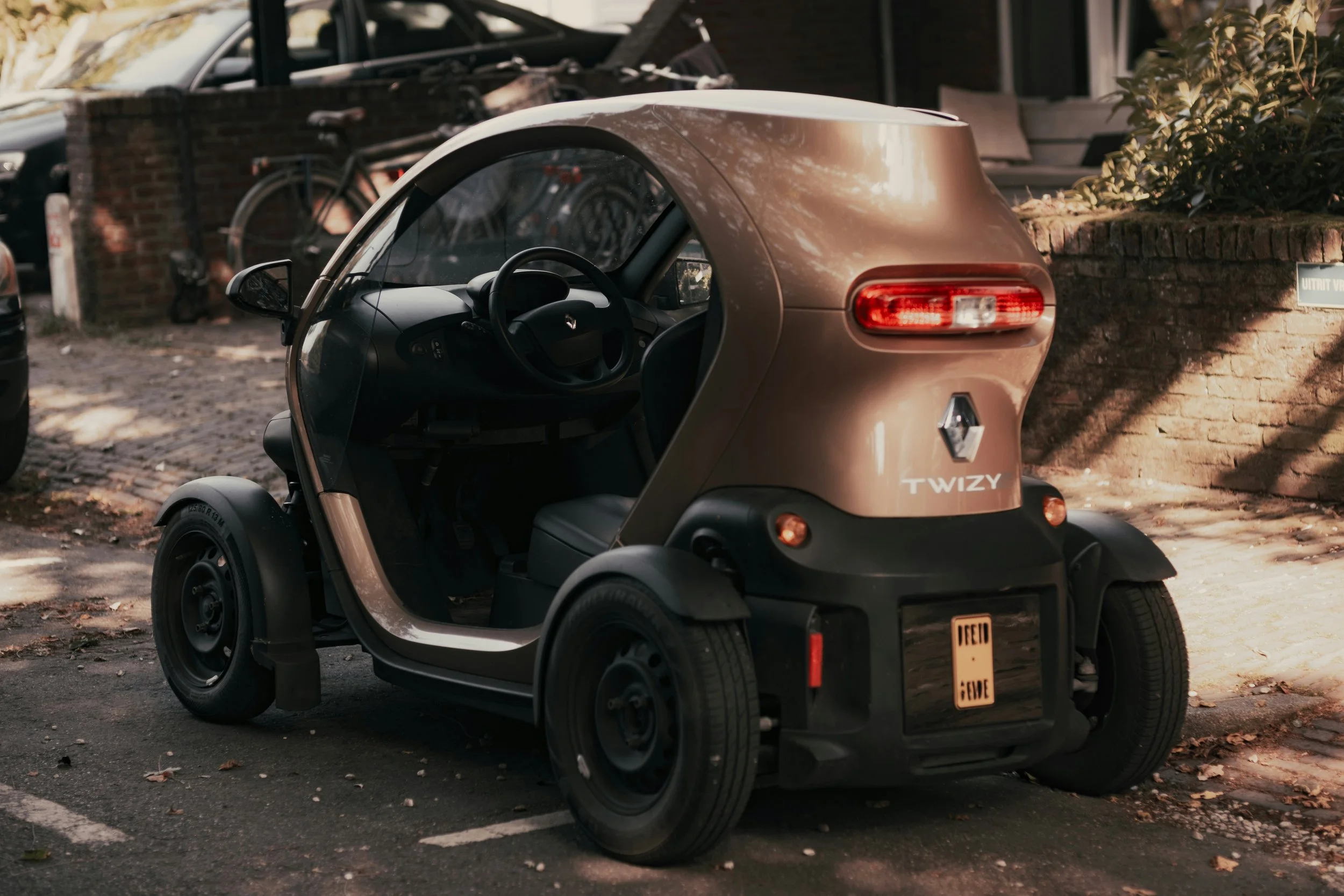
The Renault Twizy (Image credit: Haberdoedas via Unsplash)
For the next 100, the winners will be those who treat the act of travel itself almost as an afterthought; it is what happens during the journey that will matter.
While it is easy to mourn the role of the human in the process, it is more productive to look at the massive unleashing of human potential that follows; when we stop spending hundreds of hours a year staring at a bumper in front of us, we regain the capacity to work, rest, and connect, and that’s not even accounting for all the lives saved.
Legacy automotive brands face a choice: do they want to become the high-end manufacturers of the most sophisticated "Roombas" on the planet, or can they pivot into the virtual, maybe even extra-terrestrial, frontiers, where The Ultimate Driving Machine still has a soul, and is simply “The Ultimate Machine”?
The car as we know it, a chassis and four wheels, with a human controlling it, helped construct a beautiful, dangerous, and ultimately doomed, era of history.
The future belongs to the Roomba, those silent, tireless, and invisible fleets that will give us back our time, our safety, and ironically, our autonomy.
The car is dead, long live the car.
Are you ready to optimize your motorsport potential?
At Vaucher Analytics, we help manufacturers and racing organizations turn motorsport investment into brand, commercial, and strategic value.
If your motorsport programme is generating attention but not converting it into brand growth, the problem is not performance, it’s value capture.
Book your 30-minute discovery call by contacting us today:
Through our website’s contact form, or
Via email at contact@vaucheranalytics.com
Main image credit: www.autoevolution.com