

Click this link to download the original report (in French).
I recently had the opportunity to read in full Report No. 37, prepared for the 2025–2026 ordinary session of the French Senate on the state of the automotive industry.
Many of the recommendations are well-founded, and the depth of analysis reflects the complexity and strategic importance of the issue.
However, one critical dimension remains underexplored: demand-side factors.
In summary:
The report addresses the supply side almost exclusively, while significant risks are emerging on the demand side, most notably the erosion of European automakers’ ability to justify their pricing.
The forthcoming consolidation of Chinese EV manufacturers will not reduce competitive pressure. On the contrary, it will concentrate it among a small number of extremely powerful players.
Without a clear strategy to rebuild desirability and meaning around European vehicles, industrial gains risk resulting in more efficient production…of products that have become interchangeable.
The Quartz Protocol: A Playbook For Legacy Automakers to Leverage Motorsport Against the Competition From Chinese EVs
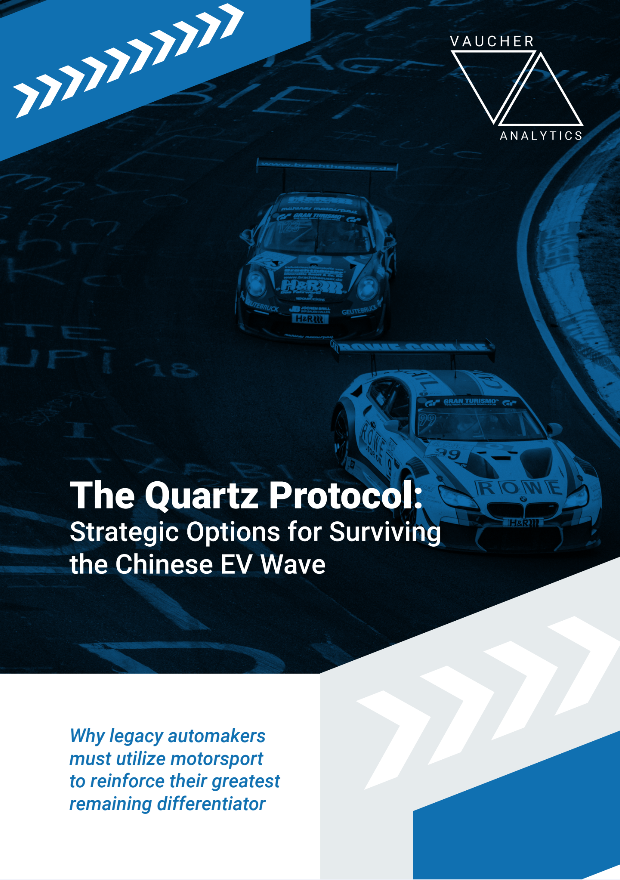
A practical framework (the Motorsport Value Capture Matrix) to see whether your brand is actually converting racing “proof” into consumer “halo”, or funding performance that never reaches the customer.
A clear strategic argument for why legacy OEMs can’t out-commodity Chinese EVs, and why motorsport-led emotion is their last defensible moat.
Tools for action, including a 10-question self-assessment plus a concrete audit approach to identify where motorsport value is lost in your racing program.
A Supply-Side Response to a Problem With a Demand-Side
All eighteen recommendations in the report (such as forced technology transfer from China to Europe in exchange for market access and a standard assessment for the health of used batteries) focus on supply-side challenges for the French and European automotive industries.
What stands out is the absence of a meaningful treatment of demand.
To that point, the report identifies the effects of “premiumization” as a structural issue. For the authors, traditional European makers of historically accessible cars such as Volkswagen started to make bigger, more luxurious cars to chase larger margins. In order to offset the higher associated costs of production, factories were moved elsewhere in Europe where labor costs were lower.
This is a valid train of thought, however, premiumization is distinct from price differences (premiums), driven by cost structure imbalances between brands.
If, according to the report, a Chinese vehicle can be offered at a price 30% lower than an equivalent European model, the central question becomes: how is that price gap justified in the eyes of the consumer?
Without a clear answer, supply-side competitiveness efforts may prove insufficient to preserve margins.
This is where demand-side strategy becomes essential.
Motorsport, Heritage, and Value Capture
Motorsport, and the heritage it has built for French automakers, remains one of the most powerful levers available.
Yet brands such as Alpine and Peugeot, despite active participation in top-level competition, are not fully translating these investments into demand for their road cars; there is a clear gap between participation and value capture.
The automotive industry could also look to the watch industry, where the “Swiss Made” label has been successfully used to signal quality, heritage, and legitimacy (the label is also used to sell other goods from Switzerland).
France itself has extensive experience with protected origin labels across multiple industries, so such an approach, even at the European level, could complement existing policies around local content.
With such a signalling system in place, in a geopolitical context that is becoming increasingly polarized, it is plausible that consumers could be encouraged to view the purchase of a French or European vehicle as something more than a purely consumer choice.
This would of course not replace product competitiveness, but it could materially influence willingness to pay.
Don’t want to be left behind?
Subscribe to Business Of Motorsport — the newsletter from Vaucher Analytics covering actionable motorsports strategy
Evolving Consumer Preferences
At the same time, consumer preferences are shifting, particularly in China.
Many buyers prioritize in-car technology, user interface, and connected features, to the point that the value of the vehicle is increasingly concentrated in its interior.
While interior features continue to evolve, styling, never a strong point of Chinese vehicles, has made strides but it is still far from distinctive; there are currently no Chinese-designed automotive icons and for several popular models, the influences of iconic European models are obvious.
This contrast highlights a potential European strength.
France, among other European countries, has a rich catalog of automotive icons, and recent successes suggest that design remains a powerful differentiator.
The Peugeot 208, Alpine A110, and more recently the Renault 5 in the EV space demonstrate that bold, identity-driven design can resonate strongly with consumers.
In other words, the “French Touch” is real, and it should be treated as a strategic asset, one to be reinforced and extended, not neglected and certainly not diluted.
The Coming Consolidation of Chinese EV Players
Another critical, demand-side dimension to consider is the structure of the Chinese EV market.
With over one hundred manufacturers engaged in intense price competition, the current environment is acting as a powerful mechanism for rapid iteration and convergence toward consumer expectations.
However, this phase will not last.
Over time, the market is expected to consolidate around a far smaller number of large, highly competitive players. These companies will emerge from a Darwinian process with deep understanding of their domestic market, strong technological capabilities, and significant economies of scale.
At that point, the nature of competition will change.
These players will not only be efficient producers; they will also be able to actively shape demand in export markets through pricing strategies, using their scale to absorb margin compression when strategically necessary.
This has major implications for European strategy.
The Chinese EV Dilemma
Today, policy decisions such as tariffs for EVs going into Europe are made to protect the region’s interest, but there is always a fine line to tread, because manufacturers know that if they push to hard, they may lose access to the world’s largest car market.
But as Chinese companies converge to a smaller number of brands, whose products are fully optimized for their home market, the question becomes whether European automakers can realistically compete on desirability in China.
So does it matter how much access Beijing threatens to grant or cut off?
Indeed, if Europe can’t consistently meet Chinese consumers’ expectations, the strategic calculus shifts.
Rather than pursuing China primarily for volume, which has always brought its own set of costs such as mandatory technology transfers, European manufacturers may choose to focus more deliberately on strengthening their position in their home markets, where they retain greater control over brand, distribution, and consumer perception.
A Multipolar World and the Role of Software
Looking ahead, the development of connected and autonomous vehicles will reinforce these dynamics.
The Senate report proposes the creation of an “Airbus-style” initiative for onboard automotive software. There is a solid logic in collaborating on foundational layers, particularly connectivity, safety, and data architecture, while preserving as many options as possible for differentiation at the level of customer experience, such as infotainment.
As the global system evolves toward a multipolar structure, different technological standards are likely to emerge across regions., and exporting manufacturers will need to adapt, much as they already do with safety regulations.
However, unlike safety standards, the frameworks governing connected and autonomous systems are still being defined.
This creates an opportunity.
If France and its European partners can establish a software and hardware infrastructure perceived as more robust, secure, and technologically advanced than other options, they can set the benchmark and subsequently shape demand for European vehicles along a new axis, one based not only on compliance, but also on trust and technological credibility.
In this scenario, Europe would no longer be reacting to China’s decisions, it would be actively shaping market direction.
Closing Thoughts
The supply-side measures outlined in the Senate report are necessary, but they do not fully address the mechanisms through which demand, and ultimately pricing power, is sustained.
In a market where performance and cost advantages are converging, the ability to justify a premium (not simply to “premiumize”) becomes the central challenge.
Without addressing this, the risk is clear: a more efficient European automotive industry producing vehicles that consumers no longer perceive as meaningfully different.
Efficiency alone will not be enough, French and other European automakers must also sustain desire.
Are You Ready to Optimize Your Motorsport Potential?
At Vaucher Analytics, we help manufacturers and racing organizations turn motorsport investment into brand, commercial, and strategic value.
If your motorsport programme is generating attention but not converting it into brand growth, the problem is not performance, it’s value capture.
Book your 30-minute discovery call by contacting us today:
Through our website’s contact form, or
Via email at contact@vaucheranalytics.com
Main image source: Owen Sellwood via Unsplash