

The first race under what we now call Formula 1 was held on May 13th, 1950 at Silverstone. That was just over 75 years ago, and during the 2025 season broadcasters have repeatedly reminded viewers of the sport’s milestone.

Source: Jeff Cooper via Unsplash
I enjoy learning about motorsport history, and it always strikes me how quaint the past now looks. When Alfa Romeo won that first Grand Prix, the cars were front-engined, had no aerodynamics, rode on narrow tires, and their steering wheels were decades away from a single button, let alone screens, microchips, or multi-function displays.
If you could show those drivers a modern F1 car, they’d assume it was built by aliens.
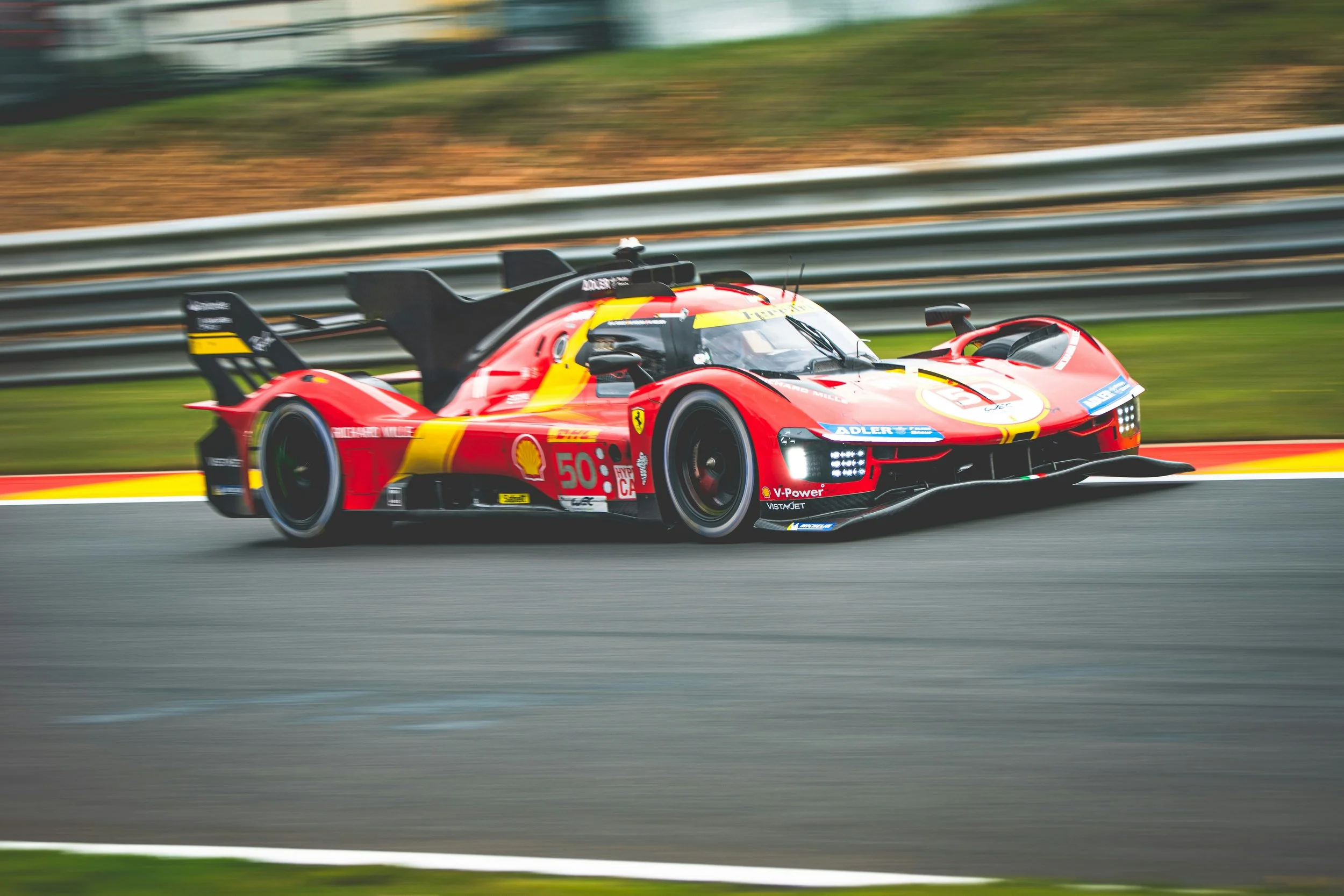
Even beyond F1, imagine the participants of the first 24 Hours of Le Mans in 1923 trying to comprehend a Ferrari 499P, a Peugeot 9X8, or any prototype from today’s WEC and IMSA grids.
And so the question is obvious:
If the last 75 years turned simple race cars into machines that resemble spacecraft, what might the next 100 years bring?
This insight piece takes a broad, cross-disciplinary look at what motorsport could become by 2125. Not next year’s regulation tweaks, not the next power unit cycle, but the long arc of change across technology, safety, accessibility, and commercial models.
What might my nieces’ and nephews’ children, or their children after that, experience at the track, or see debated in the boardrooms of the sport?
If any of this seems far-fetched, take another look at a 1950s race car. In the words of Arthur C. Clarke:
“Any sufficiently advanced technology is indistinguishable from magic.”
Source: Xavier Praillet via Unsplash
Want More Insights Like This?
Subscribe to Return On Racing — the weekly newsletter from Vaucher Analytics covering actionable motorsports strategy, cost breakdowns, and sponsor intel.
In less than 500 words.
This is where the link will jump to
Section 1 — Who Wants to Race In 2125?
Source: Eyosias G. via Unsplash
Before imagining how racing will evolve, it’s worth asking a simpler question: who will even want to go racing in 2125?
Because while access to motorsport will expand in extraordinary ways, the highest levels of real-world competition will still be very, very expensive because that dynamic is inherently a part of motorsport: cars get faster, rules add complexity, equipment becomes more capable, and those development and decisions always end with someone having to pay for them.
This means that in 2125, just as in 2025, racing will remain an investment decision with the enormous costs weighed up against similarly lofty goals: prestige, marketing, technology leadership, and national pride.
Electrification, hydrogen, and whatever comes next will be mature technologies by then, and China will be one of their global centers of excellence. Just as Japanese manufacturers were once dismissed as “cheap” alternatives before becoming motorsport powerhouses, Chinese brands will follow the same trajectory: entering global racing, improving, winning, and ultimately using motorsport to sell millions of cars worldwide.
South Korea has been following this exact playbook, as Hyundai’s presence across WRC and touring cars laid the foundation for Genesis to enter endurance racing, and you can already see this playing out again for China’s automakers, with Geely’s Lynk & Co recently announcing plans for both rallying and long-distance racing.
By 2125, it’s entirely plausible that several Chinese manufacturers will have built decades of racing lore, rivalries, icons, heartbreaks, dynasties, just as Ferrari, Mercedes, Toyota, Honda and Hyundai have today.
So where does that leave the established brands?
They will still have to race, often for their very survival:
Mass-market brands like Ford, Chevrolet and, of course, Honda and Toyota, will need motorsport to maintain visibility against hyper-competitive Chinese offerings. “Win on Sunday, sell on Monday” may evolve, but the underlying logic won’t.
Luxury and heritage brands like Ferrari, Mercedes, Aston Martin, and BMW will need racing to defend their identity. If consumer cars become increasingly appliance-like, motorsport becomes one of the last ways to differentiate on emotion, history, and cultural impact (and this is yet another reason that makes Porsche’s exit from the WEC as of next year even more shocking).
In short: any brand that is racing today will likely need to be racing in 2125.
Motorsport has always been a battlefield where brands prove they deserve to exist, and that will be even more true a century from now.
Those who disappear from the grid may well disappear from the market entirely, just as Plymouth, Pontiac, Saab, Duesenberg, and dozens of others faded out when they no longer had a reason to belong in the automotive world.
The Quartz Protocol: A Playbook For Legacy Automakers to Leverage Motorsport Against the Competition From Chinese EVs
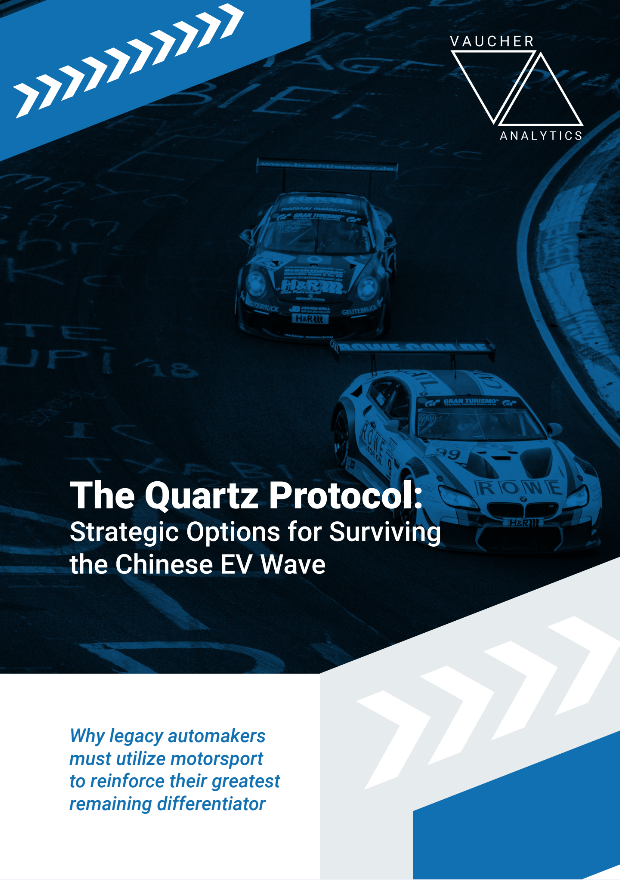
A practical framework (the Motorsport Value Capture Matrix) to see whether your brand is actually converting racing “proof” into consumer “halo”, or funding performance that never reaches the customer.
A clear strategic argument for why legacy OEMs can’t out-commodity Chinese EVs, and why motorsport-led emotion is their last defensible moat.
Tools for action, including a 10-question self-assessment plus a concrete audit approach to identify where motorsport value is lost in your racing program.
This is where the link will jump to
Section 2 — Who gets to race in 2125?
Source: Liam Charmer via Unsplash
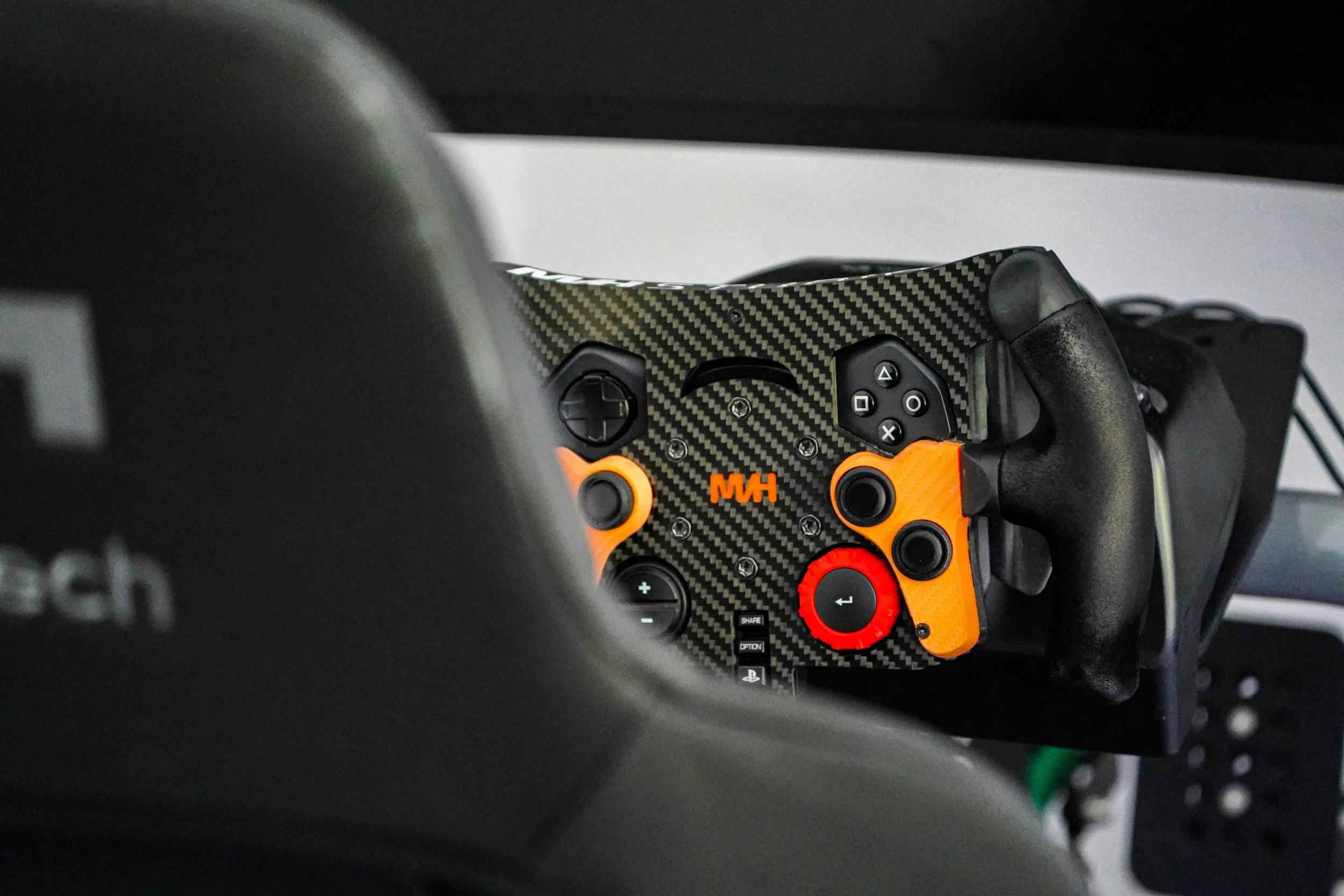
If a high-end sim rig today can already deliver motion effects, laser-scanned tracks, dynamic weather, and VR convincing enough to make you physically brace at Eau Rouge (or Sebring, like I did at the recent SimRacing Expo 2025) then by 2125 the line between “simulated driving” and “real driving” will be barely perceptible, if it even exists at all.
At that point, the idea of spending €200,000 a year on karting to “earn a shot” will look like a relic of a pre-digital age.
The primary gateway to racing will no longer be money. It will be repetition. Max Verstappen said as much recently: sims today are extremely good, but they lack the structure of a season. In 2125, methods and coaching will have been around for decades to provide that structure, and the training advantage will be undeniable.
The boy or girl who spends 100,000 hours in a fully immersive sim, practicing on as close to an actual car as can be, rather than a very dynamically different kart, will arrive closer to race-ready than the kid whose parents emptied their savings on karting.
And in fact, the sim-to-track pipeline is already emerging today; by 2125 it will be the default.
In summary: in 2125, the sport’s greatest historical inequity, access to seat time, will have collapsed.
Simracing will become the new feeder series: global, cheap, data-dense, meritocratic, and completely transparent about who has the cognitive and motor skills to compete.
But that equalization hides an unintended consequence.
If anything can be simulated with perfect fidelity, from Group C, ’70s F1, fictional anti-gravity series, even entire races that never actually happened, then audiences may gravitate not to “real” motorsport, but to the most entertaining version of simulated motorsport.
Why watch a physical touring car race when a virtual Nürburgring 24H can deliver:
perfect weather
perfect camera angles
perfect racing lines
perfect commentary
zero logistics
zero downtime
and physics indistinguishable from reality?
In 2125, even the broadcast itself can be simulated, with synthesized commentary, adaptive telemetry overlays, custom viewpoints, or even putting the viewer “in the car” in a way physical cameras never could.
In other words, the very technology that democratizes the driver ladder also threatens to cannibalize the physical product.
This is where the link will jump to
Section 3 — Racing Will Survive In the Digital 22nd Century With Analog Experiences
So in 2125, anyone with a high-quality rig can theoretically become a driver, that’s one problem solved.
The next problem that will arise from this is: who is going to care?
If simulations in 2125 can reproduce the sight, sound, physics, and tension of racing with perfect fidelity, then the economic pressure on physical motorsport becomes brutal: why bother going to a real circuit when you can experience the same spectacle at home, on demand, with custom camera angles, commentary, data overlays, and no travel cost.
This is the same existential challenge movie theaters faced (and still face) when streaming became good enough, and the parallel is useful. Theaters can no longer simply tout picture or sound quality; for years now they have to create an experience.

This includes premium screens, social atmosphere, events, even commemorative and collectible popcorn buckets, all to create the feeling that your time at the theater was worth the effort and expense over and above watching something from your couch.
Real motorsport will have to make a similar pivot.
The track becomes a destination, not just a venue.
Events will rely on what cannot be simulated: the physicality of the machines: the noise, the smell, the proximity, the shared tension with thousands of other fans.
Keeping in mind that VR in 2125 will probably be able to simulate this close to perfectly, racing series will have to go even farther, leaning heavily on exclusive, physical, in-person elements: souvenirs minted only at specific races, in-track augmented experiences, pit-lane access tied to on-site attendance, maybe even deliberately withheld broadcast angles or data feeds that make being present feel meaningfully different than watching the VR stream.
Put simply: the real thing must feel like something you earn, not something you casually consume.
This creates a new imperative for teams and drivers: loyalty will have to be earned as well.
Fans can follow virtual series, fictional championships, or perfectly recreated historic seasons without ever forming an attachment to a physical team. To compete with that, teams in 2125 will need deliberate, structured relevance-building strategies (exactly the work your Vaucher Analytics Motorsport Relevance Pyramid is designed for).
They will have to cultivate identities, build independent revenue lines, and engage fans before, during, and between events.
In a world where the virtual product may be just as entertaining as the real one, the winners, commercially and culturally, will be the teams that make fans feel a sense of belonging that algorithms and simulations cannot replicate.
If teams and drivers can do this, they will create the virtuous circle that will keep real-world racing relevant in 2125: they make the effort to earn the admiration and trust of fans, who will reward that effort with their own to show up and support them in person.
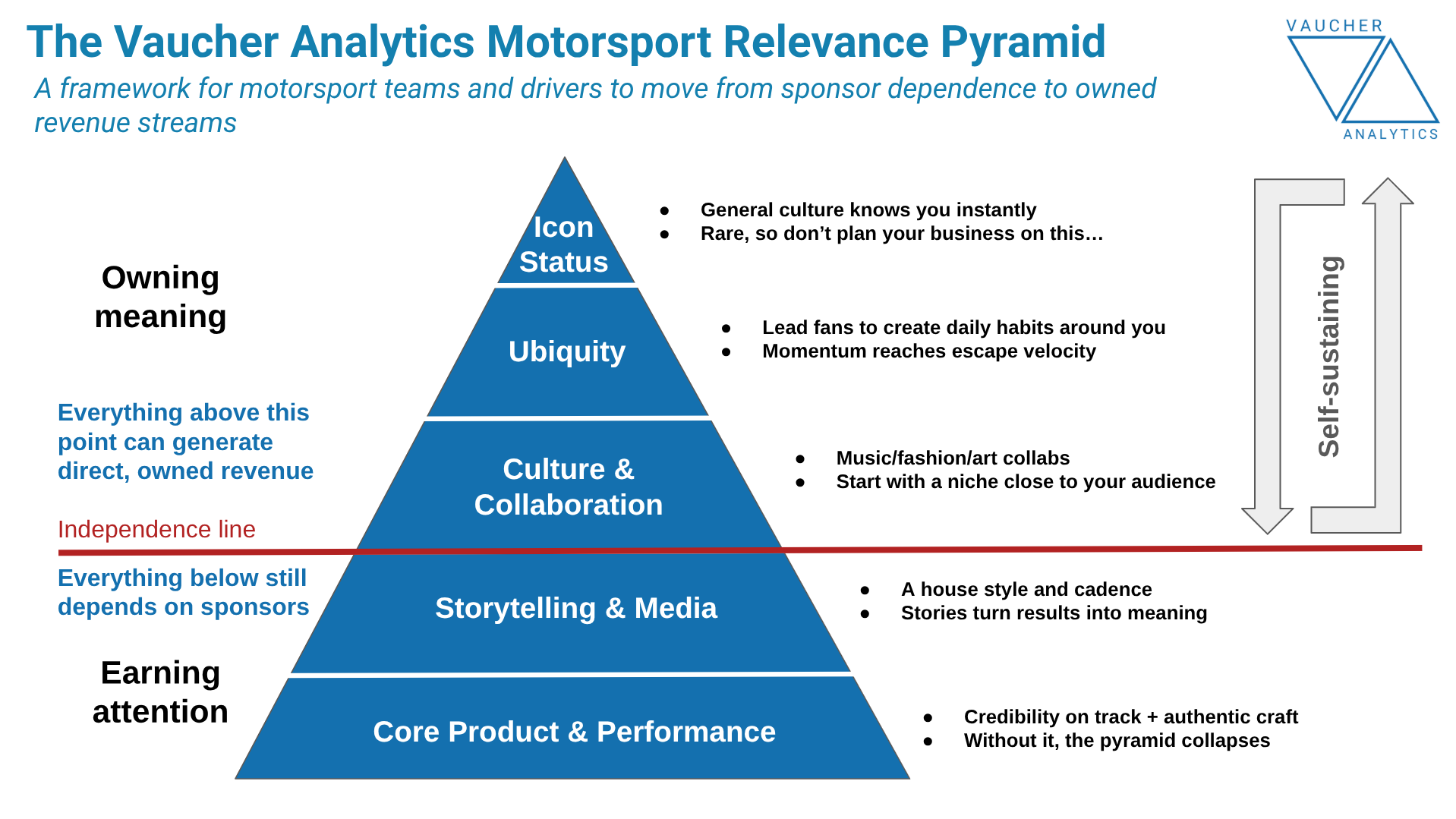
The Vaucher Analytics Motosport Relevance Pyramid describes the pathway from sponsorship as the main source of revenue to owned intellectual property.
This is where the link will jump to
Section 4 — Racing Must Be 100% Sustainable By 2125 To Be Relevant
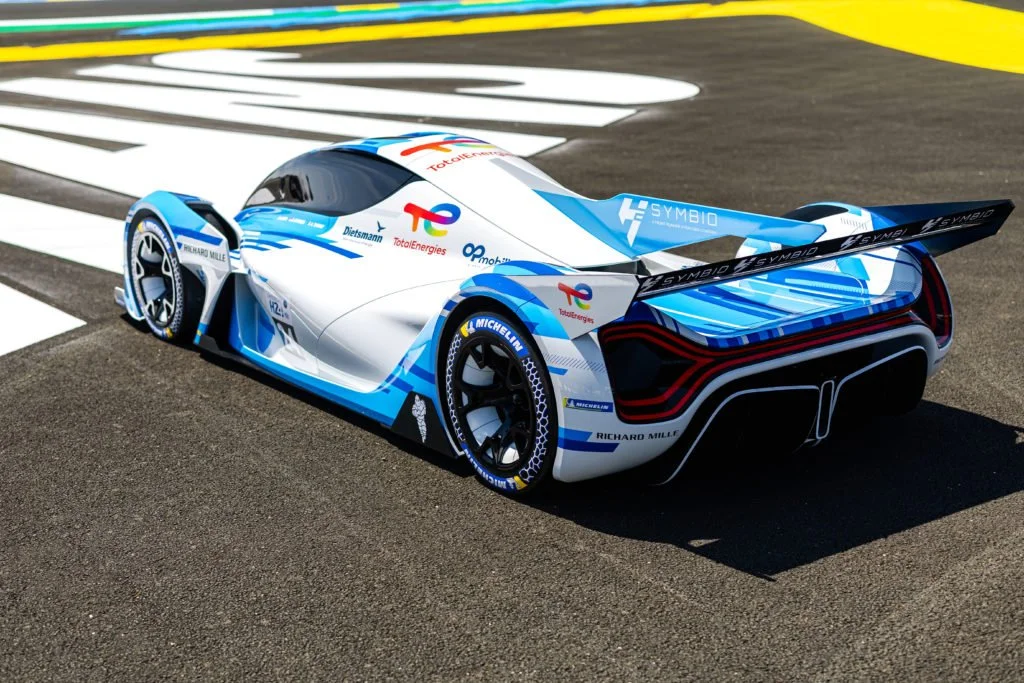
Source: MissionH24
Simracing threatens the karting industry and racing itself, not only because it presents a more convenient alternative to the race track but also because it leads to the question of why the race track, and the “traveling circus” around it, deserves to exist at all.
Indeed, even if motorsport succeeds in creating compelling in-person experiences, it still faces a more fundamental challenge by 2125: justifying its very existence. Today, there are still many climate skeptics and even among those who understand climate change, many still aren’t going to curtail their habits in any serious way.
In a century though, by which time the full effects of climate change will be felt, attitudes towards such types of entertainment could be very different.
If fully immersive VR can deliver perfect racing at home, and if society’s attitude toward carbon has hardened dramatically, then physical racing has to defend itself on environmental grounds as well as entertainment ones; the fact that the cars on-track providing spectacular action are hydrogen or electric power will seem like a cynical justification for otherwise carrying on as usual.
By 2125 the expectation won’t just be carbon neutrality; that will be baseline.
The expectation will be zero-emissions, as a result of utilizing yet-to-be invented or refined technologies (e.g. fully circular materials, closed-loop manufacturing, and transport systems that produce no meaningful emissions at any point in the chain), as well as concerted and targets plans by series to reach this point.
Teams won’t be allowed to fly gear around the world using fossil fuels, and even “offsets” will look primitive and cynical.
Racing series will be required to adopt zero-carbon or near-zero-carbon freight: renewable-powered airships, hydrogen aviation, superconducting cargo trains, modular containerized paddocks with no single-use components, and manufacturing that relies almost entirely on bio-derived composites and high-efficiency additive processes.
If a racing series cannot prove that its environmental footprint is negligible, or even net-beneficial through technology transfer and/or being carbon-negative, it will be politically and socially impossible to justify moving thousands of people and megatons of equipment when every single moment of the race can be recreated in VR with perfect fidelity, at a time when the planet is suffering from past, similar excesses.
In 2125, fans, governments, and sponsors alike will ask a simple, unforgiving question: Why should real racing still exist when the same spectacle can be provided virtually at no environmental cost?
A series that can't answer that question convincingly will vanish.
This means motorsport must evolve into something closer to a self-contained, ultra-efficient traveling laboratory. To be fair, this is what it aspires to be today but it is still far from reaching that goal.
By 2125, the journey will - must - be complete.
This is where the link will jump to
Section 5 — Who Pays to Race In 2125?
Racing will still be very expensive in 2125.

Source: Akimbo
So the real question is not whether racing is costly, it’s how anyone justifies paying for it in a world where attention is fragmented, entertainment is infinite, and simulated racing is just as compelling as the real thing.
Some of the justification will come from road-car revenue; manufacturers will still need racing as their marketing engine, their cultural anchor, their differentiator in a hyper-commoditized automotive market.
Some justification will come from fan-driven income; the teams that survive will be the ones who treat fans as a base they cultivate, not a crowd they rent, with their own platforms, products, events, and narratives that generate recurring revenue, not one-off bursts.
But the biggest structural shift will be in sponsorship.
Traditional title deals such as the 9-figure megadeals of early-21st-century Formula 1, will no longer make economic sense.
The broad, catch-all value proposition that carried sponsorship for decades will erode; in a world where audiences are atomized into thousands of micro-interests, no sponsor will be able to justify paying for a mass audience that barely exists.
By 2125, the “classic” sponsorship model won’t disappear, but it will become a minority contributor rather than the backbone of team budgets. Sponsors will seek precision: projects, activations, content pieces, technology programs, community initiatives.
These will be true long-term partnerships that provide supplementary, but not necessarily mandatory, revenues to race teams.
That leaves teams with a simple, unforgiving mandate: relevance must be built, not assumed.
Define what they stand for
Own their digital distribution
Turn drivers into multi-platform human assets
Structure sponsor programs that evolve over time rather than reset every season
In 2125, the teams that remain on the grid will be the ones that have transformed “we go racing” into a defensible business model; not a heroic fundraising exercise, but a stable system of identity, fan belonging, and targeted commercial partnerships.
This is where the link will jump to
Section 6 — Technology: The Next Century of Performance

Source: Chad Kirchoff via Unsplash
Every era of racing has been shaped by whatever technology was capable of pushing the limit: front-engined brutes in the 50s, the rise of aero on rear-engined layouts in the 60s and 70s, ground effect and carbon fiber in the 80s, hybrid systems in the 2000s, and a move towards electrification today.
But the next century won’t be a linear continuation, it will be a philosophical shift. Let’s be clear, progress will be radical, but it will always constrained by the fundamental rule that defines motorsport: the driver must remain the final decision-maker.
Across propulsion, aero, and manufacturing, 2125’s cars will be vastly more advanced, but the overarching theme is that all this technology exists to serve the human, not replace them.
This is where the link will jump to
6.1 AI: Powerful everywhere except on-track
AI will transform engineering, simulation, setup, and safety, but it will remain almost irrelevant on track.
The FIA has been consistent for decades: anything that substitutes human judgment is banned.
Active suspension, automated traction aids, adaptive aerodynamics, gone, every time. The sport protects the primacy of human decision-making because racing loses its meaning the moment software becomes the differentiator.
This is why autonomous racing, like that featured in the league being developed in Abu Dhabi, will remain a technology platform, not a replacement for motorsport. Yes, the cars will be astonishingly fast, capable of superhuman precision. Manufacturers will use it to showcase software prowess and engineers will learn a lot.
But as a spectator sport, it’s missing the essential ingredient: a human choosing to take a risk and then surpassing the limits of what seems possible.
That is the non-negotiable core of racing, and 2125’s regulations will guard it as fiercely as they guard safety.
This is where the link will jump to
6.2 Propulsion: Internal combustion doesn’t die, it becomes luxurious
One of the great misconceptions in both motorsport and the automotive industry is that electrification “kills” combustion.
The future isn’t binary.
The only reason it’s viewed that way is because ICE has had a head-start on other technologies, and established motorsport fans are comfortable with what they know
But 100 years from now, when every technology is developed and when new generations of fans have entirely different points of view on the world?
That will be a very different paradigm, one in which there is a coexistence of technologies : ICE, electric, hydrogen, hybrids, and new systems we haven’t yet invented, each powering racing formats optimized to suit their strengths and adapted for different audiences.
Why? Because racing is both entertainment and marketing.
For EV and hydrogen manufacturers, the track proves technological credibility and breaks the “appliance” perception of an automobile, especially for Chinese brands building global reputations, exactly as Japanese companies did in the late 20th century.
For luxury manufacturers, combustion becomes what mechanical watches are today: emotionally charged, artisanal, mechanical theatre. ICE survives not as commuting tech but as an experience, complete with sound, vibration, heat, and drama, precisely because it no longer exists in everyday life.
In an ironic twist, the same combustion engines that evoked images of greasy garages in the 20th century will be admired like the finest mechanical movement in the 22nd century. By 2125, combustion engines will not be dead; they will be premium objects of desire, fuelled by entirely renewable fuels.
This is where the link will jump to
6.3 Aerodynamics: More efficient than ever, but never autonomous
Aero evolution in 2125 will be defined by a tension:
Engineers want adaptive efficiency and perfect stability
Regulators insist that no system can think for the driver
History tells us who wins that fight.
So aero in 2125 will be:
Modeled via computational tools capable of replicating real-world physics to 100% accuracy
Built from materials with extremely low drag coefficients
Tailored to every track using ultra-fast, ultra-cheap micro-batch manufacturing
Strictly non-adaptive unless triggered by the driver
If anything, some series may swing in the opposite direction: less downforce, more mechanical grip, more human control, reviving the “pure” driving challenge of mid-century motorsport (that counter-revolution has already begun in pockets of the industry today).
This is where the link will jump to
6.4 Manufacturing & materials: Built and grown
By 2125, manufacturing will undergo a monumental transformation.
Motorsport moves from machining, molding, and layering to:
Full, on-site additive manufacturing of structural components
Self-healing composites that repair microfractures in real time
Adaptive monocoques that can be reconfigured (or built) in mere hours, maybe minutes, for specific circuits
Embedded strain-sensing neural networks in every major structure
Near-total recyclability of the chassis and bodywork
A race car will not be “assembled.”
It will be printed, shaped, cured, grown, or extruded, and continuously updated.
The result is a machine that is:
lighter
stronger
safer
more sustainable
faster to produce
faster to repair
and infinitely refinable
This is where the link will jump to
Section 7 — Safety: The Era of Near-Certain Survivability
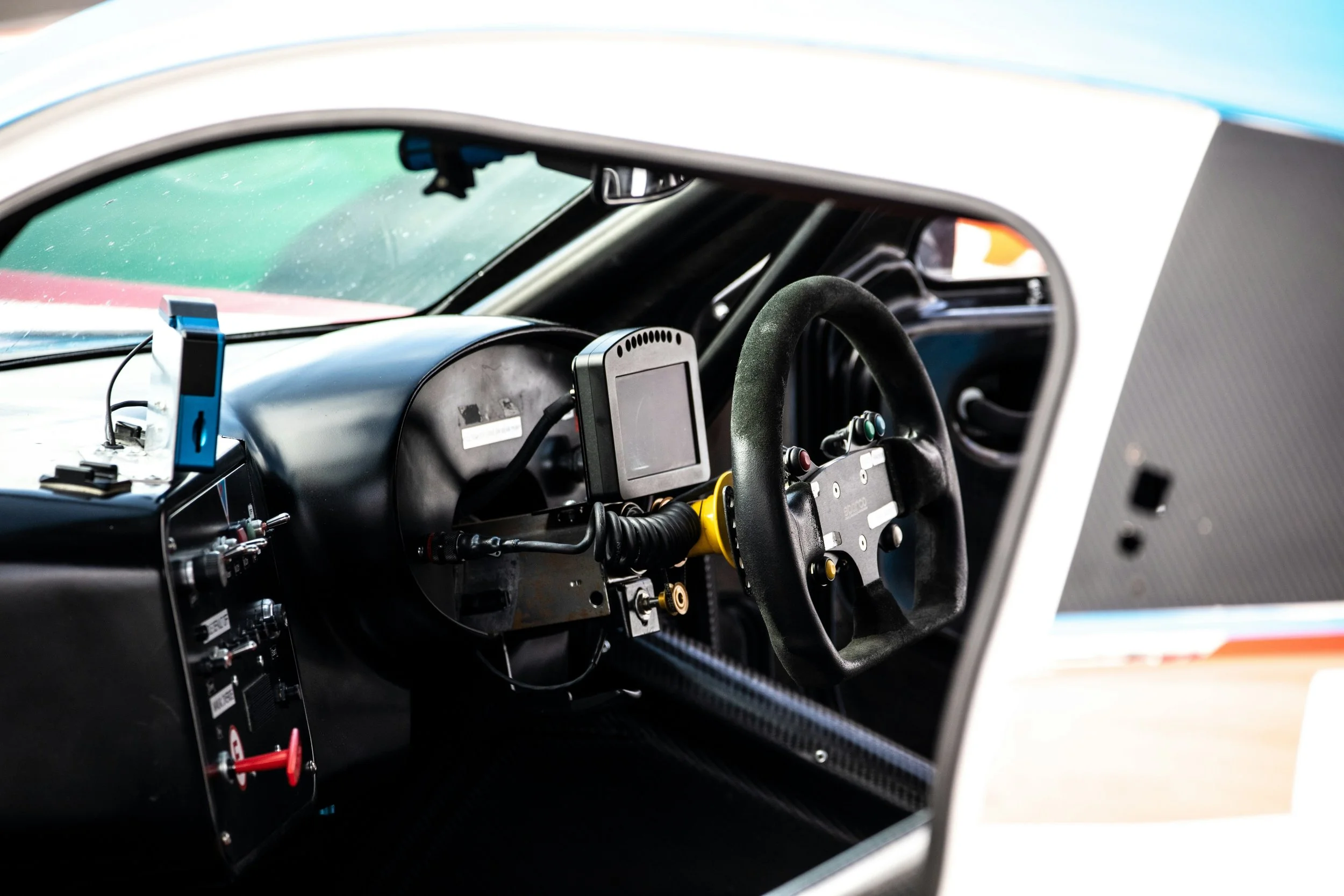
Source: Oliver Hayes via Unsplash
The racing cars of 2125 will look radically different from today’s machines, yet their safety philosophy will be the same one that reshaped motorsport over the last 30 years, roughly the period beginning after the deaths of Roland Ratzenberger and Ayrton Senna: every foreseeable crash must be survivable.
As performance rises, risk rises with it. That tension never disappears. But by 2125, the industry will finally reach the end state it has been crawling toward since the advent of carbon tubs, HANS devices, SAFER barriers, halo structures, and modern helmets: a world where serious injury is rare, and fatality is nearly mathematically impossible.
By 2125, that principle that every foreseeable crash must be survivable, will be faced with technologies that turn the cockpit into an adaptive protection system, one of which the driver almost becomes a part.
The cockpit becomes an adaptive crash organism
The carbon monocoque of 2025 is a blunt tool by 22nd-century standards.
By 2125, the cockpit will be a multi-layered energy-management system:
Smart composites that locally flex to route forces around vital organs
Fluidic crash channels beneath the driver that disperse impact loads like controlled shockwaves
Self-stiffening structures that harden on demand exactly where they need to
Thermal membranes that neutralize fire instantly (if fire is even possible with future fuels and engineering)
A crash is no longer something the chassis passively absorbs, it’s something the cockpit actively responds to.
Predictive safety: Preventing injury before impact occurs
The major leap forward will not be reaction, it will be anticipation.
By 2125, car-to-car, car-to-track, and car-to-driver networks will evaluate collision probabilities thousands of times per second, making it appear as if these systems can predict the future when a crash does occur.
Crashes will effectively “begin” before they physically occur, giving systems the split, maybe even full, seconds required to reposition, restrain, or protect the driver:
Exoskeletal race suits that apply counter-pressure during violent decelerations
Pre-tensioned harnesses that lock the driver into the safest posture
Helmet stabilization actuators that prevent rotational brain trauma
Automatic circulation support to prevent blackout or blood-pooling
Instant thermal protection for fire scenarios
The moment a crash becomes likely, the driver’s entire safety ecosystem pre-loads itself.
Immediate biological support: Treatment before the marshals arrive
In the cockpit, real-time biometrics will be monitored continuously during the normal course of a race:
Brainwave activity
Cardiac rhythm
Blood oxygenation
Muscular strain
Heat load
Concussion signatures
If a crash occurs, onboard systems begin intervention automatically:
CPR via the race suit
Brain-cooling protocols if brain trauma is predicted and/or detected
Emergency oxygenation if needed
The rescue crew arrives not to diagnose, but to continue treatment already underway, with a full medical summary and course of action autonomously pre-determined for them and also automatically sent to the closest hospital.
The end state: Death becomes theoretically possible, but practically absent
It would be naïve to say motorsport will eliminate death because so-called “corner cases” will always exist in any field.
But by 2125, the risk profile will resemble that of commercial aviation:
Theoretically present
Practically imperceptible
Drivers will still feel fear and anxiety.
They’ll still push beyond the limit.
But the tragedies that defined the first century of racing will be rarities future generations read about rather than witness.
This is the future of safety in motorsport: a world where humans still take risks at the edge of control, but almost never pay for it with their lives.
This is where the link will jump to
Conclusion — The More Racing Will Change, the More It Will Stay the Same
For all the speculation about propulsion revolutions, immersive simulations, sustainability imperatives, and evolving business models, the truth is simpler than all of it: in 2125, racing will still look like racing.
The world around it may transform beyond recognition, but the core spectacle of a human being balancing courage, judgment, and instinct at the edge of control will remain the beating heart of the sport.
The environment supporting that spectacle will be radically more advanced, absolutely.
Tracks might generate electricity as cars drive on them.
Calendars will be shaped as much by environmental impact as by tradition.
Stewarding will rely on gigantic data sets collected and intepreted automatically in fractions of a second rather than debate.
Fans will be immersed physically and digitally in ways we can barely imagine today.
But these innovations won’t replace racing, they will protect it, wrapping the familiar competition in a 22nd-century ecosystem built to justify its existence and amplify its appeal.
And that’s the real promise of motorsport’s next 100 years: not that it becomes something alien, but that it remains something recognizably human.
The formats that survived the last century such as endurance battles, hillclimbs, rallies thundering through forests and mountain passes, will still be with us, just…
Different.
The machines will evolve, the world will evolve, but the thrill of watching someone wrestle a car at the limit will always be the same.
Are you ready to optimize your motorsport potential?
At Vaucher Analytics, we help race teams and manufacturers turn racing ability into brand capital.
If you’re serious about making your motorsport team or series matter beyond the podium, let’s talk.
Book your 30-minute discovery call by contacting us today:
Through our website’s contact form, or
Via email at contact@vaucheranalytics.com
Main image credit: Hans Westbeek via Unsplash