In the 1970’s, the Swiss watch industry was rocked by the introduction of quartz timekeeping technology, which replaced mechanical assemblies powered by springs and gears with battery-powered alternatives.
These new assemblies had fewer parts, could run uninterrupted for long periods of time, kept far more accurate time, and quickly became much, much cheaper than their mechanical ancestors.
Swiss manufacturers were in a panic, and the predominant strategy was to literally destroy their mechanical heritage to chase what seemed like the only way forward in developing their own quartz models.
In the context of the global car industry, this sounds very familiar, doesn’t it?
About a decade ago, after it became clear that diesel was not the way forward, everyone then seemed to agree that the only way to “solve” transportation’s contribution to climate change was to electrify the entire fleet.
Today, another energy crisis is accelerating interest in EVs, but the fleet is not close to fully electrified, and we can ask ourselves if it ever will be, keeping in mind some of the more marginal, yet culturally and financially important, segments of the market.
The Quartz Protocol: A Playbook For Legacy Automakers to Leverage Motorsport Against the Competition From Chinese EVs
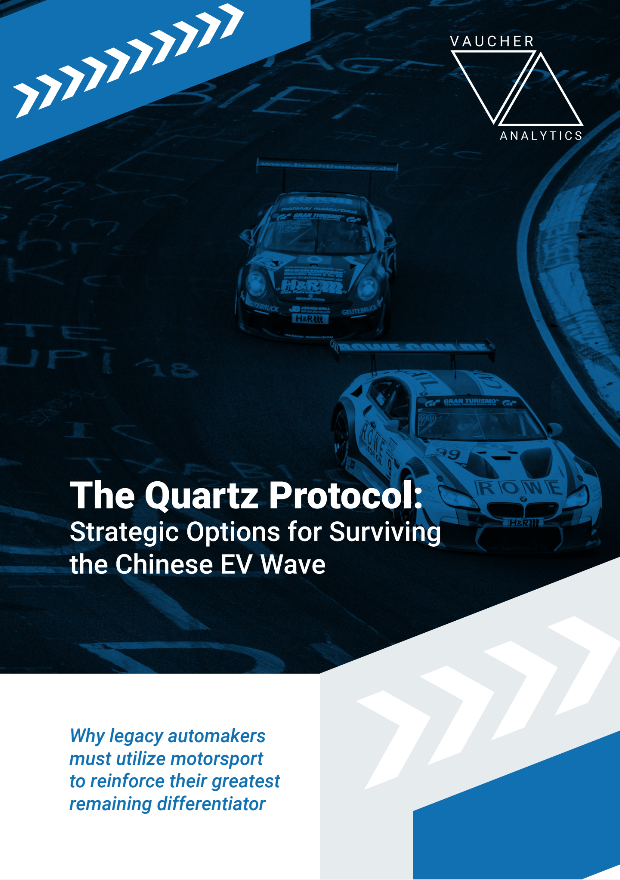
A practical framework (the Motorsport Value Capture Matrix) to see whether your brand is actually converting racing “proof” into consumer “halo”, or funding performance that never reaches the customer.
A clear strategic argument for why legacy OEMs can’t out-commodity Chinese EVs, and why motorsport-led emotion is their last defensible moat.
Tools for action, including a 10-question self-assessment plus a concrete audit approach to identify where motorsport value is lost in your racing program.
Indeed, luxury automakers were at first enthusiastic about electrification but with hindsight, it’s clear that their customers were not nearly so receptive of the idea.
Porsche’s struggles with electrification have been well-documented.
Lamborghini just announced the cancellation of its first EV.
Jaguar’s relaunch as an EV brand could be one of the most scrutinized brand rebirths in history, with many pundits already thinking up their most savage takes for social media when the first model is finally unveiled.
While the potential for failure looms large over Jaguar, so does the potential for success: the radical change in direction for the relaunch was widely mocked when it was first unveiled, yet it’s this radical rethinking as applied to the new car itself that could be just what the industry needs to set the benchmark of what a luxury, performance EV should actually be.
The Current View of Performance EVs
At the high end of the market, electric performance cars have largely been met with hesitation and outright rejection rather than desire, and this has encouraged an easy conclusion: electric sports cars simply do not work.
That conclusion is misguided because it assumes that luxury manufacturers will never move beyond the painful transition period in which they currently find themselves.
The real issue is not that legacy manufacturers are incapable of building a technically competent EV.
Of course they are, but is this what their customers actually want?
So far, legacy performance car manufacturers have approached electrification at the high end as if it were a powertrain substitution problem, when in reality it is a category-definition problem.
They assumed that if they took an existing idea of a desirable performance car and replaced the engine, the market would eventually accept the result.
What they underestimated was how deeply customers, especially high-end customers, already understood the product they were buying, and that was all they wanted to buy.
That mistake has many precedents.
Don’t want to be left behind?
Subscribe to Business Of Motorsport — the newsletter from Vaucher Analytics covering actionable motorsports strategy
New Coke, Old Watch Movements
In the 1980s, Coca-Cola was losing ground to Pepsi, especially in blind taste tests where consumers preferred Pepsi’s sweeter formula.
Coca-Cola decided to reformulate its flagship product to win on taste.
In 1985, Coca-Cola launched “New Coke,” replacing the original formula. Consumers reacted negatively, not because the new taste was bad, but because they felt the brand had abandoned something iconic.
The backlash was so strong that Coca-Cola reintroduced the original formula as “Coca-Cola Classic” within months, driving home a crucial lesson in branding: they optimized the product, but misunderstood the emotional ownership consumers had over it.
Coca-Cola knew how to make a drink, and in fact “New Coke” was backed by ample market research. Ultimately, the effort failed because the company misunderstood who really “owned” the brand in the minds of consumers.
In an economy where so much of marketing is based on feelings, companies may own the marketing rights to a brand, but in reality, they can only take their orders from consumers as to a brand’s direction.
This is exactly what we see in the watch industry as well.
The Swiss watch industry made a crucial pivot after the introduction of quartz, positioning their mechanical products as objects of desire and luxury, a positioning which still persists to this day.
Prices for watches continue to increase but crucially, the watches themselves look very similar from decade to decade. This is the double-edge sword of leaning on luxury heritage: you can use it to sell your products, and heaven help you if you deviate from it, so you have to maintain it as much as you exploit it.
This is why a Rolex Submariner in 2026 looks very similar to the earliest Submariner from the 1950s, and why it is inconceivable that Rolex would ever market a quartz version on the basis that it would be more accurate in a diving environment that does, actually, present the need for as much accuracy and reliability as possible.
And yet, this is exactly the path that performance-oriented automakers have followed so far in their quest to electrify.
Vaucher Analytics’ primary thesis with regards to electrification is that if legacy automakers hope to compete with better value Chinese EVs, they must do so by leaning on the one advantage these new competitors cannot recreate quickly: decades of heritage.
Watch companies nurture this heritage preciously, automakers do not, and this is how the high-end of the automotive industry finds itself where it is now: with a string of disappointments behind it and a consumer base primed to reject anything coming from them that is powered by a battery.
Swapping the Powertrain Is Not Enough
Legacy performance car makers assumed that the emotional meaning of cars like a Porsche Cayman could survive a change in propulsion.
But for many high-end buyers, their car is more than transportation; it is sound, vibration, response, imperfection, mechanical theater, and a whole set of preconceived ideas about what such a car should be, which includes having a combustion engine.
When those brands charged ahead (no pun intended), they rejected the very heritage that built their customers’ desire in the first place.
But the question now is not: can legacy brands such as Porsche, Ferrari, and Jaguar make a good EV?
Absolutely they can, if one accepts that a hybrid, with its degree of electrification, is in fact an EV.
Porsche’s 918 Spyder is a useful example because Porsche has had its difficulties with electrification, but that model points to the difference between enhancement and substitution. It was a hybrid which, to this day, do well because buyers, both mass-market and enthusiasts, appear to be comforted by the presence of a combustion engine, for different reasons.
For the latter category, the 918 was well received because electrification in that case felt additive, to an objectively impressive 4.8L V8.
It sharpened performance without asking the buyer to abandon everything emotionally familiar about the car. Hybridization, electrification, actually, enhanced the experience; it did not attempt to overwrite it.
So the question now is, if enthusiasts can be satisfied with some level of electrification, what needs to be done to lead to the same satisfaction with complete electrification?
A hybrid supercar can use electric technology to intensify a legacy proposition, while a fully electric sports car often has to create a new proposition entirely.
That is a much harder creative and strategic task.
Perhaps this will not happen until the industry fundamentally rethinks what a performance EV actually should be; remember, the 918 was designed from the ground up as an electrified hybrid, but an electrified Cayman is, at the simplest level, a Cayman with a battery.
So the real, existential question for luxury automakers who will be pushed to electrify under the current regulatory paradigm, is: what would make an electric performance car genuinely desirable at the high end, on its own terms, rather than as a compromised version of something else?
That is where most of the market still looks underdeveloped.
The First True, Electric Classic Will Not Focus On The Battery
Tastes change, technology changes, demographics change, and so it seems entirely plausible that in 50 years, people will look back on a landmark electric performance car the same way they now look back on iconic combustion cars.
But if that happens, it will not be because a manufacturer took a desirable ICE model and electrified it.
It will happen because someone created a performance car that only an EV could be, while fully accounting for everything an EV can’t be.
That is the breakthrough that legacy brands, perhaps the auto industry generally, hasn’t yet grasped.
A Great Electric Sports Car May Need to Become the “Anti-EV” EV
One of the stranger failures of the current EV market is that electrification often arrives bundled with a whole unrelated design ideology.
The car becomes electric, and suddenly it must also become a rolling consumer electronics product.
Out come the screens, the capacitive buttons, the abstract interfaces, the stripped-back cabins, and, to borrow a popular expression, the sense that the battery itself has become the car’s personality.
You see this in the upcoming Luce, whose interior, designed by ex-Apple designer Jony Ive and featuring analog touches, still looks a lot like what a Ferrari as interpreted by Apple would look like.
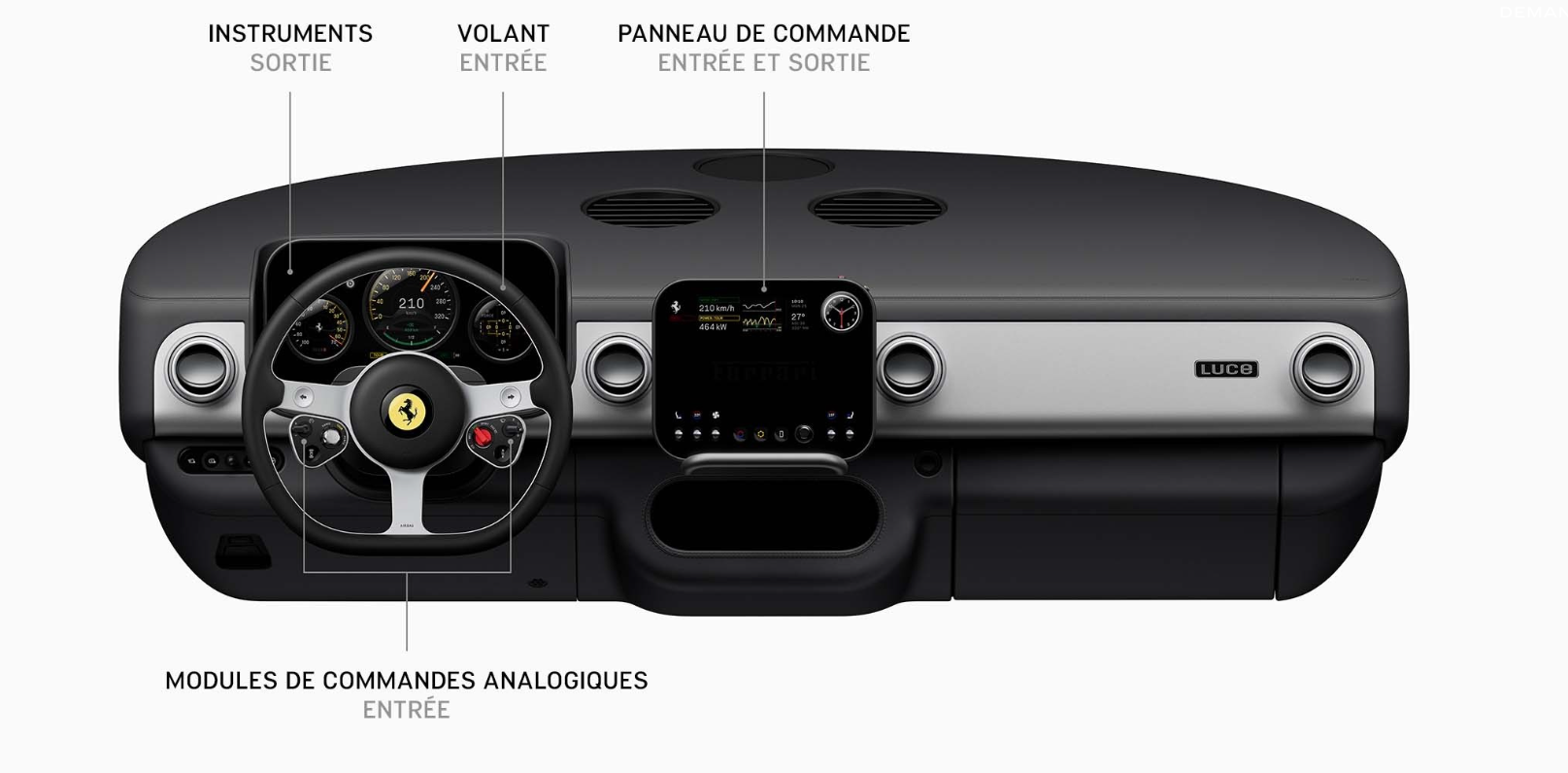
Interior of the Ferrari Luce (Image source: Ferrari website).
How this ends up being received is unknown, but it is clear that the current interior is a result of a deliberate design choice, and the trajectory so far appears to imply that it’s the wrong one for performance cars.
A genuinely great electric sports car may need to be the most analog EV possible.
That does not mean fake nostalgia nor does it mean building a museum piece.
It means recognizing that many people may not dislike EVs only because of propulsion, but also because they dislike the wider package of detachment that often comes with them.
They dislike being managed through glass.
They dislike the loss of tactility.
They dislike the feeling that the machine has been replaced by an interface.
The opportunity, then, is not to make EVs feel more like gadgets, but rather it is to make them feel more like machines again, that just happen to move forward with electrons rather than gas.
This is why converted classics projects such as the Jaguar E-Type electric conversion that appeared in the media in the early 2020s are such interesting reference points.
They are imperfect, but they point toward a possibility: an electric car whose identity is not built around digital excess, but around tactile integrity, strong design, and a sense of occasion.
Granted, not every lesson from a Jaguar E-Type conversion can scale into series production, but the instinct behind it matters. The market may respond more strongly to an electric performance car that preserves tactile dignity than to one that treats screens as progress by default.
A Great, Performance EV Does Not Have To Be Obscenely Powerful
Power is increasingly abundant, and straight-line acceleration no longer carries the same meaning when a growing number of electric vehicles can produce violent, almost absurd performance figures.
BYD’s Yangwang U9, for example, was launched as a pure electric supercar and positioned explicitly around extreme performance; in the world where such cars exist horsepower becomes less differentiating.
This is just another aspect of the automotive industry’s own “Quartz Crisis” moment, so the next great performance EV cannot just be “faster”, it has to be more coherent, with speed only being one aspect of the entire package.
It has to bring together chassis, feedback, packaging, ergonomics, and emotional logic in a way that feels complete rather than compensatory. It has to solve for what people do not like about EVs, rather than pretending those objections are backward or temporary, while also leaning into what EVs can do very well.
And in this respect, this is where Chinese manufacturers become strategically important in addition to being competitive challengers.
Chinese EV makers are running experiments legacy brands can learn from, because while legacy luxury car makers may be pausing their EV efforts, Chinese companies are not, and nothing is stopping the established players from taking a step back and letting someone else pay the costs for trial and error.
The irony is obvious. For years, the flow of learning ran in the opposite direction. Chinese manufacturers learned from legacy automotive brands, especially at the high end.
Now, in electric performance, the relationship is starting to reverse.
Cars like the Yangwang U9 matter not necessarily because they have already solved the puzzle, but because they are pushing into the space aggressively and testing what performance can mean when it is no longer defined by engine architecture or European heritage.
The U9 has been marketed around spectacle, extreme technical capability, and vehicle behaviors that would once have seemed gimmicky or impossible in a traditional supercar, because, to be clear, technological prowess is the only thing a relatively new player like Yangwang can offer.
That is not the same emotional proposition as a Ferrari or Porsche, but it may not need to be, because Yangwang never had to be anything else first, it is not fighting customer expectations in the same way.
Put another way, have you ever heard anyone complain that they wished a Yangwang U9 were an ICE car?
Of course not, that’s the freedom with which Chinese carmakers can operate; legacy carmakers don’t have this latitude but they can certainly observe how consumers respond to someone else’s more freewheeling experiments.
Legacy Automakers Will Hopefully Not Have to Operate As “Either/Or”
The 911 is not economically isolated from the rest of Porsche’s business.
Its aura helps sell other products, especially SUVs, and its these same high-margin SUVs selling in volume that allow for the further refinement of the 911.
We should also recall that when the Cayenne was first announced, it was seen as heresy by “traditional” Porsche buyers!
It’s hard not to see the same dynamics playing out with EVs, and as the market moves towards electrification, over the longer term it is conceivable that companies such as Porsche and Ferrari can continue operating with such a portfolio strategy:
That may indeed be the correct model for legacy automakers in an electrified future.
Not “electrify the icon and hope customers adapt,” but instead: preserve a limited-volume ICE enthusiast product where possible, while allowing a larger-volume EV business to support the company commercially, as more of the market moves to EVs (like, perhaps, it did towards SUVs).
The bottom-line is that customers are the real owners of the brand, and no amount of dictation from that brand’s management will force consumers to accept changes to what they love.
Especially at the top end, customers often know exactly what they want, and what they do not want. If their relationship to the brand is bound up with combustion, forcing electrification into the center of the brand story can damage rather than extend brand equity.
That does not mean giving up on EVs, but it might imply rethinking them completely in the context of the performance category.
Legacy manufacturers may need to stop treating EVs at the high end as heirs to their most emotionally loaded products.
Instead, they may need to create a new branch of the family: a model line with a separate identity, one allowed to build desirability over decades rather than inheriting a role it cannot credibly fill on day one.
Porsche did this with the Taycan but could not nail the basic blocking and tackling of reliability; Ferrari and Jaguar are the next big players in 2026 shooting their shot.
Maybe either or both of them will be the ones to finally crack the code for the “un-EV”: a high-performance electric car that rejects the worst assumptions of current EV design, embraces tactile and emotional coherence, and uses electric architecture to create something that could never have existed before.
These cars are still a mystery because both manufacturers know they have to get everything right, and if they end up looking and driving nothing like a “regular” EV, the only surprise may be that it took so long to get to that point.
Are you ready to optimize your motorsport potential?
At Vaucher Analytics, we help manufacturers and racing organizations turn motorsport investment into brand, commercial, and strategic value.
If your motorsport programme is generating attention but not converting it into brand growth, the problem is not performance, it’s value capture.
Book your 30-minute discovery call by contacting us today:
Through our website’s contact form, or
Via email at contact@vaucheranalytics.com
Main image source: Cody Reed via Unsplash