

Turning the Tables: How Legacy Automakers Can Counter the Chinese EV Onslaught
The narrative surrounding the global automotive industry has been dominated by the rapid, tech-driven rise of Chinese manufacturers.
With their rapid innovation cycles, aggressive pricing, and massive scale, Chinese firms have effectively seized the initiative in the electric vehicle (EV) transition.
In response, legacy automakers are pursuing initiatives that are certainly useful, such as catching up on battery technology and increasing the software experience in their respective models, but looking at the bigger picture it’s hard not to think that they are trying to beat the Chinese brands at their own game.
Given the head start China has, this is going to be a losing proposition over the long term if the measures taken by legacy automakers end there. However, if these legacy brands can lean on the entrenched advantages they already have, if they can bring Chinese brands onto their playing field for a change, they will stand a much better chance of staying competitive.
So, for legacy automotive giants, the goal is to exploit the weaknesses (they do in fact exist) in the current state of the Chinese EV market.
The Quartz Protocol: A Playbook For Legacy Automakers to Leverage Motorsport Against the Competition From Chinese EVs
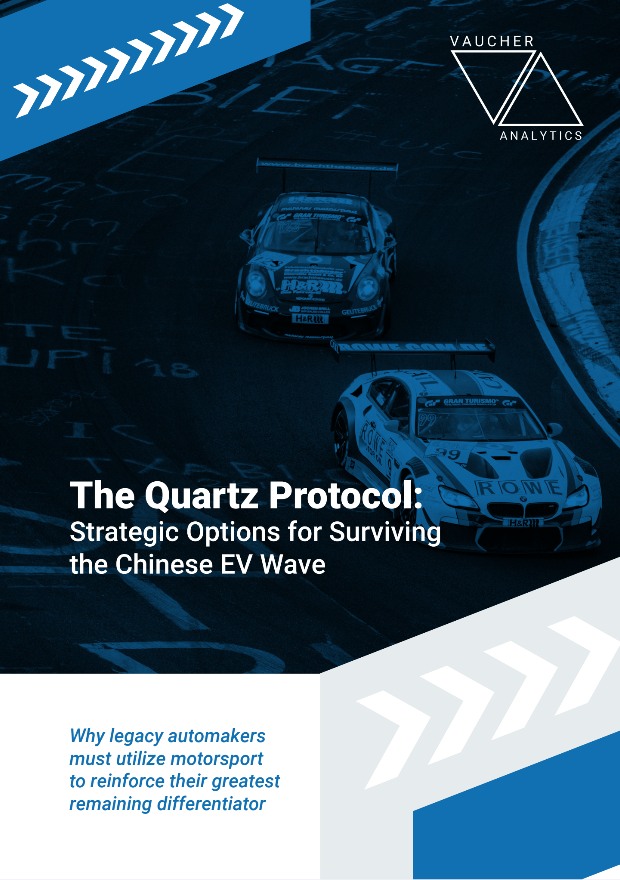
A practical framework (the Motorsport Value Capture Matrix) to see whether your brand is actually converting racing “proof” into consumer “halo”, or funding performance that never reaches the customer.
A clear strategic argument for why legacy OEMs can’t out-commodity Chinese EVs, and why motorsport-led emotion is their last defensible moat.
Tools for action, including a 10-question self-assessment plus a concrete audit approach to identify where motorsport value is lost in your racing program.
The Profitability Trap and Economic Fragility
A significant, yet often overlooked, vulnerability in the Chinese EV sector is its reliance on aggressive pricing and state support. Many Chinese EV companies are on financially shaky grounds, operating under capital structures that prioritize growth and market share at the expense of sustainable margins.
This has led to a phenomenon described as "involution", a cycle of cutthroat price competition that erodes profit margins for all participants, and from a product point of view leads to the commodization of every participant’s vehicles.
Legacy manufacturers are absolutely facing their own financial difficulties, but if they can outlast the inevitable shrinking of the number of Chinese brands, they will be able to plan their strategies in a much more targeted fashion when only a handful of Chinese brands is left.
The “Aura” Deficit: Tech Gadgets vs. Cultural Heritage
Chinese EVs are frequently marketed and perceived as "smart devices" on wheels. These vehicles are closer to hyper-connected, software-laden gadgets, in line with the preferences of Chinese consumers for whom the value of the car is largely tied up in its cabin experience.
While this appeals to a tech-savvy demographic, it leaves an opening in the market for what one might call “aura”.
Legacy automotive brands have spent decades, and in some cases over a century, cultivating a brand identity based on design leadership, emotional connection, and status.
This "aura" is a defensible moat, if legacy brands are willing to spend the money and follow the marketing adage that marketing is about “telling people one thing a thousand times, not one thousand things one time”.
For many, a car is an emotional contract, not just a utilitarian appliance; even those for whom a car is just a means of transportation have nevertheless been seduced by models such as the Beetle and Deux Chevaux.
By doubling down on design, cultural heritage, and the prestige that comes with craftsmanship honed over long periods of time, legacy automakers can differentiate themselves from the sea of undifferentiated Chinese, tech-first offerings that currently flood the market.
The 2026 Beijing Auto Show, which is ongoing at the time of this writing, provides a stark example of this in practice. Whereas many of the Chinese cars either look like rough (sometimes exact) copies of legacy models, even the more original forms all appear to have converged on common features.
And then there’s the BMW i3.
Immediately, it stands out from the rest of the models because it looks different, it looks attractive, and most importantly it looks like a BMW. Assuming BMW can repeat what it did with the well-received iX3 and continue to show why it is the maker of The Ultimate Driving Machine, it will be well positioned to stand up to Chinese brands, which for now continue to make value-based appeals to consumers outside of China.
Motorsport will have to play a large role in these efforts, for BMW and its peers. If consumers in China have been more receptive in the past to the luxury connotations of legacy brands rather than their performance characteristics, it is these very legacy brands that are most well placed to educate consumers around the world and create that desire.
While legacy brands have a substantial head start in this aspect of brand equity, it will not be permanent; Chinese companies have already announced plans to enter high-level racing, with BYD’s rumored entry into F1 recently gaining significant attention.
Don’t want to be left behind?
Subscribe to Business Of Motorsport — the newsletter from Vaucher Analytics covering actionable motorsports strategy
Operational Complexity and Brand Fragmentation
Building on the previous point, the speed with which the number of EV brands developed in China is repeating itself overseas, and this may end up being to the detriment of the whole segment, if legacy automakers know how to counter this progression.
The market is witnessing a large entry of players into a space which already has many established, trusted brand names; this creates significant confusion for consumers, during the initial research decision and downstream to purchasing and maintenance.
Managing service, distribution, and parts logistics for such a fragmented portfolio is a massive operational burden.
Legacy manufacturers possess a distinct advantage in their established, mature, and dense service and distribution networks. By leveraging this existing physical footprint, legacy companies can offer superior post-sales reliability and parts availability, areas where many Chinese entrants might currently struggle, thereby reinforcing consumer trust in the vehicle’s long-term utility.
Indeed, perhaps the most significant "home-court advantage" legacy automakers currently hold is their mature, physical footprint. While Chinese brands can ship a car across the ocean in weeks, they cannot build a comprehensive service network overnight.
Legacy manufacturers possess webs of established dealerships, certified repair centers, and deep-rooted parts logistics chains. For the consumer, a car is a long-term investment that requires maintenance, and the peace of mind that comes with knowing help is just a few miles away, and that parts are readily available, is a powerful psychological differentiator.
Certainly, Chinese brands will catch up, so legacy automakers must exploit this window of opportunity now. By emphasizing that a vehicle purchase is the beginning of a long-term service relationship rather than a transaction similar to the purchase of a cell phone, legacy players can defend their market share.
Again, this advantage is temporary; as Chinese brands aggressively scale their own local service capabilities, legacy automakers must act urgently to reinforce this "service moat" before it is bridged.
The Localization Challenge
There is a fundamental difference between a vehicle engineered for the home market and one tuned for a foreign environment. Logically, Chinese vehicles are optimized for the specific driving habits, road conditions, and software preferences of the Chinese consumer.
As the number of Chinese EV brands shrinks, there is a hypothesis to form that the surviving brands will be even more in tune with their home market; should legacy brands attempt to compete there, or should they double down and focus on their own home market, which they should inherently know better than their Chinese competitors?
Legacy brands’ engineers have decades of experience perfecting vehicles for domestic markets, so by focusing on localized engineering that prioritizes the specific needs and tastes of drivers in those traditional markets, legacy players can offer a driving experience that feels more natural and refined than imported global platforms.
As the world moves towards a multi-polar configuration, and as platforms connecting cars to infrastructure and themselves develop, the car industry could see even more structural factors that will force more targeted localization.
In other words, the days of making a car and assuming it can sell in multiple regions may be over. In fact, this trend is already under way, with Stellantis CEO Antonio Filosa recently designating four main brands (Jeep, Ram, Peugeot, Fiat) for larger investments relative to the rest of the company’s portfolio, whose other brands will now have a more regional focus.
The Reassurance Factor: Why Brand Heritage Drives Resale Value
Beyond the initial purchase price, legacy automakers hold a significant advantage in long-term value retention, a factor that Chinese entrants can’t match simply because they are not yet a proven quantity.
Established brands benefit from decades of consumer exposure, and these consumers can “price in” factors such as brand name and reliability when they look to sell their vehicle or buy someone else’s.
Today, for a buyer, this means that while a legacy brand car may require a higher upfront investment, it could very well represent a lower total cost of ownership because it won't depreciate as aggressively as a newer, unproven Chinese brand.
Legacy players can lean into this "reassurance factor," positioning their vehicles as a known financial decision rather than machines which may or may not be worth something in several years’ time (this is extremely valid today, with the number of Chinese brands expected to shrink significantly).
To fully exploit this advantage, legacy manufacturers can aggressively market their "Total Cost of Ownership" (TCO) and bolster their Certified Pre-Owned (CPO) programs (similar recommendations were made by the French Senate in a report outlining how to bolster France’s own car market).
By offering manufacturer-backed warranties and rigorous inspections for second and third owners, they create a safety net that Chinese startups, lacking a mature secondary market, cannot currently match.
Highlighting the strength of their established service networks ensures that used-market buyers can feel confident in their ability to maintain the vehicle for a decade or more. By turning resale value into a central pillar of their value proposition, legacy brands can defend their premium status and convince price-sensitive buyers that "cheap" today can absolutely become expensive tomorrow.
Closing the Cost Gap: The Return of the Attainable Car
While it is true that Chinese manufacturers have set a new baseline for "cheaper pound-for-pound" value, the narrative that legacy automakers cannot compete on price is starting to shift.
We are beginning to see the first wave of legacy products engineered specifically to meet this challenge without sacrificing quality or brand integrity. A prime example is the new Citroën C3, which has been widely praised by critics for offering a comfortable, and well-equipped experience at a price point starting under 20,000 euros (the aformentioned French Senate report takes this even further by calling for the development of a new class of European “Kei Car” modeled after the Japanese cars which birthed that name).
These "attainable" models are made with supply chains and engineering history that differ from China’s structures. Indeed, while China’s cost advantages are often cited as barriers to legacy brands catching up to their EV brands, cars like the C3 prove that legacy brands can leverage their organizations to create cars that are not just affordable, but also, and just as importantly, desirable.
Data Privacy and the Trust Advantage
In an era where vehicles are essentially "data centers on wheels," the issue of cybersecurity and data sovereignty will become a consumer concern (it is already a governmental one).
Chinese vehicles have come under scrutiny regarding how they process and store data, and how that information might be handled. The extent to which this is actually an issue is besides the point, because as the saying goes, “perception is reality”.
This creates a strategic opening for legacy manufacturers. By positioning themselves as the "trustworthy" alternative, emphasizing high standards for data privacy, cybersecurity, and adherence to transparent regulatory frameworks, they can attract security-conscious consumers and regulators who are growing increasingly wary of the opaque data practices that can accompany tech-forward foreign imports.
Closing Thoughts
The arrival of Chinese EVs has permanently redrawn the automotive map, but it is far from a death knell for established manufacturers.
For consumers, this intense rivalry is a massive win, providing a wider choice of high-tech models and forcing legacy brands to abandon "cynical" strategies of incrementalism in favor of genuine excellence. To compete, legacy carmakers must deliver products like the Citroën C3 that prove they can match Chinese price points without sacrificing quality, localized engineering refinement, and the flair and fun for which they have historically been known.
Beyond the initial purchase, legacy brands possess a formidable playbook of structural advantages that is theirs, if they are willing to turn the tables and invite China to play on their terms, rather than the other way around.
However, the window to exploit these strengths is narrowing. Legacy manufacturers must leverage their cultural aura, data privacy standards, and localization expertise with the urgency China is already displaying.
The competitive gaps will close. The path to survival requires legacy carmakers to meet the tech-first standard of the new era immediately, while ensuring their heritage serves as a launchpad for the future rather than a weight dragging them into the past.
Are You Ready to Optimize Your Motorsport Potential?
At Vaucher Analytics, we help manufacturers and racing organizations turn motorsport investment into brand, commercial, and strategic value.
If your motorsport programme is generating attention but not converting it into brand growth, the problem is not performance, it’s value capture.
Book your 30-minute discovery call by contacting us today:
Through our website’s contact form, or
Via email at contact@vaucheranalytics.com
Main image credit: Phil Hearing via Unsplash