

The New Guard: Why Great Wall Motor is Taking the Fight to Ferrari and Porsche With Its GT3 Announcement
Unveiled at Auto China 2026 in Beijing, the project is based on the manufacturer’s upcoming "GF" (Great Faith) supercar and dedicated, performance sub-brand. The car will be powered by an in-house developed 4.0-liter twin-turbo V8 engine, a significant departure from the brand’s traditional focus on SUVs and trucks, and certainly well removed from the electric power trains which are becoming synonymous with Chinese cars.
Developed under the guidance of former McLaren Automotive chief engineer Adam Thomson no less, the racing debut date is still being finalized, but this in no way diminishes the impact of the announcement.
The Quartz Protocol: A Playbook For Legacy Automakers to Leverage Motorsport Against the Competition From Chinese EVs
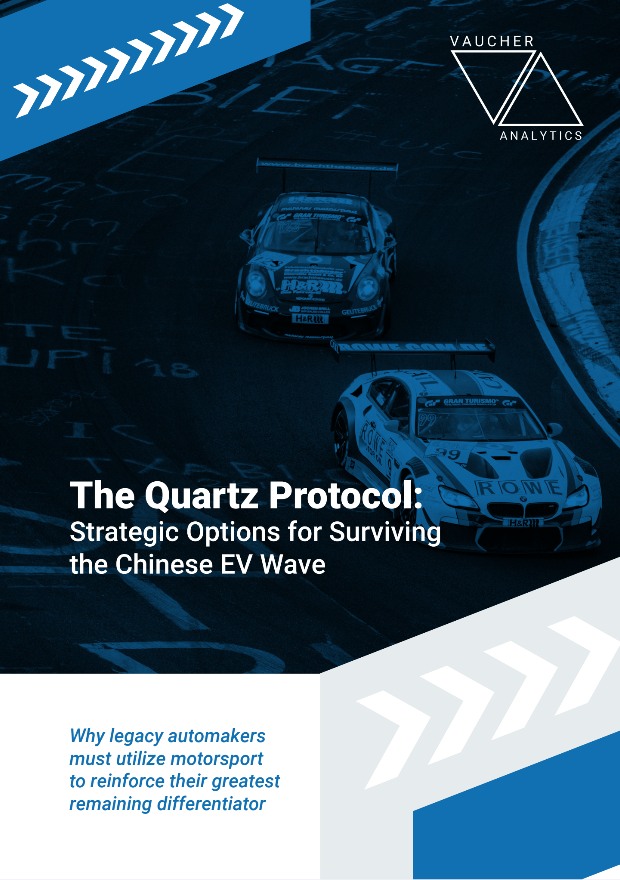
A practical framework (the Motorsport Value Capture Matrix) to see whether your brand is actually converting racing “proof” into consumer “halo”, or funding performance that never reaches the customer.
A clear strategic argument for why legacy OEMs can’t out-commodity Chinese EVs, and why motorsport-led emotion is their last defensible moat.
Tools for action, including a 10-question self-assessment plus a concrete audit approach to identify where motorsport value is lost in your racing program.
The Evolution of GT Racing: The Rattel Revolution
To understand the weight of GWM’s entry, one must understand the landscape and history of GT racing. Before Stéphane Rattel and the SRO Motorsports Group codified the GT3 category in 2005, grand touring racing was often fractured, expensive, and unsustainable.
In the 1990s and early 2000s, "GT1" cars had become "prototypes in disguise", bespoke, million-dollar machines that shared little more than a nameplate with their road-going counterparts. This led to a boom-and-bust cycle where manufacturers would enter, spend into oblivion, and then exit the sport.
Rattel’s stroke of genius was the introduction of Balance of Performance (BoP). This term is controversial in endurance racing today, but the fan debates sometimes omit that such systems are required to maintain a dynamic team and brand eco-system, which is exactly what GT3’s BOP led to.
By using various means to equalize different engine layouts and chassis designs, Rattel created a platform where a Mustang could race door-to-door with a Ferrari; the endless debates that were happening among fans before the ruleset could now be settled on-track.
This created the most popular racing category in the world.
GT3 is beloved because it features "recognizable" cars that fans can identify with, competing in prestigious global events like the 24 Hours of Spa and the Nürburgring 24 Hours.
Crucially, even though “cheap” is a relative term in motorsport, GT3 racing allows the enthusiast with some money set aside to live out their dreams, sometimes even racing alongside pros. This is just not something that is possible in other classes of racing, and it’s this accessibility that makes GWM’s announcement so signficant, and GT3 will now settle debates involving Chinese brands going up against the greatest historical names in motorsport.
A Direct Challenge to the Old Guard
The significance of the GWM announcement cannot be overstated because, unlike the bleeding-edge technology found in Formula 1 and the Hypercar/GTP segments, GT3 cars are fundamentally tied to road-going models; the former are race cars first and foremost, the latter are road-cars made into race cars.
This move puts GWM in a direct, head-to-head comparison with storied brands like Porsche, Ferrari, and Mercedes-Benz on the same tracks, in front of thousands upon thousands of fans.
This is a public declaration that Chinese engineering is ready to be measured against the absolute best in the world, without any asterisks.
Don’t want to be left behind?
Subscribe to Business Of Motorsport — the newsletter from Vaucher Analytics covering actionable motorsports strategy
The Return of the 1990s Playbook
This moment feels like a modern iteration of the early 1990s. Decades ago, the global racing community was skeptical of Japanese manufacturers until they proved their performance on the track through cars like the Acura NSX, Nissan GT-R, and Toyota Supra.
We are likely about to see a similar shift where privateer teams, the lifeblood of sports car racing, start campaigning Chinese chassis. To reiterate: in the case of GWM, this will not be a Chinese brand running its own car, but rather private entities choosing with their own money to go racing with a Chinese alternative to established names.
It’s reasonable to assume the appeal will start on the grounds of value, just as it has on the consumer side. However, once the performance is proven on the grid and the reliability is established over endurance cycles reaching 24 hours, the skepticism will fade, replaced by a new respect for Chinese performance hardware.
The Halo Effect and Brand Lineage
For GWM, the GT3 program is the ultimate "halo" strategy. Once performance is proven on the track, GWM can sell the road-going version of the GF supercar with genuine racing pedigree, and that "cool factor" then trickles down the entire price range via a dedicated, performance sub-brand.
While GWM is the first to plant its flag in the GT3 arena, it is almost certainly not the last Chinese manufacturer that will use the crucible of motorsport to redefine its global identity.
The Cost of Silence: Why the "Nice-to-Have" Mindset is Fatal
For many legacy boardrooms, motorsport has historically been viewed as a discretionary line item, a "nice-to-have" marketing expense that is often the first to be sacrificed during an economic downturn.
However, this perspective fails to account for the invisible, yet devastating, opportunity cost of allowing a brand’s performance heritage to atrophy.
In a market being rapidly reshaped by Chinese automakers who move faster on features and price, one of the few, remaining defensible moats for legacy brands is "engineering soul" and emotional desire.
Abandoning the race track doesn't just save cash, or rather, it does, but only in the short term via a “false economy”.
Not pursuing racing efforts, and just as crucially, broadcasting that participation to potential clients, effectively leaves the gate open for Chinese competitors to pair their industrial scale with their own newly forged racing legends.
A Closing Window of Opportunity
The strategic risk is no longer theoretical, as the window for legacy brands to protect their market permission is closing. As Chinese OEMs progress to pair their structural advantages with disciplined on-track proof, the historical separation between "reliable appliances" and "desirable performance objects" will inevitably disappear.
For established brands, waiting to act does not preserve optionality; it merely compounds the advantage of late entrants who are building their engineering credibility in real-time.
Those that survive the coming decades will be the ones that stop treating heritage as a given in perpetuity, and instead nurture it as a living, strategic asset with clear governance and conversion pathways to the showroom, starting at the race track.
Are You Ready to Optimize Your Motorsport Potential?
At Vaucher Analytics, we help manufacturers and racing organizations turn motorsport investment into brand, commercial, and strategic value.
If your motorsport programme is generating attention but not converting it into brand growth, the problem is not performance, it’s value capture.
Book your 30-minute discovery call by contacting us today:
Through our website’s contact form, or
Via email at contact@vaucheranalytics.com
Main image source: Benoit Fraikin via Unsplash