

Chinese EVs and the “SHEINification” of the Automobile Industry
When discussing the rise of Chinese electric vehicle manufacturers, the conversation usually focuses on supply-side factors:
Time-to-market
Subsidy structures
Battery supply chains
Aggressive industrial policy
All of these factors matter, but focusing exclusively on supply-side risks missing the deeper issue entirely.
Understandably, because Chinese manufacturers execute extraordinarily well on the supply side, most analysis focuses there, but the real disruption, and the key for legacy automakers, may actually rest on the demand side.
Supply-side prowess alone cannot explain why consumers have become so receptive to the model, and yet this is the focus. In fact France, which has a storied car industry, just released a highly-detailed report on its current state which nevertheless completely omits the demand side of the market.
Consumers around the world are increasingly behaving in ways that reward the exact type of automotive ecosystem Chinese manufacturers in all industries have optimized themselves to serve: fast-moving and tailored around affordability, speed, and value-per-dollar.
This is why comparisons between the automotive industry and fast fashion are becoming increasingly difficult to ignore, with some obvious caveats.
The danger facing the automotive sector is not necessarily that cars become “bad.” In fact, many Chinese EVs are objectively impressive products.
The danger is that the entire market begins reorganizing itself around a consumer expectation that cars should become continuously refreshed, price-sensitive products optimized primarily around value-per-dollar.
This is not how cars have ever been marketed.
In other words, the problem facing legacy automakers may not be the Chinese competition directly, but rather the industrial paradigm that China has established over decades in other consumer-facing industries such as clothing.
The automotive industry is now undergoing its own Sheinification, and whether or not legacy automakers survive rests on acknowledging this; unfortunately, if the apparel industry is any indication, there may be no going back, at least not without a very diligently implemented plan.
The Quartz Protocol: A Playbook For Legacy Automakers to Leverage Motorsport Against the Competition From Chinese EVs
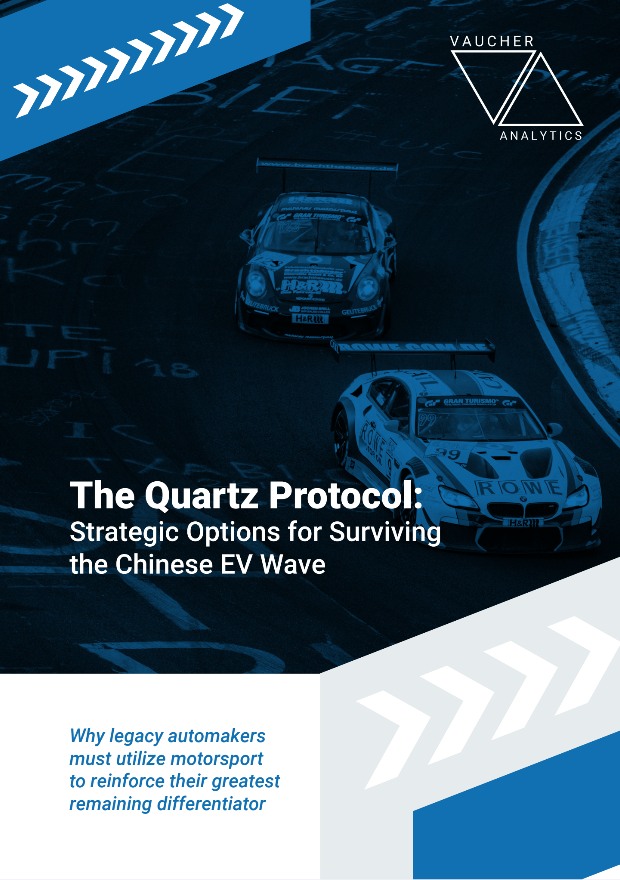
A practical framework (the Motorsport Value Capture Matrix) to see whether your brand is actually converting racing “proof” into consumer “halo”, or funding performance that never reaches the customer.
A clear strategic argument for why legacy OEMs can’t out-commodity Chinese EVs, and why motorsport-led emotion is their last defensible moat.
Tools for action, including a 10-question self-assessment plus a concrete audit approach to identify where motorsport value is lost in your racing program.
What “Sheinification” Actually Means
The term should not be interpreted as a criticism of any particular country or company. Rather, it describes a broader economic phenomenon that has already transformed multiple industries.
Fast fashion fundamentally changed the relationship consumers had with clothing.
Historically, clothing was expensive because manufacturing garments required skilled labor, time, and relatively limited production capacity. Consumers bought fewer items, kept them longer, repaired them more frequently, and attached greater value to craftsmanship and durability.
Today, many consumers increasingly prioritize very different attributes:
Constant novelty
Rapid trend cycles
Extremely low prices
Acceptable rather than exceptional quality
Near-instant availability
The system evolved to satisfy those expectations, and as a result, the clothing industry anywhere but the haute-couture and custom tailoring levels increasingly optimizes for targets such as:
Supply chain speed
Manufacturing scale
Trend responsiveness
Low-cost production
Algorithmic merchandising
Even European companies such as H&M, rather than trying to deliver affordable clothing on the old, established terms, leveraged the Chinese supply chain, because, crucially, this transformation to ultra-low cost clothing was not caused solely by manufacturers.
It was enabled by demand.
Consumers embraced the new model because it offered affordability, convenience, and variety. Social media accelerated the trend further because low-prices enabled the appearance of “SHEIN haul” videos on TikTok (coincidentally another Chinese product favoring speed and quick turnover, which is also playing a role in surfacing interest, and creating demand, for Chinese EV models, particularly in the US where access is curtailed due to 100% tariffs); this in turn drove more demand and only accelerated the price cycle downwards.
The automotive industry is now in a similar transition.
Don’t want to be left behind?
Subscribe to Business Of Motorsport — the newsletter from Vaucher Analytics covering actionable motorsports strategy
Everyone Is Looking at Technology. Almost Nobody Is Looking at Apparel.
The obvious comparison for modern EVs is consumer electronics, and it is a cliché at this point to say that a car is a computer or smartphone on four wheels; screens dominate interiors, over-the-air updates continuously change the ownership experience long after delivery, and even the exterior shapes of the cars themselves are converging towards the equivalent of the glass and aluminum devices that rarely change, and which have no room for the whimsy of early Nokia or Sony phones (incidentally, the increasing aesthetic convergence between some Chinese EV models and established automotive icons is another parallel in the Sheinification dynamic, and suggests that design heritage may remain one of the few areas where legacy brands still possess a meaningful long-term advantage).
This paradigm doesn’t just show up in how the final products look. In the same way that Henry Ford brought the automobile to the masses thanks to the lowered cost structure that assembly line production enabled, so has China been able to lower the cost structure again by treating car manufacturing in the same way as smartphone manufacturing.
This was the final piece of the “Sheinification” of the car industry. Whereas before Chinese EVs, consumers looking for transportation had to buy what was available to them under the old model, they now have considerably lower priced (but still very good) options available to them.
And because consumers have already become accustomed to prioritizing affordability, convenience, and rapid product cycles in other industries such as clothing, Chinese EVs “suddenly” look like an existential threat to the car industry.
But in fact, there’s nothing sudden about this. These consumer preferences developed over decades, and in that time frame legacy carmakers became complacent thanks to their incumbent status, raising prices and going upmarket.
It could also take decades to undo these preferences unless legacy carmakers understand that they are fighting the same fight as those selling upmarket trench coats and boots when Shein sells items which “do the job” for considerably less money.
The Problematic Wrinkle: Chinese EVs Are Often Good (Very Good)
One of the biggest analytical mistakes Western commentators make is assuming the rise of Chinese EVs can be dismissed purely as a subsidy story; that would be comforting, but it is increasingly difficult to defend.
Indeed, if subsidies were the only thing keeping the industry alive, it would not look nearly as vibrant as it does now. The recent Beijing Auto Show featured nearly 1500 vehicles, all showing off some combination of cutting-edge infotainment systems, luxurious interiors, and of course, aggressive pricing compared to legacy equivalents.
It is highly likely that even if legacy automakers catch up and create completely equivalent models, the differences in cost structures will mean a persistent 30% gap to Chinese vehicles.
Furthermore, while China can’t keep chasing the same efficiency gains year-over-year, it is highly likely that its brands will nevertheless become more efficient in the future, and in a Sheinified market increasingly optimized around value-per-dollar expectations, legacy automakers may never catch up.
The Terminal End Game For Legacy Automakers
To be clear: this is a demand problem that no one has solved yet, certainly not clothing manufacturers.
Today, there is a market for more premium clothing but mass-market purchasing behavior still overwhelmingly favors affordability and convenience.
The Swiss watch industry is somewhat of an exception in how it has managed this pivot, but it followed the shrink-to-grow path and it would take an extremely brave executive board at an automobile maker to go down this road.
So the most dangerous outcome for legacy automotive manufacturers is not merely losing EV market share temporarily, it is losing the ability to justify its pricing in perpetuity.
For decades, legacy brands relied on a combination of heritage, engineering reputation, motorsport success, craftsmanship, emotional identity, and perceived durability to sustain higher margins and differentiate themselves from competitors.
Consumers were not simply buying transportation. They were buying symbolism, trust, identity, and the promise of long-term ownership value.
However, brands also just priced cars a certain way because they were settled into a comfortable competitive ecosystem.
Now, the arrival of Chinese EVs have completely upended the chess board, and decades of Chinese manufacturing elsewhere have made consumers very receptive to what its companies have to offer in terms of transportation.
The Future Of The Industry Will Be Driven On Consumer Values That Will Not Change In the Short Term, If At All
Ultimately, the future of the legacy automotive industry may depend less on battery chemistry and more on consumer psychology.
Industrial systems do not exist independently from the people who buy products, and markets optimize around what consumers consistently reward over time.
If consumers continue prioritizing low prices above all else, constant upgrades, feature-per-dollar maximization, and increasingly disposable ownership patterns, then the automotive industry will inevitably reorganize itself around those expectations.
Manufacturers will optimize for speed, affordability, rapid iteration, and continuous refresh cycles because those are the behaviors the market incentivizes.
But to do so would be a mistake for legacy automakers.
They do after all have decades of heritage and intangible goodwill on which to rely, if they leverage those attributes properly.
A different future remains possible if enough consumers continue valuing longevity, emotional design, craftsmanship, motorsport heritage, repairability, ownership pride, and engineering depth. Those preferences create economic space for manufacturers capable of offering something beyond pure functional transportation.
But Shein is still around, the costs for everything keep going up, and legacy automakers have a very difficult road ahead of them.
Defending Automotive Positioning In a Sheinified Market
At Vaucher Analytics, we help manufacturers and racing organizations turn motorsport, heritage, and brand identity into measurable strategic advantage.
If your organization is trying to maintain premium positioning in an increasingly commoditized automotive market, we would welcome a conversation.
Book your initial appointment by contacting us today:
Through our website’s contact form, or
Via email at contact@vaucheranalytics.com
Main image credit: Lalit Kumar via Unsplash
Edits: Added wording to reflect thoughts on design convergence and the role of TikTok in building demand for Chinese EVs.