
Could Motorsport Handle Another Pandemic? Lessons From COVID and the Hantavirus Headlines
Recent headlines surrounding hantavirus have once again revived fears about pandemics and global disruption.
What would happen if a hantavirus outbreak evolved into a larger global disruption, particularly at a time when geopolitical events have already disrupted the F1 and WEC calendars?
Whether this specific situation evolves into something serious is almost beside the point for the motorsport industry, because racing already experienced a full-scale stress test during COVID: events were canceled, travel restrictions shattered calendars, hospitality vanished overnight, sponsor activations collapsed, teams furloughed staff, and entire championships were forced into survival mode.
Even Formula 1 teams suddenly found themselves exposed to the harsh reality that if cars were not physically on track, large portions of the business model stopped functioning.
The real question now is whether motorsport actually learned the right lessons from that experience, because another pandemic would occur in a world which is far more unstable than it was during the first.
The Quartz Protocol: A Playbook For Legacy Automakers to Leverage Motorsport Against the Competition From Chinese EVs
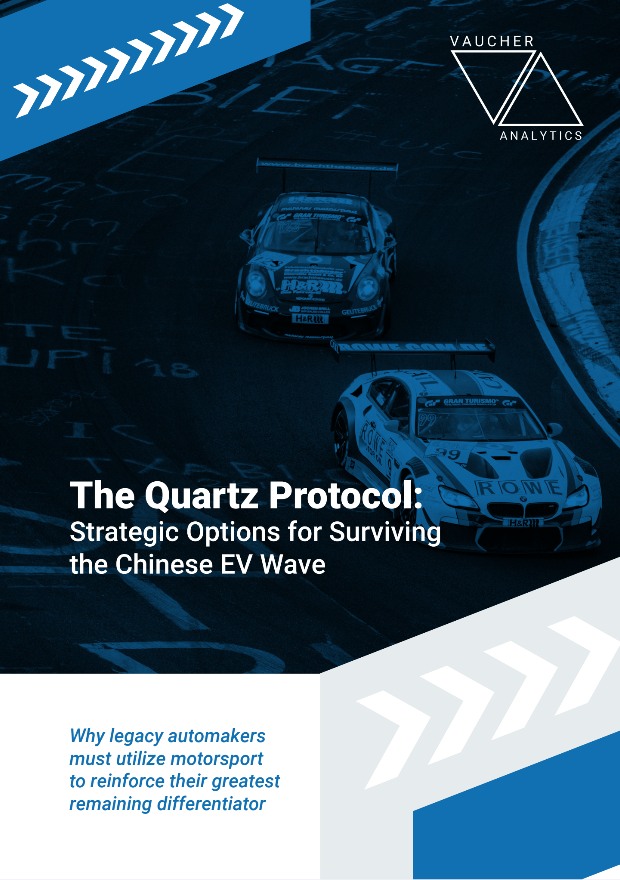
A practical framework (the Motorsport Value Capture Matrix) to see whether your brand is actually converting racing “proof” into consumer “halo”, or funding performance that never reaches the customer.
A clear strategic argument for why legacy OEMs can’t out-commodity Chinese EVs, and why motorsport-led emotion is their last defensible moat.
Tools for action, including a 10-question self-assessment plus a concrete audit approach to identify where motorsport value is lost in your racing program.
COVID Exposed How Fragile Motorsport’s Business Model Really Was
Before 2020, much of the motorsport industry operated under the assumption that race weekends were effectively permanent and uninterrupted.
The ecosystem depended heavily on:
Physical attendance
Hospitality
Sponsor activations
Ticket sales
Corporate entertainment
Predictable international travel
Then the entire system stopped almost overnight.
COVID exposed the fact that many motorsport organizations were not diversified media businesses with racing operations. They were racing operations temporarily held together by live-event revenue.
When events disappeared, many organizations discovered just how dependent they were on physical race weekends occurring exactly as planned.
Don’t want to be left behind?
Subscribe to Business Of Motorsport — the newsletter from Vaucher Analytics covering actionable motorsports strategy
Motorsport Should Be Thinking In Terms of “Low-Regret” Preparedness
One of the biggest mistakes organizations can make after a crisis is assuming the exact same disruption cannot happen twice.
In fact, multiple disruptions have already happened since, with hantavirus headlines now entering the public sphere.
Thankfully, most useful preparedness measures are not enormously expensive; indeed, the best strategic moves are low-regret actions with asymmetrical upside. These are measures that:
Cost relatively little
Improve organizational resilience
Reduce operational fragility
Help during normal conditions too
This is how sophisticated organizations think about risk: the goal is not predicting the next crisis perfectly, but rather ensuring that the business can continue functioning under stress, of different intensities and sources.
Sponsorship Relationships Need To Be Treated Differently
COVID demonstrated how vulnerable motorsport is to sponsor pullback during periods of uncertainty.
When economies weaken, the chain of events is highly predictable:
Marketing budgets tighten quickly
Hospitality becomes difficult to justify
B2B activations lose value if events are disrupted
Companies focus on protecting core operations rather than discretionary spending
With this in mind, teams and championships should already be discussing contingency activation plans with sponsors before a crisis occurs:
Digital content replacement strategies
Remote activations
Simracing integrations
Social media deliverables
Behind-the-scenes access
Alternative audience engagement tools
The worst time to start proposing sponsor solutions is after events are already collapsing, and the goal is always the same: proactively providing value to sponsors during the times they need the help most.
Simracing Resoundingly Proved Its Strategic Value
One of the most interesting developments during COVID was the sudden rise of simracing as a continuity platform.
When physical motorsport disappeared, simracing allowed:
Drivers to remain visible
Sponsors to continue receiving exposure
Fans to stay engaged
Content pipelines to continue operating
Championships to preserve audience attention
Of course, simracing did not replace real motorsport, however, the COVID pandemic proved that digital motorsport can function as operational backup infrastructure for the industry itself.
The organizations that treated simracing purely as a temporary novelty may have missed the deeper strategic lesson entirely, and in a future disruption scenario, digital ecosystems will once again become critical continuity tools.
Teams Should Already Be Reviewing Contracts And Force Majeure Clauses
Another major lesson from COVID is that teams and organizations must always be aware of their options in a time of crisis, and the costs of exercising those options.
Motorsport organizations should be reviewing:
Force majeure clauses
Cancellation obligations
Sponsor activation guarantees
Event interruption terms
Digital substitution rights
Insurance coverage
Revenue exposure concentration
These are not glamorous topics, but they are precisely the kinds of operational details that determine whether organizations survive periods of instability.
Financial Resilience Matters More Than Ever
COVID also exposed how thin the financial margins are across much of motorsport.
Even at elite levels, many teams depend heavily on continuous cash flow from sponsorships, race participation, hospitality, and commercial partnerships.
Once events stopped, liquidity pressure arrived extremely quickly.
That means organizations should already be evaluating:
Cash reserves
Fixed-cost exposure
Contingency funding pathways
Operational downsizing plans
Travel disruption scenarios
Staffing continuity plans
Yes, hantavirus might be the next disruption, but in early May 2026 the consistent messaging from health authorities has been that the risk is contained.
The next disruption may not even resemble COVID directly, but that doesn’t excuse the need for full preparedness.
Motorsport’s Organizational Structures Also Need Stress Testing
COVID revealed that many organizations were structurally slow during crisis; some teams adapted more quickly than others.
This is why scenario planning matters, but only if it is serious.
Most corporate scenario planning is performative theater.
Useful scenario planning asks detailed questions:
What breaks first?
Which revenue streams disappear immediately?
What happens if several events are canceled?
Which sponsors are most economically vulnerable?
Which departments are mission-critical?
How quickly can decisions actually be made?
Who has authority during disruption?
The organizations that adapt fastest during crisis are often not the organizations with the biggest budgets, but the organizations with the clearest decision-making structures.
Consumer And Fan Behavior Could Shift Quickly Again
COVID also demonstrated how quickly audience behavior can change during periods of instability.
Consumers suddenly prioritized:
Digital access
Flexibility
Remote engagement
Direct content
Home entertainment
Online communities
Motorsport audiences adapted quickly because they still wanted connection, narrative, and competition even while physical attendance became impossible.
This should have reinforced the importance of:
Owned audiences
Digital communities
Direct-to-fan media
Subscription ecosystems
Content infrastructure
Organizations that still depend almost entirely on race weekends for fan engagement may remain more fragile than they realize.
The Industry Cannot Assume “Normal” Is Permanent
Hantavirus is not COVID.
But the underlying lesson remains unchanged: industries optimized entirely around uninterrupted normality become vulnerable when conditions suddenly change.
Motorsport survived the last major disruption, but six years later the world appears even less stable, and the smart approach now is ensuring the industry does not need to improvise again.
In the tragic event of another pandemic, the motorsport industry can only hope it did not forget to apply the lessons of the previous one in its haste to get “back to normal”.
Are You Ready to Build a More Resilient Motorsport Operation?
At Vaucher Analytics, we help manufacturers, teams, and racing organizations identify strategic vulnerabilities, strengthen commercial resilience, and build motorsport programmes capable of adapting under pressure.
If your organization depends heavily on race weekends, hospitality, or sponsor activation without contingency plans in place, it may already have a fragility problem.
If you want to proactively protect your future earnings, contact us:
Through our website’s contact form, or
Via email at contact@vaucheranalytics.com
Main image source: Gerald Nash via Unsplash