COVID-Era Lessons: What Carmakers Should Have Learned From COVID to Prepare for a Potential Hantavirus Crisis
Recent headlines surrounding hantavirus have once again revived fears about pandemics and global disruption.
Whether this specific situation evolves into something serious is almost beside the point for the automotive industry, because carmakers have already experienced a once-in-a-generation systemic shock very recently.
The real question is whether they actually learned the right lessons from COVID.
For automakers, the pandemic was a stress test of industrial resilience, organizational flexibility, supply chain visibility, crisis response capability, and consumer behavior.
It exposed how dependent modern automotive manufacturing had become on highly optimized global systems that functioned brilliantly under stable conditions, but struggled the moment friction entered the system.
There now appears to be a non-zero chance that automakers may soon have to put those lessons to the test, at a time of historic industry upheaval with the EV transition, AI adoption and spiking energy prices.
For those organizations that perhaps did not take seriously enough the chance of another public health crisis so soon after the first one, now is the time to take action.
The Quartz Protocol: A Playbook For Legacy Automakers to Leverage Motorsport Against the Competition From Chinese EVs
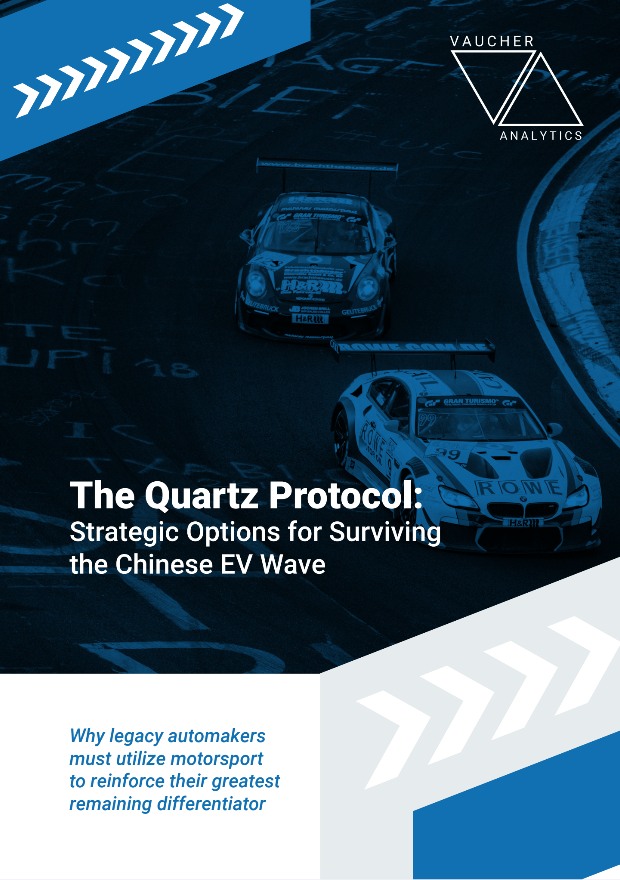
A practical framework (the Motorsport Value Capture Matrix) to see whether your brand is actually converting racing “proof” into consumer “halo”, or funding performance that never reaches the customer.
A clear strategic argument for why legacy OEMs can’t out-commodity Chinese EVs, and why motorsport-led emotion is their last defensible moat.
Tools for action, including a 10-question self-assessment plus a concrete audit approach to identify where motorsport value is lost in your racing program.
COVID Exposed How Fragile Automotive Systems Had Become
Before 2020, the automotive industry viewed globalized “just-in-time” manufacturing as a near-perfect system: factories minimized inventory, suppliers were consolidated aggressively, and supply chains stretched across continents in pursuit of lower costs and maximum efficiency.
Then COVID hit, semiconductor shortages followed, shipping routes stalled, and production planning across the industry descended into chaos.
Automakers discovered that a single missing component could halt assembly lines worth millions of dollars per day. In some cases, companies did not fully understand the deeper layers of their own supplier ecosystems beyond immediate Tier 1 suppliers.
The lesson should have been obvious: efficiency and resilience are not the same thing.
For decades, the industry optimized itself for stable global conditions while assuming that severe systemic disruptions were rare exceptions; COVID shattered that assumption, and subsequent events around the world reinforced the idea that the only “new normal” was historically abnormal.
Don’t want to be left behind?
Subscribe to Business Of Motorsport — the newsletter from Vaucher Analytics covering actionable motorsports strategy
Carmakers Should Focus On “Low-Regret” Strategic Moves
Given how the EV industry has evolved toward increasingly vertically integrated manufacturing, the risks in a hypothetical hantavirus pandemic will be different from those exposed nearly a decade ago, but they are risks nonetheless, and if a company is not completely vertically integrated, the “old rules” still apply to the “missing pieces”.
One of the most important lessons from COVID is that resilience does not always require massive spending.
The smartest strategic moves are not “build ten new factories tomorrow.” Rather, they are low-regret measures with asymmetrical upside, actions that:
Cost relatively little
Improve optionality
Reduce fragility
Help during normal conditions too
That is how sophisticated companies think about resilience.
The goal is not preparing for one exact future scenario, but rather it is building organizations capable of adapting under stress.
Carmakers Need Much Better Supply Chain Visibility
One of the most revealing aspects of COVID was how little visibility many automakers actually had into their deeper supplier ecosystems.
An OEM might know that a company like Bosch supplied a critical system, but did not realize that Bosch depended on another supplier; that supplier depended on one specific plant in Asia, then that plant shut down, and the problems were felt all the way upstream.
This is why one of the highest-value and lowest-cost actions available to automakers today is deeper supply chain visibility mapping.
That means:
Mapping dependencies further down the chain
Identifying single points of failure
Identifying geographic concentration risks
Identifying hidden monopolies inside supplier ecosystems
Identifying targets for vertical integration and having plans to accelerate that transition
This is largely organizational and analytical work rather than massive capital expenditure, and importantly, it creates value even if another pandemic never occurs.
Carmakers Should Already Be Validating Secondary Suppliers
COVID also demonstrated that “cheapest” and “lowest risk” are not the same thing.
For strategically critical systems, relying on one viable supplier can become catastrophic during disruption.
That of course does not mean every component requires expensive duplication; that would quickly become economically unsustainable.
But for genuinely critical systems, maintaining at least one secondary validated supplier can provide enormous insurance value.
Even if the secondary supplier is slightly more expensive during normal conditions, the optionality created during crisis can save billions.
EV Architectures Should Be Designed For Flexibility…With Mitigation Measures In Place
As the industry moves toward software-defined vehicles, modularity may become one of the most important resilience tools available, but ironically, software centralization simultaneously reduces some risks while increasing others.
A software-driven vehicle can theoretically adapt faster during disruption, but excessive dependency on highly centralized architectures can also create new forms of systemic fragility.
What happens, for instance, if key personnel managing software creation or deployment suddenly become unavailable in a hypothetical hantavirus pandemic?
Carmakers Should Build Regional Relationships Before Crisis Hits
One of the major mistakes many firms made during COVID was waiting until disruption had already begun before attempting localization.
By then, everyone was competing for the same limited alternatives simultaneously.
A smarter strategy is maintaining “warm” regional capabilities before they are urgently needed.
That can include:
Pre-qualifying regional suppliers
Maintaining dormant partnerships
Establishing emergency sourcing pathways
Preserving low-volume local production capability
Carmakers Cannot Afford To Outsource Strategic Understanding
Another lesson exposed during COVID was how aggressively many companies had outsourced not just production, but knowledge itself; this is especially relevant today as tens of thousands of workers are still being laid off due to AI adoption (yet another seismic shift that occurred post-COVID).
During stable conditions, from quarter-to-quarter, this may appear efficient, but in a hypothetical hantavirus pandemic which could reduce even further an organization’s capabilities, it becomes a failure point.
If your organization has recently undergone a layoff, it is of key importance to identify the most critical departments to getting products to the customer, and run stress-tests under probable scenarios to understand what the minimal staffing levels are and have plans ready if those levels are breached.
Unfortunately, even scenario planning can be fraught.
Most Corporate Scenario Planning Is Theater
Another harsh truth exposed during COVID is how many large organizations were structurally slow during crisis.
Many companies technically had “scenario plans,” but those exercises often functioned more as corporate theater than serious operational preparation.
Useful scenario planning asks very detailed questions:
What breaks first?
Which dependencies become fatal?
What revenue disappears immediately?
Which supplier failure cascades through the system?
Which factories become stranded?
Who actually has authority during crisis?
How quickly can decisions be made?
The speed of organizational adaptation often matters more than the precision of the original plan, but that ability nevertheless rests on a detailed plan: the more the risk factors and outcomes have been thought through, the more likely it is an organization can respond.
The Demand Side Could Also Look Different Next Time
COVID also demonstrated that crises reshape consumer psychology extremely quickly.
Consumers suddenly prioritized:
Autonomy
Reliability
Personal space
Domestic comfort
Control (because their previous levels of control were, to various extents, being impeded)
Public transport usage fell sharply in many regions, while private mobility regained psychological importance, vehicle prices exploded (and still haven’t come back down materially).
The next major disruption could create different demand-side pressures entirely, particularly in an EV era increasingly dependent on charging infrastructure and electrical grid stability.
Questions consumers ask themselves may subtly change:
Can I reliably charge this vehicle?
What happens during outages?
Does this vehicle make me feel secure during instability?
Can it function independently if infrastructure becomes unreliable?
That psychological dimension remains under-discussed in EV strategy conversations.
However, what is an EV but the ultimate transportation preparedness tool?
Past crises have shown that people fill up on fuel in anticipation of crises, but as long as the grid is up (and even if it isn’t, if customers have off-grid solutions in place), an EV can be charged.
The automobile industry should be ready to lean on this messaging.
The Next Crisis Will Probably Be Different. The Lesson Is The Same.
Hantavirus is not COVID, but the underlying lesson remains unchanged: systems optimized exclusively for efficiency become fragile under stress.
The automotive industry spent decades mastering optimization, and in fact has had to continue optimizing in the face of Chinese competition built on lean cost structures.
In the tragic event of another pandemic, the industry can only hope it did not forget to apply the lessons of the previous one in its haste to get “back to normal”.
Are You Ready to Build Resilience For the EV Era?
At Vaucher Analytics, we help manufacturers identify strategic vulnerabilities, reduce systemic fragility, and turn periods of disruption into competitive advantage.
If your organization is optimized for efficiency but not prepared for instability, contact us:
Through our website’s contact form, or
Via email at contact@vaucheranalytics.com
Main image source: Lenny Kuhne via Unsplash