From Virtual Simracing to Real-World “Simshifting”: Why EVs Could Become Real-Life Sim Rigs
On a recent episode of The Drivecast, the hosts talked about how Porsche wants to imitate Hyundai’s efforts to make EVs that feel like they are powered by mechanical engines mated to manual transmissions.
In an almost throwaway moment, one of the hosts said that the experience of shifting on such a vehicle was like shifting in a videogame.
However, I follow the simracing market carefully and, while the crossover potential to real world tracks is often discussed, this comment raised a potentially much larger synergy with the broader car market.
I’m calling it “simshifting”.
The Quartz Protocol: A Playbook For Legacy Automakers to Leverage Motorsport Against the Competition From Chinese EVs
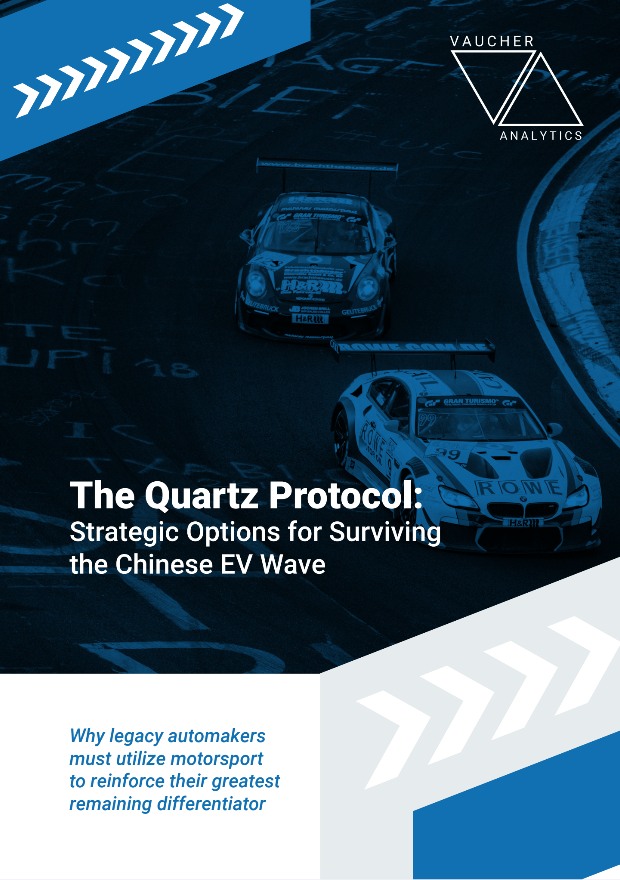
A practical framework (the Motorsport Value Capture Matrix) to see whether your brand is actually converting racing “proof” into consumer “halo”, or funding performance that never reaches the customer.
A clear strategic argument for why legacy OEMs can’t out-commodity Chinese EVs, and why motorsport-led emotion is their last defensible moat.
Tools for action, including a 10-question self-assessment plus a concrete audit approach to identify where motorsport value is lost in your racing program.
The Boundary Between Real and Simulated Racing Has Already Collapsed
For decades, the automotive industry has viewed software and hardware as two distinct pillars. However, as the EV revolution matures, these separate pillars are becoming one, and indeed, much of the experience (not to mention the very functionality) of an EV today is tied to its software.
But what if, like the hardware of a hybrid engine, software could also be used to make the transition to EVs that much smoother?
We are entering the era of "Simshifting"; after all, when we race on our sim rigs, with our cutting-edge sims and direct-drive wheelbases, and wheels designed to look and feel like the real thing, aren’t we just doing another version of what Hyundai is trying to do in its real cars?
This is the ultimate meta-loop: real car driving dynamics turned into code which is then deployed back into a car.
But the EV era is collapsing those categories into one another.
Modern EVs are already software-defined machines. Their power delivery, steering feel, regenerative braking behavior, suspension responses, and even cabin experiences are increasingly governed by code rather than purely mechanical systems.
At the exact same time, simracing has spent years moving in the opposite direction: attempting to recreate real-world driving sensations through software.
When simracers buy:
Direct-drive wheelbases
Load-cell pedals
Sequential shifters
Haptic seats
Motion rigs
they are paying thousands of euros to experience mechanically-inspired sensations generated almost entirely through software models.
And those sensations absolutely feel immersive, backed up by how, and by whom, these setups are used:
Esports audiences emotionally invest in simulated racing
Manufacturers themselves use sim platforms for development work
In other words, the market has already accepted that software-generated driving sensations can feel authentic.
That matters enormously, because once consumers accept that premise, the distinction between “real mechanical sensation” and “simulated mechanical sensation” starts becoming psychologically irrelevant.
By simulating the tactile feedback of a mechanical gearbox through software-defined sensations, simracing companies, and likely car manufacturers, are proving that the "soul" of a car is no longer a matter of gears, but a matter of code and peripherals.
Simshifting Is the Ultimate Automobile Meta-Circuit
This is the ultimate meta-loop:
Real car driving dynamics were translated into code for racing simulators, and that software logic could now be deployed back into real cars.
When Hyundai simulates gear changes, rev matching, or power delivery characteristics in an EV, it is effectively applying simulation philosophy to road-going hardware.
That sounds outlandish, but is it?
The irony is extraordinary.
For years, the assumption was that simulators were trying to become more like real cars.
Now real cars, may be tuned to behave more like simulators!
If one accepts the concept of simshifting to encompass the entirety of the process of enriching the feel of an EV, not just changing gears, the applications from simracing technology and know-how to real-life driving become vast.
A modern direct drive (DD) steering wheel does not use belts or gears to simulate the road; it uses a high-torque motor and complex algorithms to provide "Force Feedback" (FFB) to the driver.
When you feel the snap of a steering column or the vibration of a rumble strip in a simulator, you are feeling a digital interpretation of physical reality.
An EV equipped with a hypothetical, full simshifting system would therefore be, nominally, a direct drive rig that you can sit inside. It would use hardware as haptic actuators, delivering the "jolt" and "rhythm" of a transmission that doesn't physically exist, and perhaps even accentuate the bumps in a road and the friction of a tire that very much do occur in the real world.
Don’t want to be left behind?
Subscribe to Business Of Motorsport — the newsletter from Vaucher Analytics covering actionable motorsports strategy
The “Soul” Of a Car Will Be Encoded
The deeper implication of this trend is likely to anger traditional enthusiasts because it challenges one of the core assumptions of car culture: that “soul” comes from physical machinery.
Historically, driver engagement was tied to:
Pistons
Clutch pedals
Vibrations
Mechanical imperfections
But systems like Hyundai’s suggest something radically different.
The “soul” of a car may not actually depend on mechanical hardware at all.
It may depend on whether software can successfully convince the human brain that an interaction feels rewarding, dramatic, tactile, and emotionally engaging.
That is an entirely different paradigm.
Mechanical authenticity will be replaced by experiential authenticity in the EV era.
Simracing already proved this could work years ago, all you have to do is watch a race on iRacing to be convinced of that.
But the implications of simshifting go far beyond just recreating a sensation.
EVs Don’t Need to Become ICE Cars
This is where most manufacturers risk misunderstanding the opportunity.
If automakers frame these systems as simple nostalgia gimmicks designed to imitate internal combustion engines, they will fail.
Because younger enthusiasts may not care whether a sensation is mechanically authentic; many of them will not have grown up with traditional cars and, frankly, many ICE cars with engines even today feature large amounts of computer-controlled processes.
They may only care whether it is emotionally convincing, interactive, fun and memorable.
That distinction is critical: the goal is not to pretend EVs are gasoline cars, but rather to make EVs engaging in a software-native way.
That means restoring elements many enthusiasts feel EVs currently lack:
Rhythm
Anticipation
Timing
Driver workload
Tactile feedback
Reward cycles.
In other words, gameplay.
That is the word the automotive industry has not yet used.
But gameplay is exactly what systems like simshifting should aim to introduce into the driving experience.
Porsche, Hyundai, and the Future of Software-Tuned Driving
Once driving characteristics become software-defined, the long-term implications become enormous.
Manufacturers could theoretically:
Create downloadable drivetrain personalities
Tune “gearshift feel” the way videogame developers tune physics engines
Deploy track-specific driving profiles
Allow drivers to purchase new engagement modes digitally
Connect simulator data directly to real-world vehicle setups
The crossover potential of the automobile industry with simracing becomes especially interesting in this world, going way beyond the on-track dreams that are so often discussed online.
After all, if engineers can tune vehicle behavior in a simulator, and modern EVs increasingly rely on software-defined dynamics, the line between virtual setup work and real-world setup work begins to blur dramatically.
This would go way beyond a simracer winning a race; under the simshifting paradigm, whole engineering teams, both hardware and software, working in the simracing industry could find themselves qualified to work on EV systems (and, absolutely, the Chinese EV industry could absolutely progress the same way, given the momentum that their homegrown simracing companies already have).
Simracing May Have Accidentally Predicted the Future
For years, simracing was viewed by many traditional enthusiasts as an imitation of “real driving.”
But what if the opposite turns out to be true?
What if simracing was actually an early prototype for where driving itself was heading?
The modern sim rig already normalizes:
Software-generated steering feel
Simulated drivetrain behavior
Artificial gear engagement
Virtual, mechanical drama
And millions of users willingly accept those sensations because they create immersion and emotional investment.
That means simracing culture may be uniquely positioned to understand EVs in a way traditional car culture does not yet fully grasp.
Not because simracers reject mechanical authenticity, but because they already understand that software can create emotionally meaningful driving experiences.
That is the real significance of “simshifting.”
It is certainly not “fake” driving, but it just might be the future of driving.
Are You Ready to Optimize Your Motorsport Potential?
At Vaucher Analytics, we help manufacturers and racing organizations turn motorsport investment into brand, commercial, and strategic value.
If your motorsport programme is generating attention but not converting it into brand growth, the problem is not performance, it’s value capture.
Book your 30-minute discovery call by contacting us today:
Through our website’s contact form, or
Via email at contact@vaucheranalytics.com
Main image source: Jake De-bique via Unsplash